

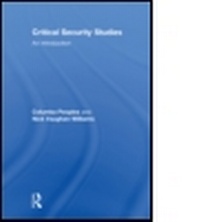
Critical Security Studies
An Introduction
Published on 28. June 2010
Book
Hardback
184 pages
978-0-415-48443-5 (ISBN)
Description
Critical Security Studies introduces students of Politics and International Relations to the sub-field through a detailed yet accessible survey of emerging theories and practices.
Written in an accessible and clear manner, this textbook:
offers a comprehensive and up-to-date introduction to critical security studies
locates Critical Security Studies within the broader context of social and political theory
evaluates fundamental theoretical positions in critical security studies against backdrop of new security challenges.
The book is divided into two main parts. The first part, `Approaches', surveys the newly extended and contested theoretical terrain of Critical Security Studies, and the different schools within the subdiscipline, including Feminist, Postcolonial and Poststructuralist viewpoints. The second part, `Issues', will then offer examples of how these various theoretical approaches have been put to work against the backdrop of a diverse range of issues in contemporary security practices, from environmental, human and homeland security to border security and the War on Terror.
The historical and geographical scope of the book is deliberately broad and readers will be introduced to a number of key illustrative case studies. Each of the chapters in Part II will act to concretely illustrate one or more of the approaches discussed in Part I, with clear internal referencing allowing the text to act as a holistic learning tool for students.
This book will be essential reading for upper level students of Critical Security Studies, and an important resource for students of International/Global Security, Political Theory, and IR in general.
Columba Peoples is Lecturer in International Relations in the Department of Politics, University of Bristol, UK.
Nick Vaughan-Williams is Lecturer in International Relations in the Department of Politics, University of Exeter, UK.
Written in an accessible and clear manner, this textbook:
offers a comprehensive and up-to-date introduction to critical security studies
locates Critical Security Studies within the broader context of social and political theory
evaluates fundamental theoretical positions in critical security studies against backdrop of new security challenges.
The book is divided into two main parts. The first part, `Approaches', surveys the newly extended and contested theoretical terrain of Critical Security Studies, and the different schools within the subdiscipline, including Feminist, Postcolonial and Poststructuralist viewpoints. The second part, `Issues', will then offer examples of how these various theoretical approaches have been put to work against the backdrop of a diverse range of issues in contemporary security practices, from environmental, human and homeland security to border security and the War on Terror.
The historical and geographical scope of the book is deliberately broad and readers will be introduced to a number of key illustrative case studies. Each of the chapters in Part II will act to concretely illustrate one or more of the approaches discussed in Part I, with clear internal referencing allowing the text to act as a holistic learning tool for students.
This book will be essential reading for upper level students of Critical Security Studies, and an important resource for students of International/Global Security, Political Theory, and IR in general.
Columba Peoples is Lecturer in International Relations in the Department of Politics, University of Bristol, UK.
Nick Vaughan-Williams is Lecturer in International Relations in the Department of Politics, University of Exeter, UK.
Reviews / Votes
'A much needed book. Combining a systematic overview of the evolution of critical security studies with a compelling account of today's complex and vibrant debates, it is both an excellent introduction to the subject and a substantial contribution to its development' --- Michael C. Williams, University of Ottawa, Canada'In an accessible way, this book presents a state of the art of critical security studies that simultaneously redefines it by bringing together familiar and less familiar approaches. It succeeds in providing an overview of developments over the past 15 years to define a future-oriented field of critical security studies' --- Jef Huysmans, Open University, UK
`Well written and well organised, this text offers a thoughtful analysis of a range of approaches and issues, and provides a concise guide to a burgeoning and complex subfield' --- Political Studies Review
More details
Language
English
Place of publication
London
United Kingdom
Publishing group
Taylor & Francis Ltd
Target group
College/higher education
Illustrations
5 s/w Zeichnungen, 2 s/w Tabellen
5 Line drawings, black and white; 2 Tables, black and white
Dimensions
Height: 229 mm
Width: 174 mm
Weight
498 gr
ISBN-13
978-0-415-48443-5 (9780415484435)
Copyright in bibliographic data and cover images is held by Nielsen Book Services Limited or by the publishers or by their respective licensors: all rights reserved.
Schweitzer Classification
Other editions
New editions
Book
08/2014
2nd Edition
Routledge
€178.56
Withdrawn from sale
Additional editions
Book
06/2010
Routledge
€54.71
Article exhausted; check for reprint
Persons
Columba Peoples is Lecturer in International Relations in the Department of Politics, University of Bristol, UK.
Nick Vaughan-Williams is Lecturer in International Relations in the Department of Politics, University of Exeter, UK.
Nick Vaughan-Williams is Lecturer in International Relations in the Department of Politics, University of Exeter, UK.
Content
Part 1: Approaches 1. Critical Theory and Security 2. Feminist and Gender Approaches 3. Postcolonial Perspectives 4. Poststructuralism and International Political Sociology 5. Securitization Theory Part 2: Issues 6. Environmental Security 7. Homeland Security and the `War against Terrorism' 8. Human Security and Development 9. Migration and Border Security 10. Technology and Warfare in the Information Age