

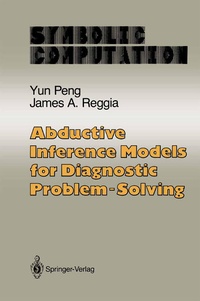
Abductive Inference Models for Diagnostic Problem-Solving
Published on 20. November 2012
Book
Paperback/Softback
XII, 285 pages
978-1-4612-6450-7 (ISBN)
Description
Making a diagnosis when something goes wrong with a natural or m- made system can be difficult. In many fields, such as medicine or electr- ics, a long training period and apprenticeship are required to become a skilled diagnostician. During this time a novice diagnostician is asked to assimilate a large amount of knowledge about the class of systems to be diagnosed. In contrast, the novice is not really taught how to reason with this knowledge in arriving at a conclusion or a diagnosis, except perhaps implicitly through ease examples. This would seem to indicate that many of the essential aspects of diagnostic reasoning are a type of intuiti- based, common sense reasoning. More precisely, diagnostic reasoning can be classified as a type of inf- ence known as abductive reasoning or abduction. Abduction is defined to be a process of generating a plausible explanation for a given set of obs- vations or facts. Although mentioned in Aristotle's work, the study of f- mal aspects of abduction did not really start until about a century ago.
More details
Series
Edition
Softcover reprint of the original 1st ed. 1990
Language
English
Place of publication
New York
United States
Target group
Professional and scholarly
Research
Illustrations
XII, 285 p.
Dimensions
Height: 235 mm
Width: 155 mm
Thickness: 17 mm
Weight
458 gr
ISBN-13
978-1-4612-6450-7 (9781461264507)
DOI
10.1007/978-1-4419-8682-5
Schweitzer Classification
Other editions
Additional editions
Yun Peng | James A. Reggia
Abductive Inference Models for Diagnostic Problem-Solving
E-Book
12/2012
1st Edition
Springer
€96.29
Available for download
Yun Peng | James A. Reggia
Abductive Inference Models for Diagnostic Problem-Solving
Book
06/1990
Springer
€106.99
Shipment within 5-7 days
Content
1 Abduction and Diagnostic Inference.- 2 Computational Models for Diagnostic Problem Solving.- 3 Basics of Parsimonious Covering Theory.- 4 Probabilistic Causal Model.- 5 Diagnostic Strategies in the Probabilistic Causal Model.- 6 Causal Chaining.- 7 Parallel Processing for Diagnostic Problem-Solving.- 8 Conclusion.