

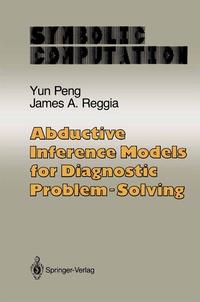
Abductive Inference Models for Diagnostic Problem-Solving
Published on 26. June 1990
Book
Hardback
XII, 285 pages
978-0-387-97343-2 (ISBN)
Description
Making a diagnosis when something goes wrong with a natural or m- made system can be difficult. In many fields, such as medicine or electr- ics, a long training period and apprenticeship are required to become a skilled diagnostician. During this time a novice diagnostician is asked to assimilate a large amount of knowledge about the class of systems to be diagnosed. In contrast, the novice is not really taught how to reason with this knowledge in arriving at a conclusion or a diagnosis, except perhaps implicitly through ease examples. This would seem to indicate that many of the essential aspects of diagnostic reasoning are a type of intuiti- based, common sense reasoning. More precisely, diagnostic reasoning can be classified as a type of inf- ence known as abductive reasoning or abduction. Abduction is defined to be a process of generating a plausible explanation for a given set of obs- vations or facts. Although mentioned in Aristotle's work, the study of f- mal aspects of abduction did not really start until about a century ago.
More details
Series
Edition
1990 ed.
Language
English
Place of publication
New York
United States
Target group
Professional and scholarly
Research
Illustrations
XII, 285 p.
Dimensions
Height: 241 mm
Width: 160 mm
Thickness: 21 mm
Weight
617 gr
ISBN-13
978-0-387-97343-2 (9780387973432)
DOI
10.1007/978-1-4419-8682-5
Schweitzer Classification
Other editions
Additional editions
Yun Peng | James A. Reggia
Abductive Inference Models for Diagnostic Problem-Solving
E-Book
12/2012
1st Edition
Springer
€96.29
Available for download
Yun Peng | James A. Reggia
Abductive Inference Models for Diagnostic Problem-Solving
Book
11/2012
Springer
€106.99
Shipment within 15-20 days
Previous edition

Yun Peng | James A. Reggia
Abductive Inference Models for Diagnostic Problem-Solving
Book
07/1990
Springer
€42.09
Article exhausted; check for reprint
Content
1 Abduction and Diagnostic Inference.- 2 Computational Models for Diagnostic Problem Solving.- 3 Basics of Parsimonious Covering Theory.- 4 Probabilistic Causal Model.- 5 Diagnostic Strategies in the Probabilistic Causal Model.- 6 Causal Chaining.- 7 Parallel Processing for Diagnostic Problem-Solving.- 8 Conclusion.