

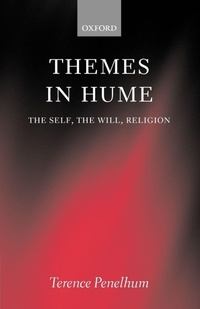
Themes in Hume
The Self, the Will, Religion
Published on 6. November 2003
Book
Paperback/Softback
316 pages
978-0-19-926635-7 (ISBN)
Description
Terence Penelhum presents a selection of the best of his essays on Hume, most of them quite recent, and three of them not published elsewhere. The central themes of the book are selfhood, the will, and religious belief.
Penelhum argues that Hume's sceptical conclusions on personal identity are based on conceptual confusions, but that the common charge of circularity made against him is unfounded. He examines the role Hume gives the idea of the self in his analysis of the passions, the dissonance between the account of the self in the first book of the Treatise of Human Nature and that found in the second, and the reasons for Hume's own dissatisfaction with his views on this theme.
The essays on the will examine Hume's famous attacks on rationalist understandings of human motives, and try to expose the deficiencies in his 'compatibilist' interpretation of freedom.
The discussion of Hume's views on religion relates them to his scepticism and to his doctrine of natural belief. Penelhum maintains that Hume's ultimate views on religion are to be found in the harshly negative judgements of the first Enquiry, which he did not ever see reason to modify.
Penelhum's essays will be fascinating for all who work on these themes, whether from an eighteenth-century or a twentieth-century perspective.
Penelhum argues that Hume's sceptical conclusions on personal identity are based on conceptual confusions, but that the common charge of circularity made against him is unfounded. He examines the role Hume gives the idea of the self in his analysis of the passions, the dissonance between the account of the self in the first book of the Treatise of Human Nature and that found in the second, and the reasons for Hume's own dissatisfaction with his views on this theme.
The essays on the will examine Hume's famous attacks on rationalist understandings of human motives, and try to expose the deficiencies in his 'compatibilist' interpretation of freedom.
The discussion of Hume's views on religion relates them to his scepticism and to his doctrine of natural belief. Penelhum maintains that Hume's ultimate views on religion are to be found in the harshly negative judgements of the first Enquiry, which he did not ever see reason to modify.
Penelhum's essays will be fascinating for all who work on these themes, whether from an eighteenth-century or a twentieth-century perspective.
Reviews / Votes
one of the best ever books on Hume... an essential addition to even the most cash-strapped university library. * Antony Flew, British Journal for the History of Philosophy *More details
Language
English
Place of publication
Oxford
United Kingdom
Target group
Professional and scholarly
Dimensions
Height: 216 mm
Width: 140 mm
Thickness: 19 mm
Weight
448 gr
ISBN-13
978-0-19-926635-7 (9780199266357)
Copyright in bibliographic data and cover images is held by Nielsen Book Services Limited or by the publishers or by their respective licensors: all rights reserved.
Schweitzer Classification
Other editions
Additional editions
Book
06/2000
Oxford University Press
€82.30
Shipment within 15-20 days
Person
Content
1. David Hume: An Appreciation ; 2. Hume on Personal Identity ; 3. Hume's Theory of the Self Revisited ; 4. Self-identity and Self-regard ; 5. The Self of Book I and the Selves of Book II ; 6. Hume, Identity and Selfhood ; 7. Hume's Moral Psychology ; 8. Hume and the Freedom of the Will ; 9. Hume's Scepticism and the Dialogues ; 10. Natural Belief and Religious Belief in Hume's Philosophy ; 11. Religion in the Enquiry and After ; 12. Butler and Hume ; 13. Human Nature and Truth: Hume and Pascal ; References ; Indes