

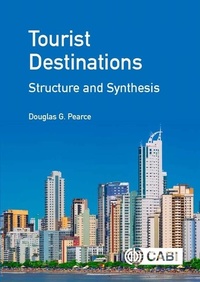
Tourist Destinations: Structure and Synthesis
Published on 15. December 2020
Book
Hardback
288 pages
978-1-78924-583-7 (ISBN)
Description
Destinations are a central feature of tourism and the focus of much tourism research. Destinations have been studied from diverse perspectives using multiple concepts and a range of approaches. As a result, destination research today has become increasingly fragmented as studies have become more specialized. There is a need for a more integrated approach, one which systematically draws together these different research threads to provide a comprehensive and coherent picture and a fuller understanding of destinations, their structure and how they function. This book provides such a synthesis by critically reviewing a wide range of international research and incorporating in one volume many different facets of destinations from studies which have appeared in related but often divergent literatures. Conceptual and methodological issues are illustrated with empirical examples from Europe, North and South America, Asia and Oceania. This material is drawn together around two major structural themes: spatial and organizational structure. Spatial structure concerns the physical location, distribution, configuration and inter-connectedness of products, services and actors and the factors which underlie the resultant patterns of these. Organizational structure focuses on the diverse configurations and the ways in which multiple actors, collectively and individually, come together, interact and behave to produce the experiences sought by tourists. The originality and contribution of this work lies in the systematic examination and combination of these two themes across destinations from the national to the local scale. This integrated approach provides fresh insights, produces a comprehensive understanding of destinations and identifes avenues for future research.
More details
Language
English
Place of publication
Wallingford
United Kingdom
Target group
College/higher education
Professional and scholarly
Dimensions
Height: 247 mm
Width: 176 mm
Thickness: 19 mm
Weight
862 gr
ISBN-13
978-1-78924-583-7 (9781789245837)
Copyright in bibliographic data and cover images is held by Nielsen Book Services Limited or by the publishers or by their respective licensors: all rights reserved.
Schweitzer Classification
Other editions
Additional editions
Douglas Pearce
Tourist Destinations: Structure and Synthesis
E-Book
11/2020
CABI Publishing
€137.99
Available for download
Person
Douglas Pearce is Emeritus Professor of Tourism Management at Victoria University of Wellington. He completed a doctorat de troisieme cycle at the Universite d'Aix-Marseille II in 1975, was on the staff of the Department of Geography at the University of Canterbury (1976-1999) and then held the position of professor of tourism management at Victoria University of Wellington until he retired in 2015. He has also been a visiting professor at the Universitat Autonoma de Barcelona, Universite de Paris IV (Paris-Sorbonne), University of Hawaii at Manoa and, most recently, at the Universidad Austral de Chile and the Universidade Federal de Parana. He has published widely on diverse aspects of tourism, including the following books: Frameworks for Tourism Research (2012, CABI); Tourist Organizations (1992, Longman); Tourism Today: a geographical analysis (2nd ed. 1995, Longman) and Tourist Development (2nd ed, 1989, Longman). His books have been translated into French, Italian, Spanish, Portuguese and Japanese. Douglas is an Emeritus Fellow of the International Academy for the Study of Tourism.
Content
1: Introduction: the Spatial and Organizational Structure of Destinations 2: Perspectives on Destinations 3: Frameworks for Tourist Destinations 4: Analysing the Structure of Destinations 5: Structure of National Destinations 6: Structure of Regional Destinations 7: Structure of Urban Destinations 8: Structure of Coastal Resorts? 9: Structure of Ski Resorts and Rural and Natural Area Destinations 10: Spatial and Organizational Structure of Destinations: a Synthesis