

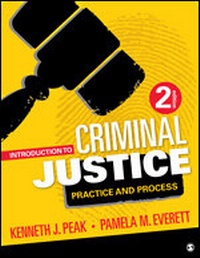
Introduction to Criminal Justice
Practice and Process
2nd Edition
Published on 14. March 2016
Book
Paperback/Softback
504 pages
978-1-5063-0592-9 (ISBN)
Description
This fully updated, comprehensive best-selling text uses a proven problem-based learning approach with an applied perspective to enhance your students' critical thinking and analytic skills.
Reviews / Votes
"This textbook provides excellent and relevant information that it is inter-disciplinary." -- Chris Chaney "I already like Peak's style and I like everything that has been added to make this particular book so comprehensive." -- Coy Johnston "This text provides a clear and interesting format through which students may understand often difficult criminal justice concepts. Peak provides students with an interactive format for learning, complete with up-to-date supplementary information. The text is concise, informative and interesting." -- Tameka Samuels-Jones "Clearly and concisely written [and] as up-to-date as possible which helped the students understand the material" -- Dianne Berger-Hill, M.A.S. "Chapters 1 and 2 are strong - well written foundational materials [and] E-book a strong addition and useful for students that are technology based (given that most are tech savvy)." -- Jacqueline van Wormer, Ph.D. "Engaging chapters" -- Dominic D. Yin, MS., JD. "Provides students with many opportunities to further their knowledge and understanding of the area" -- Richard StringerMore details
Edition
2nd Revised edition
Language
English
Place of publication
Thousand Oaks
United States
Target group
College/higher education
Edition type
Revised edition
Dimensions
Height: 279 mm
Width: 216 mm
Weight
1130 gr
ISBN-13
978-1-5063-0592-9 (9781506305929)
Copyright in bibliographic data and cover images is held by Nielsen Book Services Limited or by the publishers or by their respective licensors: all rights reserved.
Schweitzer Classification
Other editions
Previous edition
Book
03/2014
1st Edition
SAGE Publications Inc
€115.32
Article exhausted; check for reprint
Persons
Kenneth J. Peak, Ph.D., is a professor emeritus and former chairman of the criminal justice department at the University of Nevada, Reno, where he was named "Teacher of the Year" by the UNR Honor Society and also served as acting director of public safety. He has authored or coauthored more than 40 books on community policing, introductory policing, justice administration, introduction to criminal justice, women in law enforcement, and police supervision and management; two historical books (on bootlegging and temperance); and more than 60 journal articles and additional book chapters on a wide range of justice-related subjects. He has served as chairman of the Police Section, Academy of Criminal Justice Sciences and a past president of the Western Association of Criminal Justice. Prior to coming to UNR, Dr. Peak held positions as a municipal police officer, nine-county criminal justice planner; and director of a four-state Technical Assistance Institute. He also served twice as a chief of university police and as an assistant professor at Wichita State University (five years). He received two gubernatorial appointments to statewide criminal justice committees while in Kansas and holds a doctorate from the University of Kansas.
Pamela Everett, J.D. is an attorney, Assistant Teaching Professor of Criminal Justice at the University of Nevada, Reno, and the author of Little Shoes: The Sensational Depression-Era Murders That Became My Family's Secret (2017), a New-York Times Book Review Summer 2017 Must Read, about an historic wrongful convictions case.
She earned her undergraduate degree in Criminal Justice at the University of Nevada, Reno and her Juris Doctorate from the University of San Diego, where she wrote for the University of San Diego Law Review. She was a contributing features and opinion columnist on legal and justice system issues for the Omaha World-Herald and the Wayne Stater from 2009-2014. She was also a Contributing Author and Assistant Editor for SAGE Publications' Encyclopedia of Criminal Justice (2013).
She has served as a volunteer attorney for the California Innocence Project for the last decade, and among other topics, she teaches a popular course at the University of Nevada, Reno on Wrongful Convictions. Her other teaching focuses on the mentally ill in the criminal justice system, the courts, and criminal law.
Pamela Everett, J.D. is an attorney, Assistant Teaching Professor of Criminal Justice at the University of Nevada, Reno, and the author of Little Shoes: The Sensational Depression-Era Murders That Became My Family's Secret (2017), a New-York Times Book Review Summer 2017 Must Read, about an historic wrongful convictions case.
She earned her undergraduate degree in Criminal Justice at the University of Nevada, Reno and her Juris Doctorate from the University of San Diego, where she wrote for the University of San Diego Law Review. She was a contributing features and opinion columnist on legal and justice system issues for the Omaha World-Herald and the Wayne Stater from 2009-2014. She was also a Contributing Author and Assistant Editor for SAGE Publications' Encyclopedia of Criminal Justice (2013).
She has served as a volunteer attorney for the California Innocence Project for the last decade, and among other topics, she teaches a popular course at the University of Nevada, Reno on Wrongful Convictions. Her other teaching focuses on the mentally ill in the criminal justice system, the courts, and criminal law.
Content
PART I. Criminal Justice as a System: The Basics
Chapter 1. Fundamentals of Criminal Justice: Essential Themes and Practices
Introduction
Foundations of Criminal Justice: Legal and Historical Bases
Politics and Criminal Justice
Crime Control and Due Process: Do Ends Justify Means?
Discretion: Making and Applying the Law
The Criminal Justice Process: An Overview of Flow and Functions
The Wedding Cake Model of Criminal Justice
Ethics Throughout the Criminal Justice System
Chapter 2. Foundations of Law and Crime: Nature, Elements, and Defenses
Introduction
Common Law and Its Progeny
Modern-Day Sources and Hierarchy of Law
Criminal and Civil Law
Substantive and Procedural Law
Essential Elements: Mens Rea and Actus Reus
Felonies and Misdemeanors
Offense Definitions and Categories
Defenses
Chapter 3. Theories of Crime and Measuring Victimization
Introduction
Classical and Positivist Theories
Biological Determinism
Psychological Rationales
Sociocultural Explanations
Women and Crime
White-Collar Crime
In Their Own Words: Offenders Speak
Measuring Crime and Victimization
Chapter 4. Ethical Essentials: "Doing Right When No One Is Watching"
Introduction
Good Examples of Bad Examples
Philosophical Foundations
Ethics in Policing
Ethics in the Courts
Ethical Conduct of Federal Employees
Ethics in Corrections
The Ethical Decision-Making Process
Ethics Tests for the Criminal Justice Student
PART II. The Police
Chapter 5. Police Organizations: Structure and Functions
Introduction
English and Colonial Roots: An Overview
Policing Comes to the United States
Federal Law Enforcement
State Agencies
Local Agencies: Municipal Police and Sheriff's Departments
On Guard: The Private Police
Chapter 6. Police at Work: Patrolling and Investigating
Introduction
From Citizen to Patrol Officer
Having the "Right Stuff": A Working Personality
Defining the Role
Stressors of Police Work
A Study of Patrol Effectiveness
The Traffic Function
Police Discretion
Community Policing and Problem Solving
The Work of Forensics and Detectives
Chapter 7. Policing Methods and Challenges
Introduction
Use of Force: A Sacred Trust
The Role of Local Police in Homeland Security
When Failing the Public Trust: Civil Liability
Needed: More Women and Minorities
Police Technologies
Chapter 8. Expounding the Constitution: Laws of Arrest, Search, and Seizure
Introduction
Some Caveats
The Fourth Amendment
The Fifth Amendment
The Sixth Amendment
PART III. The Courts
Chapter 9. Court Organization: Structure, Functions, and the Trial Process
Introduction
Our Adversarial System
The Influence of Courts in Policy Making
American Courts: A Dual Court System
State Courts
Federal Courts
Making Preparations: Pretrial Processes
The Trial Process
Technologies in the Courts
Chapter 10. The Bench and The Bar: Those Who Judge, Prosecute, and Defend
Introduction
Those Who Would Be Judge: Selection Methods and Issues
Jurists' Benefits, Training, and Challenges
The Art of Judging, Courtroom Civility, and Judicial Misconduct
The Attorneys
Chapter 11. Court Methods and Challenges: Sentencing and Punishment
Introduction
Purposes of Punishment
Types of Sentences to Be Served
Sentencing Guidelines
Victim Impact Statements
Capital Punishment
Aggravating and Mitigating Circumstances
Criminal Appeals
PART IV. Corrections
Chapter 12. Prisons and Jails: Structure and Function
Introduction
Correctional Facilities as Organizations
State Prisons as Organizations
Federal Prisons
Supermax Prisons
Jails as Organizations
Technologies in Prisons: The Good and the Bad
Chapter 13. The Inmates' World: The "Keepers" and the "Kept"
Introduction
The Nature of Incarceration
Potentially Hazardous Work
Jail Personnel
Issues of Prison Governance
Preparation for Reentry and Aftercare
Prisoners' Constitutional Rights
Chapter 14. Corrections in the Community: Probation, Parole, and Other Alternatives to Incarceration
Introduction
Why Alternatives to Incarceration
Origins of Probation and Parole
Probation and Parole Today
Do Probation and Parole Work?
Functions of Probation and Parole Officers
Other Alternatives: Intermediate Sanctions
Confronting Recidivists: The Risk-Needs-Responsivity (RNR) Model
Restorative Justice
PART V. Spanning the System: Methods and Issues
Chapter 15. Juvenile Justice: Philosophy, Law, and Practices
Introduction
History of Juvenile Justice
Unique Philosophy, Principles, and Goals
Juvenile Offending Today
Case Flow of the Juvenile Justice Process
The Problem of Labeling
Youth Gangs: An Overview
Aftercare and Reentry
Significant Court Decisions
Chapter 16. On the Crime Policy and Prevention Agenda: Terrorism, the Mentally Ill in the Criminal Justice System, and the Changing War on Drugs
Introduction
Terrorism
The "New Asylums": The Mentally Ill in the Criminal Justice System
The Changing War on Drugs
Appendix: Constitution of the United States
Answers
Glossary
Notes
Index
Chapter 1. Fundamentals of Criminal Justice: Essential Themes and Practices
Introduction
Foundations of Criminal Justice: Legal and Historical Bases
Politics and Criminal Justice
Crime Control and Due Process: Do Ends Justify Means?
Discretion: Making and Applying the Law
The Criminal Justice Process: An Overview of Flow and Functions
The Wedding Cake Model of Criminal Justice
Ethics Throughout the Criminal Justice System
Chapter 2. Foundations of Law and Crime: Nature, Elements, and Defenses
Introduction
Common Law and Its Progeny
Modern-Day Sources and Hierarchy of Law
Criminal and Civil Law
Substantive and Procedural Law
Essential Elements: Mens Rea and Actus Reus
Felonies and Misdemeanors
Offense Definitions and Categories
Defenses
Chapter 3. Theories of Crime and Measuring Victimization
Introduction
Classical and Positivist Theories
Biological Determinism
Psychological Rationales
Sociocultural Explanations
Women and Crime
White-Collar Crime
In Their Own Words: Offenders Speak
Measuring Crime and Victimization
Chapter 4. Ethical Essentials: "Doing Right When No One Is Watching"
Introduction
Good Examples of Bad Examples
Philosophical Foundations
Ethics in Policing
Ethics in the Courts
Ethical Conduct of Federal Employees
Ethics in Corrections
The Ethical Decision-Making Process
Ethics Tests for the Criminal Justice Student
PART II. The Police
Chapter 5. Police Organizations: Structure and Functions
Introduction
English and Colonial Roots: An Overview
Policing Comes to the United States
Federal Law Enforcement
State Agencies
Local Agencies: Municipal Police and Sheriff's Departments
On Guard: The Private Police
Chapter 6. Police at Work: Patrolling and Investigating
Introduction
From Citizen to Patrol Officer
Having the "Right Stuff": A Working Personality
Defining the Role
Stressors of Police Work
A Study of Patrol Effectiveness
The Traffic Function
Police Discretion
Community Policing and Problem Solving
The Work of Forensics and Detectives
Chapter 7. Policing Methods and Challenges
Introduction
Use of Force: A Sacred Trust
The Role of Local Police in Homeland Security
When Failing the Public Trust: Civil Liability
Needed: More Women and Minorities
Police Technologies
Chapter 8. Expounding the Constitution: Laws of Arrest, Search, and Seizure
Introduction
Some Caveats
The Fourth Amendment
The Fifth Amendment
The Sixth Amendment
PART III. The Courts
Chapter 9. Court Organization: Structure, Functions, and the Trial Process
Introduction
Our Adversarial System
The Influence of Courts in Policy Making
American Courts: A Dual Court System
State Courts
Federal Courts
Making Preparations: Pretrial Processes
The Trial Process
Technologies in the Courts
Chapter 10. The Bench and The Bar: Those Who Judge, Prosecute, and Defend
Introduction
Those Who Would Be Judge: Selection Methods and Issues
Jurists' Benefits, Training, and Challenges
The Art of Judging, Courtroom Civility, and Judicial Misconduct
The Attorneys
Chapter 11. Court Methods and Challenges: Sentencing and Punishment
Introduction
Purposes of Punishment
Types of Sentences to Be Served
Sentencing Guidelines
Victim Impact Statements
Capital Punishment
Aggravating and Mitigating Circumstances
Criminal Appeals
PART IV. Corrections
Chapter 12. Prisons and Jails: Structure and Function
Introduction
Correctional Facilities as Organizations
State Prisons as Organizations
Federal Prisons
Supermax Prisons
Jails as Organizations
Technologies in Prisons: The Good and the Bad
Chapter 13. The Inmates' World: The "Keepers" and the "Kept"
Introduction
The Nature of Incarceration
Potentially Hazardous Work
Jail Personnel
Issues of Prison Governance
Preparation for Reentry and Aftercare
Prisoners' Constitutional Rights
Chapter 14. Corrections in the Community: Probation, Parole, and Other Alternatives to Incarceration
Introduction
Why Alternatives to Incarceration
Origins of Probation and Parole
Probation and Parole Today
Do Probation and Parole Work?
Functions of Probation and Parole Officers
Other Alternatives: Intermediate Sanctions
Confronting Recidivists: The Risk-Needs-Responsivity (RNR) Model
Restorative Justice
PART V. Spanning the System: Methods and Issues
Chapter 15. Juvenile Justice: Philosophy, Law, and Practices
Introduction
History of Juvenile Justice
Unique Philosophy, Principles, and Goals
Juvenile Offending Today
Case Flow of the Juvenile Justice Process
The Problem of Labeling
Youth Gangs: An Overview
Aftercare and Reentry
Significant Court Decisions
Chapter 16. On the Crime Policy and Prevention Agenda: Terrorism, the Mentally Ill in the Criminal Justice System, and the Changing War on Drugs
Introduction
Terrorism
The "New Asylums": The Mentally Ill in the Criminal Justice System
The Changing War on Drugs
Appendix: Constitution of the United States
Answers
Glossary
Notes
Index