

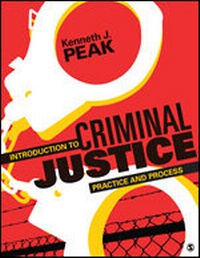
Introduction to Criminal Justice
Practice and Process
1st Edition
Published on 13. March 2014
Book
Paperback/Softback
480 pages
978-1-4833-0735-0 (ISBN)
Description
Students will learn about core topics in criminal justice-including policing, corrections, criminal behaviour, and criminal law and courts, as well as special topics such as juvenile justice, terrorism, gangs, hate crimes, sex offenders, and domestic violence-while learning how to solve problems they are likely to face in a variety of criminal justice career paths.
More details
Language
English
Place of publication
Thousand Oaks
United States
Target group
College/higher education
Dimensions
Height: 279 mm
Width: 216 mm
Weight
1053 gr
ISBN-13
978-1-4833-0735-0 (9781483307350)
Copyright in bibliographic data and cover images is held by Nielsen Book Services Limited or by the publishers or by their respective licensors: all rights reserved.
Schweitzer Classification
Other editions
New editions
Book
03/2016
2nd Edition
SAGE Publications Inc
€110.37
Article is exhausted; no reprint
Person
Kenneth J. Peak, Ph.D., is a professor emeritus and former chairman of the criminal justice department at the University of Nevada, Reno, where he was named "Teacher of the Year" by the UNR Honor Society and also served as acting director of public safety. He has authored or coauthored more than 40 books on community policing, introductory policing, justice administration, introduction to criminal justice, women in law enforcement, and police supervision and management; two historical books (on bootlegging and temperance); and more than 60 journal articles and additional book chapters on a wide range of justice-related subjects. He has served as chairman of the Police Section, Academy of Criminal Justice Sciences and a past president of the Western Association of Criminal Justice. Prior to coming to UNR, Dr. Peak held positions as a municipal police officer, nine-county criminal justice planner; and director of a four-state Technical Assistance Institute. He also served twice as a chief of university police and as an assistant professor at Wichita State University (five years). He received two gubernatorial appointments to statewide criminal justice committees while in Kansas and holds a doctorate from the University of Kansas.
Content
Part I: CRIMINAL JUSTICE AS A SYSTEM: THE BASICS
Chapter 1. Fundamentals of Criminal Justice: Essential Themes and Practices
Chapter 2. Foundations of Law and Crime: Nature, Elements, and Defenses
Chapter 3. Theories of Crime and Measuring Victimization
Chapter 4. Ethical Essentials: "Doing right when no one is watching"
Part II: THE POLICE
Chapter 5. Police Organization: Structure and Functions
Chapter 6. Police at Work: Patrolling and Investigating
Chapter 7. Police Methods and Challenges
Chapter 8. Expounding the Constitution: Laws of Arrest, Search, and Seizure
Part III THE COURTS
Chapter 9. Court Organization: Structures, Functions and the Trial Process
Chapter 10. The Bench and the Bar: Those Who Judge, Prosecute and Defend
Chapter 11. Court Methods and Challenges: Sentencing and Punishment
Part IV: CORRECTIONS
Chapter 12. Prison and Jail Organization: Structures and Functions
Chapter 13. The Inmates' World: The "Keepers" and the "Kept"
Chapter 14. Corrections in the Community: Probation, Parole, Other Alternatives to Incarceration
Part V: SPANNING THE SYSTEM: METHODS AND ISSUES
Chapter 15: Juvenile Justice: Philosophy, Law, and Practices
Chapter 16: On the Crime Policy and Prevention Agenda: Terrorism, Gun Control, and Marijuana
Appendix I: Selected Amendments to the U.S. Constitution
Appendix II: Careers in Criminal Justice
Chapter 1. Fundamentals of Criminal Justice: Essential Themes and Practices
Chapter 2. Foundations of Law and Crime: Nature, Elements, and Defenses
Chapter 3. Theories of Crime and Measuring Victimization
Chapter 4. Ethical Essentials: "Doing right when no one is watching"
Part II: THE POLICE
Chapter 5. Police Organization: Structure and Functions
Chapter 6. Police at Work: Patrolling and Investigating
Chapter 7. Police Methods and Challenges
Chapter 8. Expounding the Constitution: Laws of Arrest, Search, and Seizure
Part III THE COURTS
Chapter 9. Court Organization: Structures, Functions and the Trial Process
Chapter 10. The Bench and the Bar: Those Who Judge, Prosecute and Defend
Chapter 11. Court Methods and Challenges: Sentencing and Punishment
Part IV: CORRECTIONS
Chapter 12. Prison and Jail Organization: Structures and Functions
Chapter 13. The Inmates' World: The "Keepers" and the "Kept"
Chapter 14. Corrections in the Community: Probation, Parole, Other Alternatives to Incarceration
Part V: SPANNING THE SYSTEM: METHODS AND ISSUES
Chapter 15: Juvenile Justice: Philosophy, Law, and Practices
Chapter 16: On the Crime Policy and Prevention Agenda: Terrorism, Gun Control, and Marijuana
Appendix I: Selected Amendments to the U.S. Constitution
Appendix II: Careers in Criminal Justice