

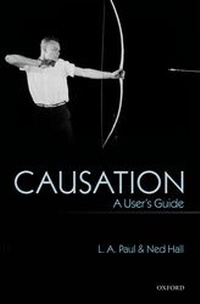
Causation
A User's Guide
Published on 9. May 2013
Book
Paperback/Softback
300 pages
978-0-19-967345-2 (ISBN)
Description
Causation is at once familiar and mysterious. Many believe that the causal relation is not directly observable, but that we nevertheless can somehow detect its presence in the world. Common sense seems to have a firm grip on causation, and much work in the natural and social sciences relies on the idea. Yet neither common sense nor extensive philosophical debate has led us to anything like agreement on the correct analysis of the concept of causation, or an account of the metaphysical nature of the causal relation. Contemporary debates are driven by opposing motivations, conflicting intuitions, and unarticulated methodological assumptions.
Causation: A User's Guide cuts a clear path through this confusing but vital landscape. L. A. Paul and Ned Hall guide the reader through the most important philosophical treatments of causation, negotiating the terrain by taking a set of examples as landmarks. Special attention is given to counterfactual and related analyses of causation. Using a methodological principle based on the close examination of potential counterexamples, they clarify the central themes of the debate about causation, and cover questions about causation involving omissions or absences, preemption and other species of redundant causation, and the possibility that causation is not transitive. Along the way, Paul and Hall examine several contemporary proposals for analyzing the nature of causation and assess their merits and overall methodological cogency.
The book is designed to be of value both to trained specialists and those coming to the problem of causation for the first time. It provides the reader with a broad and sophisticated view of the metaphysics of the causal relation.
Causation: A User's Guide cuts a clear path through this confusing but vital landscape. L. A. Paul and Ned Hall guide the reader through the most important philosophical treatments of causation, negotiating the terrain by taking a set of examples as landmarks. Special attention is given to counterfactual and related analyses of causation. Using a methodological principle based on the close examination of potential counterexamples, they clarify the central themes of the debate about causation, and cover questions about causation involving omissions or absences, preemption and other species of redundant causation, and the possibility that causation is not transitive. Along the way, Paul and Hall examine several contemporary proposals for analyzing the nature of causation and assess their merits and overall methodological cogency.
The book is designed to be of value both to trained specialists and those coming to the problem of causation for the first time. It provides the reader with a broad and sophisticated view of the metaphysics of the causal relation.
Reviews / Votes
This engaging volume ... serves to promote a discussion about basic methodological principles that has ramifications for every philosophical discipline. This is a deep and important conversation, and Causation: A Users Guide provides a challenging and philosophically central test case. This is not a book just for students: it is an important methodological treatise in its own right * Tim Maudlin, Philosophy of Science * ...a rich and sophisticated piece of philosophical work. No doubt its detailed analyses make a precious contribution to the fascinating philosophical debate on causation. * Max Kistler, Metascience *More details
Language
English
Place of publication
Oxford
United Kingdom
Target group
College/higher education
Professional and scholarly
Dimensions
Height: 235 mm
Width: 162 mm
Thickness: 17 mm
Weight
456 gr
ISBN-13
978-0-19-967345-2 (9780199673452)
Copyright in bibliographic data and cover images is held by Nielsen Book Services Limited or by the publishers or by their respective licensors: all rights reserved.
Schweitzer Classification
Other editions
Persons
L. A. Paul is Professor of Philosophy at the University of North Carolina at Chapel Hill. She has held positions at Yale University, the Australian National University, and the University of Arizona.
Ned Hall is Professor of Philosophy at Harvard University.
Ned Hall is Professor of Philosophy at Harvard University.
Content
Preface ; 1. The scope and aims of this "guide" ; 2. Framework and preliminaries ; 3. Varieties of redundant causation ; 4. Causation involving omissions ; 5. Cases that threaten transitivity ; 6. Concluding remarks ; References ; Index