

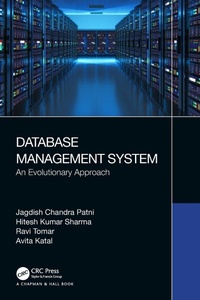
Database Management System
An Evolutionary Approach
1st Edition
Published on 12. March 2025
Book
Paperback/Softback
229 pages
978-1-032-18346-6 (ISBN)
Description
A database management system (DBMS) is a collection of programs that enable users to create and maintain a database; it also consists of a collection of interrelated data and a set of programs to access that data. Hence, a DBMS is a general-purpose software system that facilitates the processes of defining, constructing, and manipulating databases for various applications.
The primary goal of a DBMS is to provide an environment that is both convenient and efficient to use in retrieving and storing database information. It is an interface between the user of application programs, on the one hand, and the database, on the other.
The objective of Database Management System: An Evolutionary Approach, is to enable the learner to
grasp a basic understanding of a DBMS, its need, and its terminologies
discern the difference between the traditional file-based systems and a DBMS
code while learning to grasp theory in a practical way
study provided examples and case studies for better comprehension
This book is intended to give under- and postgraduate students a fundamental background in DBMSs. The book follows an evolutionary learning approach that emphasizes the basic concepts and builds a strong foundation to learn more advanced topics including normalizations, normal forms, PL/SQL, transactions, concurrency control, etc.
This book also gives detailed knowledge with a focus on entity-relationship (ER) diagrams and their reductions into tables, with sufficient SQL codes for a more practical understanding.
The primary goal of a DBMS is to provide an environment that is both convenient and efficient to use in retrieving and storing database information. It is an interface between the user of application programs, on the one hand, and the database, on the other.
The objective of Database Management System: An Evolutionary Approach, is to enable the learner to
grasp a basic understanding of a DBMS, its need, and its terminologies
discern the difference between the traditional file-based systems and a DBMS
code while learning to grasp theory in a practical way
study provided examples and case studies for better comprehension
This book is intended to give under- and postgraduate students a fundamental background in DBMSs. The book follows an evolutionary learning approach that emphasizes the basic concepts and builds a strong foundation to learn more advanced topics including normalizations, normal forms, PL/SQL, transactions, concurrency control, etc.
This book also gives detailed knowledge with a focus on entity-relationship (ER) diagrams and their reductions into tables, with sufficient SQL codes for a more practical understanding.
More details
Language
English
Place of publication
United Kingdom
Publishing group
Taylor & Francis Ltd
Target group
Professional and scholarly
Academic
Illustrations
47 s/w Abbildungen, 47 s/w Zeichnungen, 77 s/w Tabellen
77 Tables, black and white; 47 Line drawings, black and white; 47 Illustrations, black and white
Dimensions
Height: 234 mm
Width: 156 mm
Thickness: 14 mm
Weight
392 gr
ISBN-13
978-1-032-18346-6 (9781032183466)
Copyright in bibliographic data and cover images is held by Nielsen Book Services Limited or by the publishers or by their respective licensors: all rights reserved.
Schweitzer Classification
Other editions
Additional editions
Jagdish Chandra Patni | Hitesh Kumar Sharma | Ravi Tomar
Database Management System
An Evolutionary Approach
Book
01/2022
1st Edition
Chapman & Hall/CRC
€155.80
Shipment within 15-20 days
Jagdish Chandra Patni | Hitesh Kumar Sharma | Ravi Tomar
Database Management System
An Evolutionary Approach
E-Book
01/2022
1st Edition
Chapman & Hall/CRC
€63.49
Available for download
Jagdish Chandra Patni | Hitesh Kumar Sharma | Ravi Tomar
Database Management System
An Evolutionary Approach
E-Book
01/2022
1st Edition
Chapman & Hall/CRC
€63.49
Available for download
Persons
Jagdish Chandra Patni, Hitesh Kumar Sharma, Ravi Tomar, Avita Katal
Content
1. Basics of Database. 1.1 Introduction and History of Database. 1.2 Data and Information. 1.3 Database. 1.4 Need for a Database. 1.5 File based database management system. 1.6 Database System. 1.7 Database System components. 1.8 Database Management System Services. 1.9 Database Characteristics. 1.10 Advantages of Database. 1.11 Limitations of Database. Case Studies. Summary. Review Questions. References. 2. Data models and Architecture of DBMS. 2.1 Evolution of Data Model. 2.2 Hierarchical Database Model. 2.3 Network Data Model. 2.4 Relational Database Model. 2.5 Object Oriented Data Model. 2.6 Object Relational Data Model. 2.7 Three Level Architecture of Database. 2.8 Data Independence. 2.9 Database Languages. Summary. Review Questions. References. 3. Relational Database Management System (RDBMS). 3.1 Difference Between RDBMS and DBMS. 3.2 Features of RDBMS. 3.3 Advantages of RDBMS. 3.4 Disadvantages of RDBMS. 3.5 Examples of RDBMS. 3.6 RDBMS Terminologies. 3.7 Keys in Database. 3.8 Integrity Constraints in DBMS. 3.9 Relational Algebra. 3.10 Structured Query Language (SQL). 3.11 CODD's Twelve Rules of Relational Database. 3.12 Database Development Life Cycle. Summary. Case Studies. Review Questions. References. 4. Entity Relationship Model. 4.1 Entity Relationship Diagram. 4.2 Components of a ER Diagram. 4.3 Participation Constraints. 4.4 Strong and Weak Relationship. 4.5 Handling Many to Many Relationship. 4.6 Example of E-R Model. 4.7 Enhanced Entity-Relationship Model. 4.8 Reduction of ER Diagram to Relational model. Summary. Review Questions. References. 5. Normalization. 5.1 Introduction Normalization -A bottom up approach. 5.2 Need for Normalization. 5.3 Types of Dependencies. 5.4 First Normal Form. 5.5 Second Normal Form. 5.6 Third Normal Form. 5.7 Boyce-Codd Normal Form. 5.8 Multi-valued Dependency. 5.9 Join Dependency. 5.10 Lossless and Lossy Decompositions. Summary. Review Questions. References. 6. Managing Data Using Structured Query Language (SQL). 6.1 Introduction to SQL. 6.2 Data Definition Commands. 6.3 Data Manipulation Language (DML). 6.4 Data Control Language. 6.5 Transaction Control Language (TCL). 6.6 Data Query Language (DQL). 6.7 Aggregate Functions. 6.8 Date and Time Functions. 6.9 String Functions. 6.10 Conversion Functions. 6.11 Mathematical Functions. 6.12 Special Operators. 6.13 Types of Constraints. 6.14 Sub Query. Summary. Review Question. References. 7. Introduction to PL/SQL. 7.1 Variable and Constants. 7.2 Data Types. 7.3 PL/SQL Literals. 7.4 Control Statement. 7.5 PL/SQL case statement. 7.6 PL/SQL Loop. 7.7 PL/SQL Continue statement. 7.8 PL/SQL GOTO statement. 7.9 PL/SQL Procedure and Functions. 7.10 PL/SQL cursor. 7.11 PL/SQL Exception. 7.12 PL/SQL Exception Handling. 7.13 PL/SQL Triggers. Summary. Review Questions. References. 8. Transaction Management in Database. 8.1 Definition of Transaction. 8.2 Properties of Transaction. 8.3 States of Transactions. 8.4 Schedule. 8.5 Serializability. 8.6 Recoverable Schedules. 8.7 Concurrency Control. 8.8 Concurrency Control Mechanism. 8.9 Database Back UP and Recovery. 8.10 Security, Integration and Authorization. Summary. Review Questions. References.