

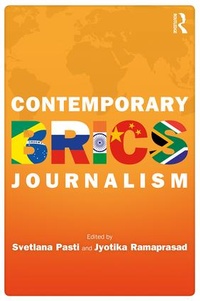
Contemporary BRICS Journalism
Non-Western Media in Transition
1st Edition
Published on 27. November 2017
Book
Paperback/Softback
274 pages
978-1-138-21733-1 (ISBN)
Description
Contemporary BRICS Journalism: Non-Western Media in Transition is the first comparative study of professional journalists working in BRICS countries (Brazil, Russia, India, China, and South Africa). The book presents a range of insider perspectives, offering a valuable insight into the nature of journalism in these influential economies.
Contributors to this volume have conducted in-depth interviews with more than 700 journalists, from mainstream and online media, between 2012 and 2015. They present and analyse their findings here, revealing how BRICS journalism is envisioned, experienced, and practised in the twenty-first century. Compelling evidence in the form of journalists' narratives reveals the impact of digital culture on modern reporting and the evolving dynamic between new media technology and traditional journalistic practice. Insightful comparisons are made between BRICS countries, highlighting the similarities and differences between them. Topics covered include; professionalism, ethics and ideals, community journalism, technological developments in the newsroom and the reporting of protest movements.
This book's ambitious analysis of journalistic landscapes across these non-Western nations will significantly broaden the scope of study and research in the field of journalism for students and teachers of communication, journalism, and media studies.
Contributors to this volume have conducted in-depth interviews with more than 700 journalists, from mainstream and online media, between 2012 and 2015. They present and analyse their findings here, revealing how BRICS journalism is envisioned, experienced, and practised in the twenty-first century. Compelling evidence in the form of journalists' narratives reveals the impact of digital culture on modern reporting and the evolving dynamic between new media technology and traditional journalistic practice. Insightful comparisons are made between BRICS countries, highlighting the similarities and differences between them. Topics covered include; professionalism, ethics and ideals, community journalism, technological developments in the newsroom and the reporting of protest movements.
This book's ambitious analysis of journalistic landscapes across these non-Western nations will significantly broaden the scope of study and research in the field of journalism for students and teachers of communication, journalism, and media studies.
Reviews / Votes
"The burgeoning corpus of comparative communication scholarship has mainly applied quantitative methodologies to the analysis of mainstream media in Western societies. This book makes a distinctive and insightful contribution to this field in three main ways. It focuses on journalism in transition in the BRICS countries. It examines the digitalization of their outlets, processes and work. And through in-depth interviews with journalists of all kinds - treated both as agents and as insider witnesses - it provides accounts of what is going on, and how journalists are reacting, in terms that statistical correlations cannot reach."-- Jay G. Blumler, Emeritus Professor of Public Communication, University of Leeds, UK"Contemporary BRICS Journalism marks a remarkable addition to the growing field of comparative journalism. [...] The book makes a valuable and timely reference for anyone interested in comparative communication research, international communication, as well as the comparison of media systems and journalists."--Joseph M. Chan, Emeritus Professor, School of Journalism and Communication, The Chinese University of Hong Kong
"Contemporary BRICS Journalism is an important contribution into the study of journalistic and media practices in the BRICS countries. [...] Emphasis on comparison allows for a deeper understanding of how public information practices have been changing in the two decades."--Mikhail F. Chernysh, First Deputy Director of the Federal Center of Theoretical and Applied Sociology of the Russian Academy of Sciences
More details
Series
Language
English
Place of publication
London
United Kingdom
Publishing group
Taylor & Francis Ltd
Target group
College/higher education
Illustrations
43 s/w Tabellen
43 Tables, black and white
Dimensions
Height: 234 mm
Width: 156 mm
Weight
408 gr
ISBN-13
978-1-138-21733-1 (9781138217331)
Copyright in bibliographic data and cover images is held by Nielsen Book Services Limited or by the publishers or by their respective licensors: all rights reserved.
Schweitzer Classification
Other editions
Additional editions
E-Book
11/2017
Routledge
€60.49
Available for download
E-Book
11/2017
Routledge
€60.49
Available for download
Book
11/2017
1st Edition
Routledge
€208.00
Shipment within 10-20 days
Persons
Svetlana Pasti is Docent of Journalism and Media Studies at the Faculty of Communication Sciences at the University of Tampere, Finland. She is author of two monographs and more than 20 peer-reviewed chapters and articles in platforms including The Global Journalist in the 21st Century, European Journal of Communication, and Nordicom Review.
Jyotika Ramaprasad is Professor at the School of Communication, University of Miami, USA. Her research is focused on journalism studies and communication for social change. She has presented and published her work in various publications including?Journalism Quarterly,?Journalism Studies, Gazette,?and Mass Communication and Society.
Jyotika Ramaprasad is Professor at the School of Communication, University of Miami, USA. Her research is focused on journalism studies and communication for social change. She has presented and published her work in various publications including?Journalism Quarterly,?Journalism Studies, Gazette,?and Mass Communication and Society.
Content
Introduction Part I: Transitioning concepts and practice across BRICS 1. Professionalism: Continuities and change 2. Newsmaking: Navigating digital territory 3. Ethics: Ideals and realities 4. Gender: Towards equality? 5. Profession and practice: Re-imagining the future of journalism Part II: Two-country comparisons of critical issues 6. Technological manifestations in the newsroom: India and Brazil 7. Journalists and protest: Russia and China 8. Community radio for the right to communicate: Brazil and South Africa