

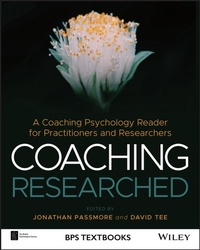
Coaching Researched
Using Coaching Psychology to Inform Your Research and Practice
1st Edition
Published on 23. July 2020
Book
Paperback/Softback
225 pages
978-1-119-65688-3 (ISBN)
Description
This book will be a collection of papers from the BPS publication: International Coaching Psychology Review. The new work would bring together the best papers from the last 15 years of the peer review publication, with the aim of more widely showcasing this research, making more accessible to the growing number of coaching researchers in business, health and education, and practitioners where there is a growing interest in evidenced based practice.
The last five years have seen a growth in the number of University courses in the UK, and wider English speaking world; Australia, South Africa, and US, as well as in Europe and beyond. We now estimate some fifty plus universities are offering coaching programmes at post-graduate level, with several hundred under-graduate and post-graduate coaching modules leading to a significant growth in coaching related research activity within universities.
A second audience we see for the title are practitioners interested in evidenced based practice. In the early development of coaching the focus was on models, specifically those claiming high impact of magical transformations. The growing professionalism of coaching, and the focus of coaching professional bodes such as the International Coach Federation (ICF), Association for Coaching (AC) and European Mentoring and Coaching Council (EMCC) on evidenced based practice, as seen a growth interest in the science of coaching.
ICPR's growth has been limited as access to the journal is constrained by the BPS. A paper copy of the journal is published, but due to BPS's approach to its in-house 'journals' the use of discoverability on the journals is severely constrained. As a result many of the papers are not in wider circulation, among coaching students and coaching academics.
The last five years have seen a growth in the number of University courses in the UK, and wider English speaking world; Australia, South Africa, and US, as well as in Europe and beyond. We now estimate some fifty plus universities are offering coaching programmes at post-graduate level, with several hundred under-graduate and post-graduate coaching modules leading to a significant growth in coaching related research activity within universities.
A second audience we see for the title are practitioners interested in evidenced based practice. In the early development of coaching the focus was on models, specifically those claiming high impact of magical transformations. The growing professionalism of coaching, and the focus of coaching professional bodes such as the International Coach Federation (ICF), Association for Coaching (AC) and European Mentoring and Coaching Council (EMCC) on evidenced based practice, as seen a growth interest in the science of coaching.
ICPR's growth has been limited as access to the journal is constrained by the BPS. A paper copy of the journal is published, but due to BPS's approach to its in-house 'journals' the use of discoverability on the journals is severely constrained. As a result many of the papers are not in wider circulation, among coaching students and coaching academics.
More details
Other editions
Additional editions
Jonathan Passmore | David Tee
Coaching Researched
A Coaching Psychology Reader for Practitioners and Researchers
E-Book
10/2020
1st Edition
Wiley-ISTE
€38.99
Available for download
Jonathan Passmore | David Tee
Coaching Researched
A Coaching Psychology Reader for Practitioners and Researchers
E-Book
10/2020
1st Edition
Wiley-ISTE
€38.99
Available for download
Content
Foreword: President of the BPS
Section 1: The nature of coaching and coaching supervision
Chapter 1: Coaching defined
Jonathan Passmore & Yi-Ling
Chapter 2: The state and future of coaching supervision
Tkach & DiGiroamo
Section 2: Coaching Theory
Chapter 3: Does coaching work or are we asking the wrong question?
Annette Fillery-Travis & David Lane
Chapter 4: A languishing-flourishing model of goal striving and mental health for coaching populations
Anthony M. Grant
Chapter 5: Addressing deficit performance through coaching - using motivational interviewing for performance improvement at work
Jonathan Passmore
Chapter 6: Does coaching psychology need the concept of formulation?
David A. Lane & Sarah Corrie
Chapter 7: An integrated model of goal-focused coaching: An evidence-based framework for teaching and practice
Anthony M. Grant
Section 2: Insights from qualitative research
Chapter 8: Super-vision, extra-vision or blind faith? A grounded theory study of the efficacy of coaching supervision
Jonathan Passmore & Susan McGoldrick
Chapter 9: Coaching with emotion: How coaches deal with difficult emotional situations
Elaine Cox & Tatiana Bachkirova
Chapter 10: Critical moments of clients and coaches: A direct-comparison study
Erik de Haan, Colin Bertie, Andrew Day & Charlotte Sills
Chapter 11: Differences between critical moments for clients, coaches, and sponsors of coaching
Erik de Haan & Christiane Nieß
Chapter 12: One-to-one coaching as a catalyst for personal development: An Interpretative Phenomenological Analysis of coaching undergraduates at a UK university
Natalie Lancer & Virginia Eatough
Section 3: Insights from quantitative research
Chapter 13: Evidence-based life coaching for senior high school students: Building hardiness and hope
Suzy Green, Anthony Grant & Jo Rynsaardt
Chapter 14: Positive coaching with frontline managers: Enhancing their effectiveness and understanding why
Nickolas Yu, Catherine G. Collins, Michael Cavanagh, Kate White & Greg Fairbrother
Chapter 15: Evaluating the impact of a peer coaching intervention on well-being amongst psychology undergraduate students
Emma Short, Gail Kinman & Sarah Baker
Chapter 16: A pilot study evaluating strengths-based coaching for primary school students: Enhancing engagement and hope
Wendy Madden, Suzy Green & Anthony M. Grant
Chapter 17: The quantitative assessment of Motivational Interviewing using Co-Active Life Coaching skills as an intervention for adults struggling with obesity
Courtney Newnham-Kanas, Jennifer D. Irwin, Don Morrow & Danielle Battram
Section 5: Insights from mixed methods
Chapter 18: Coaching as a learning methodology - a mixed methods study in driver development using a randomised controlled trial and thematic analysis
Jonathan Passmore & Hannah Rehman
Chapter 19: Evaluating a coaching and mentoring programme: Challenges and solutions
Tatiana Bachkirova, Linet Arthur & Emma Reading
Chapter 20: Towards a model of coaching transfer: Operationalising coaching success and the facilitators and barriers to transfer'.
Section 6: The future of coaching research
Section 1: The nature of coaching and coaching supervision
Chapter 1: Coaching defined
Jonathan Passmore & Yi-Ling
Chapter 2: The state and future of coaching supervision
Tkach & DiGiroamo
Section 2: Coaching Theory
Chapter 3: Does coaching work or are we asking the wrong question?
Annette Fillery-Travis & David Lane
Chapter 4: A languishing-flourishing model of goal striving and mental health for coaching populations
Anthony M. Grant
Chapter 5: Addressing deficit performance through coaching - using motivational interviewing for performance improvement at work
Jonathan Passmore
Chapter 6: Does coaching psychology need the concept of formulation?
David A. Lane & Sarah Corrie
Chapter 7: An integrated model of goal-focused coaching: An evidence-based framework for teaching and practice
Anthony M. Grant
Section 2: Insights from qualitative research
Chapter 8: Super-vision, extra-vision or blind faith? A grounded theory study of the efficacy of coaching supervision
Jonathan Passmore & Susan McGoldrick
Chapter 9: Coaching with emotion: How coaches deal with difficult emotional situations
Elaine Cox & Tatiana Bachkirova
Chapter 10: Critical moments of clients and coaches: A direct-comparison study
Erik de Haan, Colin Bertie, Andrew Day & Charlotte Sills
Chapter 11: Differences between critical moments for clients, coaches, and sponsors of coaching
Erik de Haan & Christiane Nieß
Chapter 12: One-to-one coaching as a catalyst for personal development: An Interpretative Phenomenological Analysis of coaching undergraduates at a UK university
Natalie Lancer & Virginia Eatough
Section 3: Insights from quantitative research
Chapter 13: Evidence-based life coaching for senior high school students: Building hardiness and hope
Suzy Green, Anthony Grant & Jo Rynsaardt
Chapter 14: Positive coaching with frontline managers: Enhancing their effectiveness and understanding why
Nickolas Yu, Catherine G. Collins, Michael Cavanagh, Kate White & Greg Fairbrother
Chapter 15: Evaluating the impact of a peer coaching intervention on well-being amongst psychology undergraduate students
Emma Short, Gail Kinman & Sarah Baker
Chapter 16: A pilot study evaluating strengths-based coaching for primary school students: Enhancing engagement and hope
Wendy Madden, Suzy Green & Anthony M. Grant
Chapter 17: The quantitative assessment of Motivational Interviewing using Co-Active Life Coaching skills as an intervention for adults struggling with obesity
Courtney Newnham-Kanas, Jennifer D. Irwin, Don Morrow & Danielle Battram
Section 5: Insights from mixed methods
Chapter 18: Coaching as a learning methodology - a mixed methods study in driver development using a randomised controlled trial and thematic analysis
Jonathan Passmore & Hannah Rehman
Chapter 19: Evaluating a coaching and mentoring programme: Challenges and solutions
Tatiana Bachkirova, Linet Arthur & Emma Reading
Chapter 20: Towards a model of coaching transfer: Operationalising coaching success and the facilitators and barriers to transfer'.
Section 6: The future of coaching research