

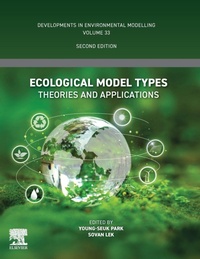
Ecological Model Types
Theories and Applications
2nd Edition
Will be published approx. on 1. December 2025
Book
Hardback
470 pages
978-0-443-36304-7 (ISBN)
Description
Ecological Model Types: Theories and Applications, Second Edition presents an understanding of how to quantitatively analyze complex and dynamic ecosystems with the tools available today. Recently, besides process-based models, data driven models such as machine learning methods are popularly applied in ecological and environmental models. This second edition covers both process-based models and data-driven models which are fundamental and popular in ecological modeling studies with theories and applications. It also explains how ecological modeling can assist the implementation of sustainable development as well as how mathematical models and systems analysis can describe ecological processes, which can support sustainable management of resources.
More details
Series
Edition
2nd edition
Language
English
Place of publication
Philadelphia
United States
Target group
Professional and scholarly
College/higher education
Dimensions
Height: 244 mm
Width: 200 mm
Thickness: 28 mm
Weight
1076 gr
ISBN-13
978-0-443-36304-7 (9780443363047)
Copyright in bibliographic data and cover images is held by Nielsen Book Services Limited or by the publishers or by their respective licensors: all rights reserved.
Schweitzer Classification
Other editions
Additional editions
E-Book
12/2025
2nd Edition
Elsevier
€110.00
Available for download
Previous edition
Sven Erik Jorgensen
Ecological Model Types: Volume 28
Book
11/2016
Elsevier
€115.50
Shipment within 15-20 days
Persons
Young-Seuk Park is a Professor at the Department of Biology, Kyung University, Seoul, Republic of Korea. After completing a PhD at Pusan National University, he undertook post-doctoral research at CNRS, Universite Paul Sabatier, and Cemagraf in France, and he obtained an HDR (Habilitation a Diriger des Recherches / Accreditation to Supervise Research) from the Universite Paul Sabatier in Toulouse, France, before returning Korea to establish his independent reseach group at Kyung Hee University. His laboratory studies the effects of environmental changes on biological systems at different hierarchical levels from molecules, individuals, populations, and communities through ecological modelling and ecological informatics approaches. In particular, his research is focused on the effects of global changes on ecosystems, and ecological monitoring and assessment for sustainable ecosystem management. He is interested in computational approaches such as machine learning techniques and advanced statistical methods. He is an associate editor of two scientific journals Annales de Limnologie - International Journal of Limnology and Journal of Ecology and Environment, and he is also on the editorial boards of several journals including Ecological Informatics and Animal Cells and Systems. He was a guest editor for several Special Issues in scientific journals including Ecological Modelling, Ecological Informatics, Annales de Limnologie - International Journal of Limnology, Inland Waters, and Water. He is the recipient of the 2014 Yeocheon Ecology Award. Sovan Lek is a Professor at the University of Toulouse. His research is mainly in Fish Community Ecology and Ecological Modelling. In Fish Community Ecology, his research concerns the biodiversity and the spatial distribution of fish according to the environmental characteristics and the response of fish community to the human disturbances, especially land-use, hydromorphology, climate warming. The distribution of fish is considered according to the scale of variation, varying from local to regional and global scales, in relationship with the environmental variables. In Ecological Modelling, he is mainly interested in the use of machine learning techniques. He is also familiar with the uses of classical modelling techniques like classical statistic methods (multiple linear regression, multi-variate analyses ) and modern statistical methods (CART, GAM, PLS ).He has participated in several EU projects in the fields of Ecology and Global changes. He also participated in bilateral projects with several Asian countries. He is an editorial member of Ecological Modelling and associate editor of Ecological Informatics.
Content
1. Introduction: An Overview
Section 1: Process-based models
2. Biogeochemical models
3. Dynamic Population Models
4. Ecotoxicological Models
5. Structurally Dynamic Models (SDMs)
6. Steady State Models
7. Spatially Explicit Models
8. Fugacity Models
9. Network model: Econet
10. Process-based Modelling in Ecology
Section 2: Data-driven models
11. Artificial Neural Networks (Multilayer Perceptron) in Ecology
12. Decision Tree Models
13. Ensemble Models
14. Support Vector Machines for Ecological Modelling
15. Deep learning: Long short-term memory networks
16. Automated Machine Learning
Section 1: Process-based models
2. Biogeochemical models
3. Dynamic Population Models
4. Ecotoxicological Models
5. Structurally Dynamic Models (SDMs)
6. Steady State Models
7. Spatially Explicit Models
8. Fugacity Models
9. Network model: Econet
10. Process-based Modelling in Ecology
Section 2: Data-driven models
11. Artificial Neural Networks (Multilayer Perceptron) in Ecology
12. Decision Tree Models
13. Ensemble Models
14. Support Vector Machines for Ecological Modelling
15. Deep learning: Long short-term memory networks
16. Automated Machine Learning