

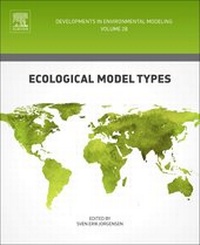
Ecological Model Types: Volume 28
Published on 1. November 2016
Book
Hardback
278 pages
978-0-444-63623-2 (ISBN)
Description
Ecological Model Types brings an understanding on how to quantitatively analyze complex and dynamic ecosystems with the tools available today. Ecosystem studies widely use the notions of order, complexity, randomness, and organization, and are used interchangeably in literature, which causes much confusion.
Better models synthesize our knowledge on ecosystems and their environmental problems, in contrast to statistical analysis, which only reveal the relationships between the data. This book brings together experts on ecological models to create a definitive work on how to understand our complex Earth.
Better models synthesize our knowledge on ecosystems and their environmental problems, in contrast to statistical analysis, which only reveal the relationships between the data. This book brings together experts on ecological models to create a definitive work on how to understand our complex Earth.
More details
Series
Language
English
Place of publication
Oxford
United Kingdom
Publishing group
Elsevier Science & Technology
Target group
Professional and scholarly
Product notice
Laminated cover
Dimensions
Height: 235 mm
Width: 191 mm
Thickness: 18 mm
Weight
698 gr
ISBN-13
978-0-444-63623-2 (9780444636232)
Copyright in bibliographic data and cover images is held by Nielsen Book Services Limited or by the publishers or by their respective licensors: all rights reserved.
Schweitzer Classification
Other editions
New editions
Book
approx. 12/2025
2nd Edition
Elsevier
€117.50
Not yet published
Additional editions
Person
Sven Erik Jorgensen was the professor emeritus in environmental chemistry at the University of Copenhagen. He received a master of science in chemical engineering from the Danish Technical University (1958), a doctor of environmental engineering (Karlsruhe University) and a doctor of science in ecological modelling (Copenhagen University). He was the honourable doctor at Coimbra University, Portugal and at Dar es Salaam University (Tanzania). In 1975 he founded the journal Ecological Modelling and in 1978 the ISEM (International Society of Ecological Modelling). He has received several awards, the Ruder Boskovic Medal, the Prigogine Prize, the Pascal Medal, the Einstein professorship at the Chinese Academy of Sciences, the Santa Chiara Prize for multidisciplinary teaching and the very prestigious Stockholm Water Prize. He has published 366 papers of which 275 were published in peer-reviewed international journals and he has edited or authored 76 books, of which several have been translated to other languages (Chinese, Russian, Spanish and Portuguese). He has authored a successful textbook in ecological modelling "Fundamentals of Ecological Modelling?, which was published as a fourth edition together with Brian Fath in 2011. It has been translated into Chinese and Russian (third edition). He authored a well received textbook in system ecology entitled "Introduction to Systems Ecology?. It was published as an English edition in 2012 and as a Chinese edition in 2013. He was editor in chief of the Encyclopedia of Ecology, published in 2008, and of the Encyclopedia of Environmental Management, published in December 2012. He has taught courses in ecological modelling in 32 different countries. He is the editorial board member of 18 international journals in the fields of ecology and environmental management. He was the president of ISEM and he also was elected member of the European Academy of Sciences, for which he was the chairman of the Section for Environmental Sciences.
Content
Chapter 1. Introduction: An Overview
Chapter 2. Biogeochemical Models
Chapter 3. Dynamic Population Models
Chapter 4. Steady State Models
Chapter 5. Earth's Surface Modeling
Chapter 6. Application of Structurally Dynamic Models (SDMs)
Chapter 7. Artificial Neural Networks: Multilayer Perceptron for Ecological Modeling
Chapter 8. Ecotoxicological Models
Chapter 9. Fugacity Models
Chapter 10. Fuzzy Adaptive Management of Coupled Natural and Human Systems
Chapter 11. Coastal Ecosystem Modeling in the Context of Climate Change: An Overview With Case Studies
Chapter 2. Biogeochemical Models
Chapter 3. Dynamic Population Models
Chapter 4. Steady State Models
Chapter 5. Earth's Surface Modeling
Chapter 6. Application of Structurally Dynamic Models (SDMs)
Chapter 7. Artificial Neural Networks: Multilayer Perceptron for Ecological Modeling
Chapter 8. Ecotoxicological Models
Chapter 9. Fugacity Models
Chapter 10. Fuzzy Adaptive Management of Coupled Natural and Human Systems
Chapter 11. Coastal Ecosystem Modeling in the Context of Climate Change: An Overview With Case Studies