

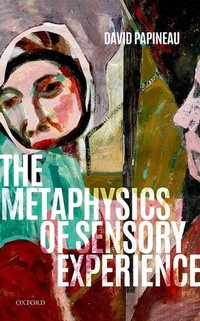
The Metaphysics of Sensory Experience
Published on 18. March 2021
Book
Hardback
176 pages
978-0-19-886239-0 (ISBN)
Description
What are the materials of conscious perceptual experience? What is going on when we are consciously aware of a visual scene, or hear sounds, or otherwise enjoy sensory experience? In this book David Papineau exposes the flaws in contemporary answers to this central philosophical question and defends a new alternative.
Contemporary theories of perceptual experience all hold that conscious experiences reach out into the world beyond the mind. According to naive realism, experiences literally incorporate perceived facts, while representationalism holds that experiences contain ordinary properties of the kind possessed by physical objects. These ideas might seem attractive at first sight, however Papineau shows that they do not stand up to examination. Instead, he argues for a purely qualitative account of sensory experience. Conscious sensory experiences are intrinsic states with no essential connection to external circumstances or represented properties. This might run counter to initial intuition, yet Papineau develops this qualitative theory in detail and illustrates how it can accommodate the rich structure of sensory experience.
Papineau's qualitative account has respectable antecedents in the history of philosophy. By placing the qualitative theory on a firm footing, he shows that those curious about experience need not be restricted to the options in contemporary philosophical discourse.
Contemporary theories of perceptual experience all hold that conscious experiences reach out into the world beyond the mind. According to naive realism, experiences literally incorporate perceived facts, while representationalism holds that experiences contain ordinary properties of the kind possessed by physical objects. These ideas might seem attractive at first sight, however Papineau shows that they do not stand up to examination. Instead, he argues for a purely qualitative account of sensory experience. Conscious sensory experiences are intrinsic states with no essential connection to external circumstances or represented properties. This might run counter to initial intuition, yet Papineau develops this qualitative theory in detail and illustrates how it can accommodate the rich structure of sensory experience.
Papineau's qualitative account has respectable antecedents in the history of philosophy. By placing the qualitative theory on a firm footing, he shows that those curious about experience need not be restricted to the options in contemporary philosophical discourse.
Reviews / Votes
Papineau's book is effective precisely because it does not take on more than it can chew. It very well may signal the death knell for representationalism or, at the very least, force representationalists to seriously rethink their commitments. * Ekin Erkan, Phenomenology and the Cognitive Sciences *More details
Language
English
Place of publication
Oxford
United Kingdom
Target group
Professional and scholarly
Product notice
sewn/stitched
Cloth over boards
Dimensions
Height: 218 mm
Width: 140 mm
Thickness: 18 mm
Weight
358 gr
ISBN-13
978-0-19-886239-0 (9780198862390)
Copyright in bibliographic data and cover images is held by Nielsen Book Services Limited or by the publishers or by their respective licensors: all rights reserved.
Schweitzer Classification
Other editions
Additional editions
David Papineau
The Metaphysics of Sensory Experience
E-Book
03/2021
1st Edition
OUP eBook
€28.49
Available for download
David Papineau
The Metaphysics of Sensory Experience
E-Book
03/2021
1st Edition
OUP eBook
€28.49
Available for download
Person
David Papineau is Professor of Philosophy at King's College London. He has previously worked at the University of Reading, Macquarie University, Birkbeck College, Cambridge University, and the City University of New York. He has served as president of the Aristotelian Society, the Mind Association, and the British Society for the Philosophy of Science.
Content
Introduction
1: Clearing the Ground
2: Against Representationalism
3: The Structure of Experience
4: Introspection, Adverbialism, and Rich Contents
1: Clearing the Ground
2: Against Representationalism
3: The Structure of Experience
4: Introspection, Adverbialism, and Rich Contents