

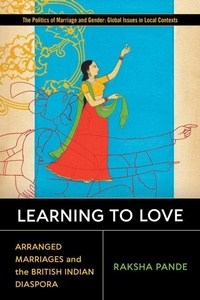
Learning to Love
Arranged Marriages and the British Indian Diaspora
Published on 19. March 2021
Book
Paperback/Softback
154 pages
978-0-8135-9963-2 (ISBN)
Description
Learning to Love moves beyond the media and policy stereotypes that conflate arranged marriages with forced marriages. Using in-depth interviews and participant observations, this book assembles a rich and diverse array of everyday marriage narratives and trajectories and highlights how considerations of romantic love are woven into traditional arranged marriage practices. It shows that far from being a homogeneous tradition, arranged marriages involve a variety of different matchmaking practices where each family tailors its own cut-and-paste version of British-Indian arranged marriages to suit modern identities and ambitions. Pande argues that instead of being wedded to traditions, people in the British-Indian diaspora have skillfully adapted and negotiated arranged marriage cultural norms to carve out an identity narrative that portrays them as "modern and progressive migrants"-ones who are changing with the times and cultivating transnational forms of belonging.
Reviews / Votes
"Marriage never went out of fashion, certainly among South Asians, though its forms, culture, and politics were never static. Learning to Love gives us a fine grained narration of fluid, changing practices and negotiations shaping 'arranged marriage' and intimacy through the voices of two generations of British Indians. Raksha Pande uncovers their making of culture, tradition, choice, modernity, and claims to citizenship contesting the stereotypes that prevail in the 'west'."- Rajni Palriwala, co-editor of Marrying in South Asia: Shifting Concepts, Changing Practices in a Globalising World"Amidst rising anti-immigrant sentiment, Learning to Love is a welcome intervention into entrenched, nationalist discourses of 'arranged marriage' that present it as anachronistic and utterly different from love marriage. Pande highlights the hopes and strategies of British-Indians, young and old, who talk of 'rishta,' matchmaking, intergenerational negotiation, modernity, and falling in love with the right person. A breath of fresh air!"- Meena Khandelwal, author of Women in Ochre Robes
"Theoretically robust, lucid in style, and presented in an accessible manner. It is a welcome addition to the literature on marriage and spousal selection in general and diasporic marriages in particular. It will be of interest to scholars in the domain of geography, social anthropology, sociology, and gender studies working on questions of diaspora, marriage migration, and (informal) citizenship and anyone interested in the theme of marriage and transnational lives."- Gender, Place & Culture
More details
Language
English
Place of publication
New Brunswick NJ
United States
Target group
College/higher education
Product notice
Paperback (trade)
Unsewn / adhesive bound
Illustrations
1 figure, 1 table
Dimensions
Height: 225 mm
Width: 147 mm
Thickness: 9 mm
Weight
224 gr
ISBN-13
978-0-8135-9963-2 (9780813599632)
Copyright in bibliographic data and cover images is held by Nielsen Book Services Limited or by the publishers or by their respective licensors: all rights reserved.
Schweitzer Classification
Person
RAKSHA PANDE is a lecturer in the School of Geography, Politics and Sociology at Newcastle University in the UK.
Content
Series Foreword by Peter Berta
Preface and Acknowledgments
1 The Politics of Marriage and Migration in Postcolonial Britain
2 Becoming Modern and British: Enacting Citizenship through Arranged Marriages
3 Continuing Traditions as a Matter of Arrangement
4 Becoming a "Suitable Boy" and a "Good Girl"
5 Learning to Love
6 The Ties That Bind: Marriage, Belonging, and Identity
7 Conclusion
References
Index
Preface and Acknowledgments
1 The Politics of Marriage and Migration in Postcolonial Britain
2 Becoming Modern and British: Enacting Citizenship through Arranged Marriages
3 Continuing Traditions as a Matter of Arrangement
4 Becoming a "Suitable Boy" and a "Good Girl"
5 Learning to Love
6 The Ties That Bind: Marriage, Belonging, and Identity
7 Conclusion
References
Index