

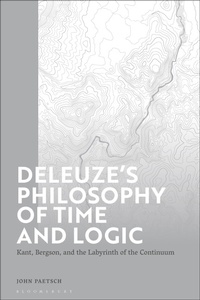
Deleuze's Philosophy of Time and Logic
Kant, Bergson, and the Labyrinth of the Continuum
Published on 30. April 2026
Book
Hardback
248 pages
978-1-350-57743-5 (ISBN)
Description
In this compelling study John Paetsch explores the overlooked relationship between time and logic in Gilles Deleuze's philosophy.
Drawing on the work of philosophers and mathematicians, from Kant and Peirce to Bergson and Brandom, this book plots an original path through Deleuze's thought and transcendental empiricism.
Divided into 2 parts, each with a transcendental and a logical focus respectively, Part I introduces the concept of time in Deleuze's philosophy. Having dismissed all previous philosophies of time as deficient, with the notable exception of Bergson, Paetsch reveals how, in critiquing theories of temporality, Deleuze turns in particular to Kant. In doing so, Deleuze innovatively reconsiders transcendental philosophy in light of Bergson's theses on duree (lived duration). Building on the first part, Part II then investigates Deleuze's understanding of logic and its relation to time. Both Deleuze and Bergson claimed that time undermines the central principles of every logical system. And yet, this book examines how Deleuze steps beyond logic, contending that a mathematical expression of 'durative continuity' could inaugurate a novel philosophy of physics.
Engaging with key Deleuzian texts, including Logic of Sense, Difference and Repetition, and A Thousand Plateaus, Deleuze's Philosophy of Time and Logic provides a bold new interpretation of fundamental questions concerning time, how we understand it, and how it affects what we think. It will be of interest to scholars across continental philosophy, logic, philosophy of mathematics, and metaphysics.
Drawing on the work of philosophers and mathematicians, from Kant and Peirce to Bergson and Brandom, this book plots an original path through Deleuze's thought and transcendental empiricism.
Divided into 2 parts, each with a transcendental and a logical focus respectively, Part I introduces the concept of time in Deleuze's philosophy. Having dismissed all previous philosophies of time as deficient, with the notable exception of Bergson, Paetsch reveals how, in critiquing theories of temporality, Deleuze turns in particular to Kant. In doing so, Deleuze innovatively reconsiders transcendental philosophy in light of Bergson's theses on duree (lived duration). Building on the first part, Part II then investigates Deleuze's understanding of logic and its relation to time. Both Deleuze and Bergson claimed that time undermines the central principles of every logical system. And yet, this book examines how Deleuze steps beyond logic, contending that a mathematical expression of 'durative continuity' could inaugurate a novel philosophy of physics.
Engaging with key Deleuzian texts, including Logic of Sense, Difference and Repetition, and A Thousand Plateaus, Deleuze's Philosophy of Time and Logic provides a bold new interpretation of fundamental questions concerning time, how we understand it, and how it affects what we think. It will be of interest to scholars across continental philosophy, logic, philosophy of mathematics, and metaphysics.
Reviews / Votes
John Paetsch's Deleuze's Philosophy of Time and Logic joins the work of Zourabichvili in the front rank of Deleuze criticism. But Paetsch also gives us an original work of philosophy in itself, one in which the traditional labyrinth of the composition of the continuum is subjected to profound philosophical revaluation. Sensitive to the history of philosophy as well as the contexts of the arts and sciences, Paetsch pursues a new type of philosophy inspired by the work of Gilles Deleuze. * O. Bradley Bassler, Associate Professor, Emeritus, Department of Philosophy, University of Georgia, US * A rare work that reads as beautifully and energetically as it thinks, Deleuze's Philosophy of Time and Logic is a tour de force of conceptual invention. Philosophically exacting and charged with an insurgent, scintillating vitality, this book reconsiders logic in light of time's heterogeneity. * Vaclav Paris, University of Padua, Italy *More details
Language
English
Place of publication
London
United Kingdom
Publishing group
Bloomsbury Publishing PLC
Target group
College/higher education
Dimensions
Height: 240 mm
Width: 161 mm
Thickness: 18 mm
Weight
537 gr
ISBN-13
978-1-350-57743-5 (9781350577435)
Copyright in bibliographic data and cover images is held by Nielsen Book Services Limited or by the publishers or by their respective licensors: all rights reserved.
Schweitzer Classification
Other editions
Additional editions
John Paetsch
Deleuze's Philosophy of Time and Logic
Kant, Bergson, and the Labyrinth of the Continuum
E-Book
04/2026
1st Edition
Bloomsbury Academic
€94.49
Available for download
John Paetsch
Deleuze's Philosophy of Time and Logic
Kant, Bergson, and the Labyrinth of the Continuum
E-Book
04/2026
1st Edition
Bloomsbury Academic
€94.49
Available for download
Person
John Paetsch is an Instructor at Penn State University, Abington, USA.
Content
Introduction
Part I. Prolegomenon to a General Economy of Time: Radicalizing Kant In Light of Bergsonian Duree
1. Deleuze's Immanent Critique of Kant: "Duration is closer to me than I am to myself"
2. The Noise of Time: Deleuze and Kant at the "fissure"
Part II. Formal and Transcendental Logic: "The Irrational Logic of Aberrant Movements"
3. Towards an Anarcho-Spinozist Semantics: From the Paradoxes of Sense to Virtual Problems
4. My Kingdom for a Truth-Condition-or, What if semantics turned not upon truth but upon power?
Bibliography
Index
Part I. Prolegomenon to a General Economy of Time: Radicalizing Kant In Light of Bergsonian Duree
1. Deleuze's Immanent Critique of Kant: "Duration is closer to me than I am to myself"
2. The Noise of Time: Deleuze and Kant at the "fissure"
Part II. Formal and Transcendental Logic: "The Irrational Logic of Aberrant Movements"
3. Towards an Anarcho-Spinozist Semantics: From the Paradoxes of Sense to Virtual Problems
4. My Kingdom for a Truth-Condition-or, What if semantics turned not upon truth but upon power?
Bibliography
Index