

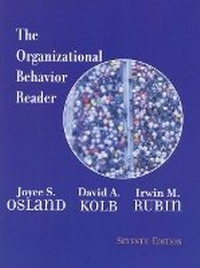
The Organizational Behavior Reader
7th Edition
Published on 11. September 2000
Book
Paperback/Softback
594 pages
978-0-13-026554-8 (ISBN)
Description
For courses in Organizational Behavior, Individual Behavior in Organizations, and Industrial Psychology.
This perennial favorite conveys the concepts of organizational behavior through experiential learning, using carefully developed group exercises and simulations that have been proven over a period of 30 years. It is designed for professors who want to create a unique, effective, enjoyable learning experience for students.
This perennial favorite conveys the concepts of organizational behavior through experiential learning, using carefully developed group exercises and simulations that have been proven over a period of 30 years. It is designed for professors who want to create a unique, effective, enjoyable learning experience for students.
More details
Edition
7th edition
Language
English
Place of publication
United States
Publishing group
Pearson Education (US)
Target group
Professional and scholarly
Dimensions
Width: 233 mm
Thickness: 21 mm
Weight
843 gr
ISBN-13
978-0-13-026554-8 (9780130265548)
Copyright in bibliographic data and cover images is held by Nielsen Book Services Limited or by the publishers or by their respective licensors: all rights reserved.
Schweitzer Classification
Other editions
New editions
Joyce S. Osland | Marlene E. Turner | David A. Kolb
The Organizational Behavior Reader
Book
04/2006
8th Edition
Pearson
€143.59
Article exhausted; check for reprint
Previous edition

David A. Kolb | Joyce S. Osland | Irwin M. Rubin
The Organizational Behavior Reader
Book
04/1995
6th Edition
Prentice Hall
€38.37
Article exhausted; check for reprint
Content
I. UNDERSTANDING YOURSELF AND OTHER PEOPLE AT WORK.
1. The Psychological Contract.
2. Theories of Managing People.
3. Individual and Organizational Learning.
4. Individual and Organizational Motivation.
5. Value and Ethics.
6. Personal Growth and Work Stress.
II. CREATING EFFECTIVE WORK GROUPS.
7. Interpersonal Communication.
8. Perception and Attribution.
9. Group Dynamics and Work Teams.
10. Problem Solving and Creativity.
11. Conflict and Negotiation.
12. Managing Diversity.
III. LEADERSHIP AND MANAGEMENT.
13. Leadership.
14. Organizational Culture.
15. Decision Making.
16. Power and Influence.
17. Empowerment and Coaching.
18. Performance Appraisal.
IV. MANAGING EFFECTIVE ORGANIZATIONS.
19. Organization Design.
20. Managing Change.
1. The Psychological Contract.
2. Theories of Managing People.
3. Individual and Organizational Learning.
4. Individual and Organizational Motivation.
5. Value and Ethics.
6. Personal Growth and Work Stress.
II. CREATING EFFECTIVE WORK GROUPS.
7. Interpersonal Communication.
8. Perception and Attribution.
9. Group Dynamics and Work Teams.
10. Problem Solving and Creativity.
11. Conflict and Negotiation.
12. Managing Diversity.
III. LEADERSHIP AND MANAGEMENT.
13. Leadership.
14. Organizational Culture.
15. Decision Making.
16. Power and Influence.
17. Empowerment and Coaching.
18. Performance Appraisal.
IV. MANAGING EFFECTIVE ORGANIZATIONS.
19. Organization Design.
20. Managing Change.