

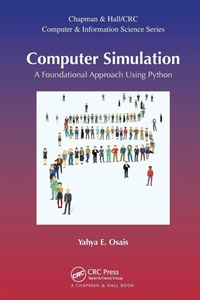
Computer Simulation
A Foundational Approach Using Python
1st Edition
Published on 30. June 2020
Book
Paperback/Softback
314 pages
978-0-367-57266-2 (ISBN)
Description
Computer simulation is an effective and popular universal tool that can be applied to almost all disciplines. Requiring only basic knowledge of programming, mathematics, and probability theory, Computer Simulation: A Foundational Approach Using Python takes a hands-on approach to programming to introduce the fundamentals of computer simulation.
The main target of the book is computer science and engineering students who are interested mainly in directly applying the techniques to their research problems. The book will be of great interest to senior undergraduate and starting graduate students in the fields of computer science and engineering and industrial engineering.
The main target of the book is computer science and engineering students who are interested mainly in directly applying the techniques to their research problems. The book will be of great interest to senior undergraduate and starting graduate students in the fields of computer science and engineering and industrial engineering.
Reviews / Votes
"This book is highly recommended for a graduate course in modeling and simulation. It is also recommended for an introductory course in modeling and simulation for a senior undergraduate course. In addition, it can be a good reference for researchers, working engineers and scientists who work in modeling and simulation and optimization. It is a good addition to the field of modeling and simulation. I hope you will enjoy the book as much as I have enjoyed reviewing it."-Mohammad S. Obaidat, Past President of the Society for Modeling and Simulation International, SCS, and Editor-in-Chief, International Journal of Communication Systems "This book is highly recommended for a graduate course in modeling and simulation. It is also recommended for an introductory course in modeling and simulation for a senior undergraduate course. In addition, it can be a good reference for researchers, working engineers and scientists who work in modeling and simulation and optimization. It is a good addition to the field of modeling and simulation. I hope you will enjoy the book as much as I have enjoyed reviewing it."
-Mohammad S. Obaidat, Past President of the Society for Modeling and Simulation International, SCS, and Editor-in-Chief, International Journal of Communication Systems
More details
Series
Language
English
Place of publication
Oxford
United Kingdom
Publishing group
Taylor & Francis Ltd
Target group
Professional and scholarly
Professional Practice & Development
Dimensions
Height: 234 mm
Width: 156 mm
Thickness: 17 mm
Weight
480 gr
ISBN-13
978-0-367-57266-2 (9780367572662)
Copyright in bibliographic data and cover images is held by Nielsen Book Services Limited or by the publishers or by their respective licensors: all rights reserved.
Schweitzer Classification
Other editions
Additional editions
E-Book
11/2017
1st Edition
Chapman & Hall/CRC
€52.49
Available for download
E-Book
11/2017
Chapman & Hall/CRC
€52.49
Available for download
Book
11/2017
1st Edition
Chapman & Hall/CRC
€209.90
Shipment within 15-20 days
Person
Yahya E. Osais is a faculty in the department of computer engineering at King Fahd University of Petroleum and Minerals (KFUPM), Dhahran, Saudi Arabia. He obtained his B.Sc. and M.Sc. from the same department in 2000 and 2003, respectively. In 2010, he obtained his Ph.D. from the department of systems and computer engineering at Carleton university, Ontario, Canada. Dr. Osais regulary teaches a graduate course on computer simulation for students in the college of computer science and engineering at KFUPM. He also teaches courses on computer engineering design and web technologies. His current research interest includes stochastic modeling and simulation, cyberphysical systems, and Internet of things.
Content
Part I The Fundamentals. Chapter 1 Introduction. Chapter 2 Building Conceptual Models. Chapter 3 Simulating Probabilities. Chapter 4 Simulating Random Variables and Stochastic Processes. Chapter 5 Simulating the SingleServer Queueing System. Chapter 6 Statistical Analysis of Simulated Data. Part II Managing Complexity. Chapter 7 Event Graphs. Chapter 8 Building Simulation Programs. Part III Problem-Solving. Chapter 9 The Monte Carlo Method. Part IV Sources Of Randomness. Chapter 10 Random Variate Generation. Chapter 11 Random Number Generation. Part V Case Studies.Chapter 12 Case Studies