

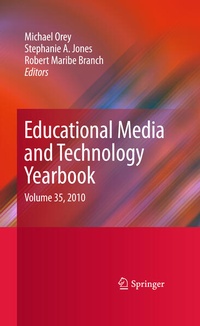
Educational Media and Technology Yearbook
Volume 35, 2010
Published on 16. February 2010
Book
Hardback
XVII, 468 pages
978-1-4419-1502-3 (ISBN)
Description
TheaudiencefortheYearbookconsistsofmediaandtechnologyprofessionalsin schools,highereducation,andbusinesscontexts. Topicsofinteresttoprofessi- alspracticingintheseareasarebroad,astheTableofContentsdemonstrates. The themeunifyingeachofthechaptersinthebookistheuseoftechnologytoenable orenhanceeducation. Formsoftechnologyrepresentedinthisvolumevaryfrom traditionaltoolssuchasthebooktothelatestadvancementsindigitaltechnology, while areas of education encompass widely ranging situations involving learning andteaching,whichareideatechnologies. Asinpriorvolumes,theassumptionsunderlyingthechapterspresentedhereare asfollows: 1. Technologyrepresentstoolsthatactasextensionsoftheeducator. 2. Mediaserveasdeliverysystemsforeducationalcommunications. 3. Technologyisnotrestrictedtomachinesandhardware,butincludestechniques andproceduresderivedfromscienti?cresearchaboutwaystopromotechange inhumanperformance. 4. The fundamental tenet is that educational media and technology should be usedto a. achieveauthenticlearningobjectives, b. situatelearningtasks, c. negotiatethecomplexitiesofguidedlearning, d. facilitatetheconstructionofknowledge, e. aidintheassessment/documentingoflearning, f. supportskillacquisition,and g.
managediversity. TheEducationalMediaandTechnologyYearbook has become a standard r- erence in many libraries and professional collections. Examined in relation to its companion volumes of the past, it provides a valuable historical record of c- rent ideas and developments in the ?eld. Part I, "Trends and Issues in Learning, Design, and Technology," presents an array of chapters that develop some of the current themes listed above, in addition to others. Part II, "Trends and Issues in v vi Preface Library and Information Science," concentrates on chapters of special relevance to K-12 education, library science education, school learning resources, and v- ious types of library and media centers - school, public, and academic among others. In Part III, "Leadership Pro?les," authors provide biographical sketches of the careers of instructional technology leaders. Part IV, "Organizations and Associations," and Part V, "Graduate Programs," are, respectively, directories of instructional technology-related organizations and institutions of higher learning offeringdegreesinrelated?elds.
Finally,PartVI,"Mediagraphy:PrintandNonprint Resources,"presentsanannotatedlistingofselectedcurrentpublicationsrelatedto the?eld. The editors of the Yearbook invite media and technology professionals to submitmanuscriptsforconsiderationforpublication. ContactMichaelOrey(mi- orey@uga. edu)forsubmissionguidelines. Foranumberofyears,wehaveworkedtogetheraseditors,andthisisthes- enth year with Dr. Michael Orey as the senior editor. Within each volume of the EducationalMediaandTechnologyYearbook(EMTY),wetrytolistallthegra- ateprograms,journals,andorganizationsthatarerelatedtobothLearning,Design, andTechnology(LDT)andInformationandLibraryScience(ILS). Wealsoinclude asectionontrendsinLDTandtrendsinILS,andwehaveasectionpro?lingsome oftheleadersinthe?eld.
managediversity. TheEducationalMediaandTechnologyYearbook has become a standard r- erence in many libraries and professional collections. Examined in relation to its companion volumes of the past, it provides a valuable historical record of c- rent ideas and developments in the ?eld. Part I, "Trends and Issues in Learning, Design, and Technology," presents an array of chapters that develop some of the current themes listed above, in addition to others. Part II, "Trends and Issues in v vi Preface Library and Information Science," concentrates on chapters of special relevance to K-12 education, library science education, school learning resources, and v- ious types of library and media centers - school, public, and academic among others. In Part III, "Leadership Pro?les," authors provide biographical sketches of the careers of instructional technology leaders. Part IV, "Organizations and Associations," and Part V, "Graduate Programs," are, respectively, directories of instructional technology-related organizations and institutions of higher learning offeringdegreesinrelated?elds.
Finally,PartVI,"Mediagraphy:PrintandNonprint Resources,"presentsanannotatedlistingofselectedcurrentpublicationsrelatedto the?eld. The editors of the Yearbook invite media and technology professionals to submitmanuscriptsforconsiderationforpublication. ContactMichaelOrey(mi- orey@uga. edu)forsubmissionguidelines. Foranumberofyears,wehaveworkedtogetheraseditors,andthisisthes- enth year with Dr. Michael Orey as the senior editor. Within each volume of the EducationalMediaandTechnologyYearbook(EMTY),wetrytolistallthegra- ateprograms,journals,andorganizationsthatarerelatedtobothLearning,Design, andTechnology(LDT)andInformationandLibraryScience(ILS). Wealsoinclude asectionontrendsinLDTandtrendsinILS,andwehaveasectionpro?lingsome oftheleadersinthe?eld.
More details
Series
Edition
2010 ed.
Language
English
Place of publication
New York
United States
Target group
Professional and scholarly
Research
Product notice
sewn/stitched
Cloth over boards
Illustrations
50 s/w Abbildungen
XVII, 468 p. 50 illus.
Dimensions
Height: 243 mm
Width: 164 mm
Thickness: 38 mm
Weight
862 gr
ISBN-13
978-1-4419-1502-3 (9781441915023)
DOI
10.1007/978-1-4419-1516-0
Schweitzer Classification
Other editions
Additional editions
Michael Orey | Stephanie A. Jones | Robert Maribe Branch
Educational Media and Technology Yearbook
Volume 35, 2010
Book
05/2012
Springer
€160.49
Shipment within 15-20 days
Michael Orey | Stephanie A. Jones | Robert Maribe Branch
Educational Media and Technology Yearbook
Volume 35, 2010
E-Book
03/2010
1st Edition
Springer
€149.79
Available for download
Content
Trends and Issues in Learning, Design, and Technology.- Understanding School Leaders' Role in Teachers' Adoption of Technology Integration Classroom Practices.- Issues and Trends in Instructional Technology: Growth and Maturation of Web-Based Tools in a Challenging Climate; Social Networks Gain Educators' Attention.- Rapid Prototyping for Designing and Delivering Technology-Based Lessons.- Theory-Based Evaluation of Instruction: Implications for Improving Student Learning Achievement in Postsecondary Education.- Developing Technology Fluency in Community Practice: Exploration of the "Paintbrush" Metaphor.- The Instructional and Learning Technologies Department (ILT) in the College of Education, Sultan Qaboos University.- Learning with Technology: Learner Voice and Agency.- Trends in Performance Improvement: Expanding the Reach of Instructional Design and Technology.- Trends and Issues in Library and Information Science.- School Library Media Specialists and School Counselors: Collaborative Partners to Expand Distance Education Opportunities for High School Students.- The Role of the School Library Media Center Program in the Education and Prevention of Cyberbullying.- E-Government, Government Documents, and School Libraries.- Leadership Profiles.- Jerrold Kemp: Designing Effective Instruction.- W. Michael Reed: At the Beginnings Using Computers in Education for Higher-Order Learning.- Organizations and Associations.- Worldwide List of Organizations in Learning, Design, Technology, Information, or Libraries.- Graduate Programs.- Worldwide List of Graduate Programs in Learning, Design, Technology, Information, or Libraries.- Mediagraphy: Print and Nonprint Resources.- Mediagraphy.