

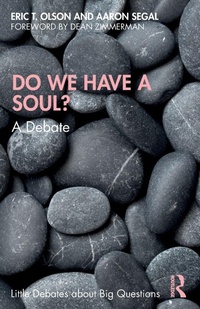
Do We Have a Soul?
A Debate
1st Edition
Published on 4. August 2023
Book
Paperback/Softback
240 pages
978-0-367-33364-5 (ISBN)
Description
Are we made entirely of matter, like sticks and stones? Or do we have a soul-a nonphysical entity-where our mental lives take place?
The authors Eric T. Olson and Aaron Segal begin this accessible and wide-ranging debate by looking at the often-overlooked question of whether we appear in ordinary experience to be material things. Olson then argues that the dependence of our mental lives on the condition of our brains-the fact that general anesthesia causes complete unconsciousness, for instance-is best explained by saying that our mental lives are physical activities in our brains rather than nonphysical activities in the soul. Segal objects that this view is incompatible with two obvious and important facts about ourselves: that there is only one of you rather than trillions of almost identical beings now thinking your thoughts, and that we exist and remain conscious for more than an instant. These facts, he claims, are presupposed in our practical and moral judgments-but they require us to be immaterial things. Olson is forced to concede that there is no easy and uncontroversial answer to these objections but doubts whether taking us to be immaterial would be any help. The debate takes in large philosophical questions extending well beyond dualism and materialism.
The book features clear statements of each argument, responses to counter-arguments, in-text definitions, a glossary of key terms, and section summaries. Scholars and students alike will find it easy to follow the debate and learn the key concepts from metaphysics, philosophy of mind, and other areas necessary to understand each position.
Key Features
Is the only introductory book devoted to the debate between substance dualism and materialism
Discusses both traditional and novel arguments for each position
Debates important but infrequently discussed questions, including:
do we appear, in ordinary experience, to be material?
should materialism be the default view?
is there a good probabilistic argument for materialism?
Written in a lively and accessible style
Uses only a limited number of technical terms and defines all of them in the glossary
The authors Eric T. Olson and Aaron Segal begin this accessible and wide-ranging debate by looking at the often-overlooked question of whether we appear in ordinary experience to be material things. Olson then argues that the dependence of our mental lives on the condition of our brains-the fact that general anesthesia causes complete unconsciousness, for instance-is best explained by saying that our mental lives are physical activities in our brains rather than nonphysical activities in the soul. Segal objects that this view is incompatible with two obvious and important facts about ourselves: that there is only one of you rather than trillions of almost identical beings now thinking your thoughts, and that we exist and remain conscious for more than an instant. These facts, he claims, are presupposed in our practical and moral judgments-but they require us to be immaterial things. Olson is forced to concede that there is no easy and uncontroversial answer to these objections but doubts whether taking us to be immaterial would be any help. The debate takes in large philosophical questions extending well beyond dualism and materialism.
The book features clear statements of each argument, responses to counter-arguments, in-text definitions, a glossary of key terms, and section summaries. Scholars and students alike will find it easy to follow the debate and learn the key concepts from metaphysics, philosophy of mind, and other areas necessary to understand each position.
Key Features
Is the only introductory book devoted to the debate between substance dualism and materialism
Discusses both traditional and novel arguments for each position
Debates important but infrequently discussed questions, including:
do we appear, in ordinary experience, to be material?
should materialism be the default view?
is there a good probabilistic argument for materialism?
Written in a lively and accessible style
Uses only a limited number of technical terms and defines all of them in the glossary
More details
Series
Language
English
Place of publication
London
United Kingdom
Publishing group
Taylor & Francis Ltd
Target group
Professional and scholarly
Professional
Dimensions
Height: 216 mm
Width: 140 mm
Thickness: 14 mm
Weight
339 gr
ISBN-13
978-0-367-33364-5 (9780367333645)
Copyright in bibliographic data and cover images is held by Nielsen Book Services Limited or by the publishers or by their respective licensors: all rights reserved.
Schweitzer Classification
Other editions
Additional editions
Book
08/2023
1st Edition
Routledge
€185.20
Shipment within 15-20 days
E-Book
08/2023
1st Edition
Routledge
€40.99
Available for download
E-Book
08/2023
1st Edition
Routledge
€40.99
Available for download
Persons
Eric T. Olson has a special interest in the metaphysical nature of human beings. He is the author of two other books: The Human Animal: Personal Identity Without Psychology (1997) and What Are We? A Study in Personal Ontology (2007).
Aaron Segal is the Michael and Bella Guggenheim Senior Lecturer in Philosophy at The Hebrew University of Jerusalem, and he has published widely in metaphysics, philosophy of religion, and analytic Jewish philosophy.
Aaron Segal is the Michael and Bella Guggenheim Senior Lecturer in Philosophy at The Hebrew University of Jerusalem, and he has published widely in metaphysics, philosophy of religion, and analytic Jewish philosophy.
Content
Foreword: Dualism and Materialism Opening Statements 1. Why I don't believe in souls 2. Why I Believe I am a Soul First Round of Replies 3. Fuzzy Edges and Amputations: Reply to Aaron Segal 4. A Sane Soul-Hypothesis and the Sane Materialist Alternative: Reply to Eric Olson Second Round of Replies 5. The Appearances and the Evidence: Reply to Aaron Segal's reply 6. Materialism is Metaphysically Messy or Morally Absurd: Reply to Eric Olson's Reply