

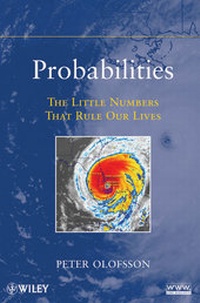
Probabilities
The Little Numbers That Rule Our Lives
Published on 26. March 2010
Book
Paperback/Softback
280 pages
978-0-470-62445-6 (ISBN)
Description
This book is intended as a popular, but abbreviated treatise on probability theory. Basic concepts and techniques are introduced and illustrated mainly by drawing from a wealth of entertaining, paradoxical, and mind-boggling probability problems (such as the birthday problem or the Monty Hall problem). The writing style is purposefully enjoyable and mostly non-technical. The pace is leisurely. No knowledge of calculus of previous knowledge of probability theory or statistics is required. The emphasis is on entertainment and pedagogy rather than applicability or usefulness. Examples reflect everyday occurrences, not pre-fabricated or altered data. While honest in approach, the author takes great pain to ease the level of mathematics throughout the work. Probability theory is learned by and through example.
More details
Edition
1. Auflage
Language
English
Place of publication
New York
United States
Target group
Professional and scholarly
Product notice
Paperback (trade)
Unsewn / adhesive bound
Illustrations
Drawings: 4 B&W, 0 Color; Tables: 0 B&W, 0 Color; Graphs: 27 B&W, 0 Color
Dimensions
Height: 234 mm
Width: 156 mm
Thickness: 15 mm
Weight
427 gr
ISBN-13
978-0-470-62445-6 (9780470624456)
Schweitzer Classification
Other editions
Additional editions
E-Book
06/2013
Wiley
€40.99
Available for download
E-Book
01/2007
Wiley
€40.99
Available for download
Book
11/2006
1st Edition
Wiley
€54.90
Article exhausted; check for reprint
Person
PETER OLOFSSON, PHD, is Associate Professor of Mathematics at Trinity University. Dr. Olofsson is an active researcher in the field of applied probability and is an experienced teacher. He is the author of Probability, Statistics, and Stochastic Processes, also from Wiley.
Content
Preface.
1. Computing Probabilities: Right Ways and Wrong Ways.
2. Surprising Probabilities: When Intuition Struggles.
3. Tiny Probabilities: Why Are They So Hard to Escape?
4. Backward Probabilities: The Reverend Bayes to Our Rescue.
5. Beyond Probabilities: What to Expect.
6. Inevitable Probabilities: Two Fascination Mathematical Results.
7. Gambling Probabilities: Why Donald Trump Is Richer than You.
8. Guessing Probabilities: Enter the Statisticians.
9. Faking Probabilities: Computer Simulation.
Index.