

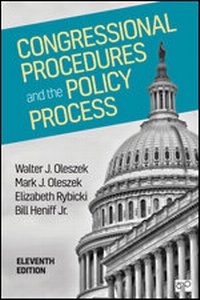
Congressional Procedures and the Policy Process
11th Edition
Published on 1. January 2020
Book
Paperback/Softback
488 pages
978-1-5063-6749-1 (ISBN)
Description
"The book does an outstanding job in covering all the necessary details on congressional rules and procedures, most of which are not easy to understand. [...] It has been and will remain to be a must-read for all the congressional politics students and Washington insiders."
- Hong Min Park, University of Wisconsin - Milwaukee
Congressional Procedures and the Policy Process examines the entire arc of the legislative process-from a bill's introduction, to its signature into law, to congressional review of the law's administrative implementation-and the many procedural pitfalls that exist along the way. Author Walter J. Oleszek and co-authors Mark Oleszek, Elizabeth Rybicki, and Bill Heniff, Jr. do not shy away from the complexity of the topic, yet they ensure that the operations of Congress are understandable to students and practitioners alike. Through an array of interesting examples, case studies, and the authors' personal anecdotes, this definitive work delivers timely explanation and analysis of the nation's premier lawmaking institution.
- Hong Min Park, University of Wisconsin - Milwaukee
Congressional Procedures and the Policy Process examines the entire arc of the legislative process-from a bill's introduction, to its signature into law, to congressional review of the law's administrative implementation-and the many procedural pitfalls that exist along the way. Author Walter J. Oleszek and co-authors Mark Oleszek, Elizabeth Rybicki, and Bill Heniff, Jr. do not shy away from the complexity of the topic, yet they ensure that the operations of Congress are understandable to students and practitioners alike. Through an array of interesting examples, case studies, and the authors' personal anecdotes, this definitive work delivers timely explanation and analysis of the nation's premier lawmaking institution.
Reviews / Votes
"With no exaggeration, I love teaching this text. The main strength of the text is the framing of the work around the policy making process. Our Political Science program has a strong Public Administration tone, so this text explains how the nuts and bolts of policy are created and how the legislative branch truly affects the outcome. We are trying to prepare our students to work in government, so any textbook that explains the nitty-gritty of policy-making is a must teach." -- Joshua R. Meddaugh "The book does an outstanding job in covering all the necessary details on congressional rules and procedures, most of which are not easy to understand. Oleszek and et. al. successfully explains very technical concepts in a clear and accessible fashion. In addition, a lot of examples and anecdotes certainly help. It has been and will remain to be a must-read for all the congressional politics students and Washington insiders." -- Hong Min Park "This book offers impressively comprehensive coverage of just about every aspect of congressional procedures that I can think of. In terms of the language, the text is very readable and accessible for undergraduates, and I appreciate how the authors have used quotes from members of Congress to illustrate numerous specific points." -- Greg M. ShawMore details
Edition
11th Revised edition
Language
English
Place of publication
Washington
United States
Publishing group
SAGE Publications Inc
Target group
College/higher education
Edition type
Revised edition
Dimensions
Height: 229 mm
Width: 152 mm
Weight
704 gr
ISBN-13
978-1-5063-6749-1 (9781506367491)
Copyright in bibliographic data and cover images is held by Nielsen Book Services Limited or by the publishers or by their respective licensors: all rights reserved.
Schweitzer Classification
Other editions
Previous edition
Walter J. Oleszek | Mark J. Oleszek | Elizabeth E. Rybicki
Congressional Procedures and the Policy Process
Book
12/2015
10th Edition
CQ Press
€95.52
Article exhausted; check for reprint
Persons
Walter J. Oleszek is a senior specialist in the legislative process at the Congressional
Research Service. He has served as either a full-time professional staff aide or consultant
to many major House and Senate congressional reorganization efforts beginning
with the passage of the Legislative Reorganization Act of 1970. In 1993, he served as
policy director of the Joint Committee on the Organization of Congress. A former
adjunct faculty member at American University, Oleszek is a frequent lecturer to various
academic, governmental, and business groups. He is the author or co-author of several
books, including Congressional Procedures and the Policy Process, 11th ed. (2020),
and Congress Under Fire: Reform Politics and the Republican Majority, with C. Lawrence
Evans (1997).
Research Service. He has served as either a full-time professional staff aide or consultant
to many major House and Senate congressional reorganization efforts beginning
with the passage of the Legislative Reorganization Act of 1970. In 1993, he served as
policy director of the Joint Committee on the Organization of Congress. A former
adjunct faculty member at American University, Oleszek is a frequent lecturer to various
academic, governmental, and business groups. He is the author or co-author of several
books, including Congressional Procedures and the Policy Process, 11th ed. (2020),
and Congress Under Fire: Reform Politics and the Republican Majority, with C. Lawrence
Evans (1997).
Content
Preface
About the Authors
Chapter 1: Congress and Lawmaking
The Constitutional Context
Functions of Rules and Procedures
Rules and Policymaking in Congress
Congressional Decision Making
The House and Senate Compared
Pressures on Members
Chapter 2: The Congressional Budget Process
Authorization-Appropriations Process
Establishing a Congressional Budget Process
Evolution of Statutory Budget Procedures
Case Study: The Government Shutdown of 2013
Chapter 3: Preliminary Legislative Action
Categories of Legislation
Bill Referral Procedure
Consideration in Committee
The Committee Chair's Role
Committee Hearings
The Markup
Committee Markup Procedures
The Report
Bypassing Committees
Chapter 4: Scheduling Legislation in the House
The House Legislative Calendars
Minor and Noncontroversial Measures
Privileged Legislation
Major Legislation
Promises of Openness by the Majority Party
Legislation Blocked in Committee
Final Scheduling Steps
Chapter 5: House Floor Procedure
Debate
Voting
Consideration of Major Legislation
Final Procedural Steps
Opposition Tactics
Chapter 6: Scheduling Legislation in the Senate
Legislative and Calendar Days
Calendars and Rule XIV
Motion to Proceed to Consider a Bill
Bills Taken Up by Unanimous Consent
Bills Privileged for Consideration
Clearance
Holds
Executive Businesses
Major Scheduling Considerations
Chapter 7: Senate Floor Procedure
Debate and the Filibuster
Cloture
The Amending Process
Principle of Precedence and the Amendment Trees
Unanimous Consent Agreements and the Amending Process
Strategic Uses of Amendments
Quorum and Voting Procedures
Procedural Change in the Senate
Chapter 8: Resolving House-Senate Differences
Procedural Methods for Reaching Agreement
Amendment Exchange Between the Chambers
Preconference Considerations
Conference Committee Process
Presidential Approval or Veto
Case Study: A Procedural Sketch: The Surface Transportation Conference, 2012
Chapter 9: Legislative Oversight
Oversight: An Overview
Techniques of Oversight
Impeachment
Oversight Trends and Incentives
Lack of Consensus on Oversight
Chapter 10: A Dynamic Process
Observations About Lawmaking
Centralization of Authority in the Speakership
Congress and the Information Age
Resurgence of Sharp Partisanship
Glossary of Selected Congressional Terms
Selected Bibliography
Selected Internet Sources
Index
About the Authors
Chapter 1: Congress and Lawmaking
The Constitutional Context
Functions of Rules and Procedures
Rules and Policymaking in Congress
Congressional Decision Making
The House and Senate Compared
Pressures on Members
Chapter 2: The Congressional Budget Process
Authorization-Appropriations Process
Establishing a Congressional Budget Process
Evolution of Statutory Budget Procedures
Case Study: The Government Shutdown of 2013
Chapter 3: Preliminary Legislative Action
Categories of Legislation
Bill Referral Procedure
Consideration in Committee
The Committee Chair's Role
Committee Hearings
The Markup
Committee Markup Procedures
The Report
Bypassing Committees
Chapter 4: Scheduling Legislation in the House
The House Legislative Calendars
Minor and Noncontroversial Measures
Privileged Legislation
Major Legislation
Promises of Openness by the Majority Party
Legislation Blocked in Committee
Final Scheduling Steps
Chapter 5: House Floor Procedure
Debate
Voting
Consideration of Major Legislation
Final Procedural Steps
Opposition Tactics
Chapter 6: Scheduling Legislation in the Senate
Legislative and Calendar Days
Calendars and Rule XIV
Motion to Proceed to Consider a Bill
Bills Taken Up by Unanimous Consent
Bills Privileged for Consideration
Clearance
Holds
Executive Businesses
Major Scheduling Considerations
Chapter 7: Senate Floor Procedure
Debate and the Filibuster
Cloture
The Amending Process
Principle of Precedence and the Amendment Trees
Unanimous Consent Agreements and the Amending Process
Strategic Uses of Amendments
Quorum and Voting Procedures
Procedural Change in the Senate
Chapter 8: Resolving House-Senate Differences
Procedural Methods for Reaching Agreement
Amendment Exchange Between the Chambers
Preconference Considerations
Conference Committee Process
Presidential Approval or Veto
Case Study: A Procedural Sketch: The Surface Transportation Conference, 2012
Chapter 9: Legislative Oversight
Oversight: An Overview
Techniques of Oversight
Impeachment
Oversight Trends and Incentives
Lack of Consensus on Oversight
Chapter 10: A Dynamic Process
Observations About Lawmaking
Centralization of Authority in the Speakership
Congress and the Information Age
Resurgence of Sharp Partisanship
Glossary of Selected Congressional Terms
Selected Bibliography
Selected Internet Sources
Index