

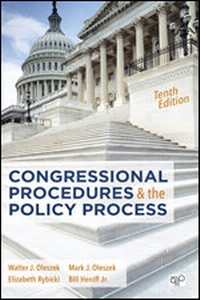
Congressional Procedures and the Policy Process
10th Edition
Published on 15. December 2015
Book
Paperback/Softback
504 pages
978-1-5063-0430-4 (ISBN)
Description
This book reveals how the majority and minority parties use procedural devices to achieve their political goals and offers an assessment of the role of conference committees in reconciling bicameral differences. Not shying away from the complexity of the topic, Oleszek and new co-authors Mark Oleszek, Elizabeth Rybicki, and William Heniff ensure that the machinations of Congress are understandable through an array of interesting examples, topical cases, and anecdotes that they are well-positioned to witness and experience first-hand.
Reviews / Votes
"Oleszek's book is wonderful! It works its way systematically through all the issues that need to be covered in a comprehensive study of Congress; it touches on much of the literature that we go on to read in full and thus shows how all the literature on Congress works together; it is utterly non-partisan (which is crucial); and it demonstrates a love of Congress and a respect for how the institution has developed over time. Oleszek gives enough history, enough current events, and enough theory for the students to see how all things congressional hang together. This book is the centerpiece of the class, and I'd never give it up!" -- Dianne Rothleder "Walter Oleszek's Congressional Procedures and the Policy Process is the gold standard of books on Congress, providing the ideal backbone to any course on Congress. The book is a must-read for Hill interns and new staff if they want to be effective in their jobs and make a difference. He who knows the rules, rules - and Walter Oleszek knows the rules. The book is fair and evenhanded in addressing controversies in Hill politics and among political scientists. A solid foundation for anyone seeking to understand Congress today. None better."-- William F. Connelly Jr. "Congressional Procedures and the Policy Process is well written, well researched and answers important questions about Congress in an accessible way. The strengths of the text clearly lie in the attention to congressional procedure. The text offers a detailed explanation of difficult concepts like filling the amendment tree and the budget and appropriation process. These sometimes highly technical concepts are explained in comprehensive yet clear terms and usually are accompanied by a visual aid of some sort. The graphics are especially important for the students. The explanation also includes plentiful examples and anecdotes from the process. These anecdotes are particularly illuminating when it comes to understanding how the rules and norms of the House and Senate are put into action by members." -- Jason D. Mycoff
More details
Edition
10th Revised edition
Language
English
Place of publication
Washington
United States
Publishing group
SAGE Publications Inc
Target group
College/higher education
Edition type
Revised edition
Dimensions
Height: 229 mm
Width: 152 mm
Weight
666 gr
ISBN-13
978-1-5063-0430-4 (9781506304304)
Copyright in bibliographic data and cover images is held by Nielsen Book Services Limited or by the publishers or by their respective licensors: all rights reserved.
Schweitzer Classification
Other editions
New editions
Walter J. Oleszek | Mark J. Oleszek | Elizabeth E. Rybicki
Congressional Procedures and the Policy Process
Book
01/2020
11th Edition
CQ Press
€169.36
Shipment within 15-20 days
Previous edition
Walter J. Oleszek
Congressional Procedures and the Policy Process
Book
04/2013
9th Edition
CQ Press
€73.22
Article exhausted; check for reprint
Persons
Walter J. Oleszek is a senior specialist in the legislative process at the Congressional
Research Service. He has served as either a full-time professional staff aide or consultant
to many major House and Senate congressional reorganization efforts beginning
with the passage of the Legislative Reorganization Act of 1970. In 1993, he served as
policy director of the Joint Committee on the Organization of Congress. A former
adjunct faculty member at American University, Oleszek is a frequent lecturer to various
academic, governmental, and business groups. He is the author or co-author of several
books, including Congressional Procedures and the Policy Process, 11th ed. (2020),
and Congress Under Fire: Reform Politics and the Republican Majority, with C. Lawrence
Evans (1997).
Research Service. He has served as either a full-time professional staff aide or consultant
to many major House and Senate congressional reorganization efforts beginning
with the passage of the Legislative Reorganization Act of 1970. In 1993, he served as
policy director of the Joint Committee on the Organization of Congress. A former
adjunct faculty member at American University, Oleszek is a frequent lecturer to various
academic, governmental, and business groups. He is the author or co-author of several
books, including Congressional Procedures and the Policy Process, 11th ed. (2020),
and Congress Under Fire: Reform Politics and the Republican Majority, with C. Lawrence
Evans (1997).
Content
Chapter 1: Congress and Lawmaking
The Constitutional Context
Functions of Rules and Procedures
Rules and Policymaking in Congress
Congressional Decision Making
The House and Senate Compared
Pressures on Members
Chapter 2: The Congressional Budget Process
Authorization-Appropriations Process
Prelude to Budget Reform
Evolution of Statutory Budget Procedures
The Challenge Ahead
Case Study: The Government Shutdown of 2013
Chapter 3: Preliminary Legislative Action
Categories of Legislation
Bill Referral Procedure
Consideration in Committee
The Committee Chair's Role
Committee Hearings
The Markup
Committee Markup Procedures
The Report
Bypassing Committees
Chapter 4: Scheduling Legislation in the House
The House Legislative Calendars
Minor and Noncontroversial Measures
Privileged Legislation
Major Legislation
Promise of Openness by the Majority Party
Legislation Blocked in Committee
Final Scheduling Steps
Chapter 5: House Floor Procedure
Debate
Voting
Consideration of Major Legislation
Final Procedural Steps
Opposition Tactics
Chapter 6: Scheduling Legislation in the Senate
Major Scheduling Considerations
Classifying Measures
Noncontroversial Bills
Major Legislation
Unanimous Consent Agreements
The Track System
Scheduling Procedures Compared
Chapter 7: Senate Floor Procedure
Legislative and Calendar Days
Daily Order of Business
Debate in the Modern Senate
Bills Considered by Unanimous Consent
The Amending Process
The Filibuster
Procedures to Circumvent Committees
Chapter 8: Resolving House-Senate Differences
Procedural Methods for Reaching Agreement
Amendment Exchange Between the Chambers
Preconference Considerations
Conference Committee Process
Presidential Approval or Veto
Case Study: A Procedural Sketch: The Surface Transportation Conference, 2012
Chapter 9: Legislative Oversight
Oversight: An Overview
Techniques of Oversight
Impeachment
Oversight Trends and Incentives
Lack of Consensus on Oversight
Chapter 10: A Dynamic Process
Observations About Lawmaking
The Constitutional Context
Functions of Rules and Procedures
Rules and Policymaking in Congress
Congressional Decision Making
The House and Senate Compared
Pressures on Members
Chapter 2: The Congressional Budget Process
Authorization-Appropriations Process
Prelude to Budget Reform
Evolution of Statutory Budget Procedures
The Challenge Ahead
Case Study: The Government Shutdown of 2013
Chapter 3: Preliminary Legislative Action
Categories of Legislation
Bill Referral Procedure
Consideration in Committee
The Committee Chair's Role
Committee Hearings
The Markup
Committee Markup Procedures
The Report
Bypassing Committees
Chapter 4: Scheduling Legislation in the House
The House Legislative Calendars
Minor and Noncontroversial Measures
Privileged Legislation
Major Legislation
Promise of Openness by the Majority Party
Legislation Blocked in Committee
Final Scheduling Steps
Chapter 5: House Floor Procedure
Debate
Voting
Consideration of Major Legislation
Final Procedural Steps
Opposition Tactics
Chapter 6: Scheduling Legislation in the Senate
Major Scheduling Considerations
Classifying Measures
Noncontroversial Bills
Major Legislation
Unanimous Consent Agreements
The Track System
Scheduling Procedures Compared
Chapter 7: Senate Floor Procedure
Legislative and Calendar Days
Daily Order of Business
Debate in the Modern Senate
Bills Considered by Unanimous Consent
The Amending Process
The Filibuster
Procedures to Circumvent Committees
Chapter 8: Resolving House-Senate Differences
Procedural Methods for Reaching Agreement
Amendment Exchange Between the Chambers
Preconference Considerations
Conference Committee Process
Presidential Approval or Veto
Case Study: A Procedural Sketch: The Surface Transportation Conference, 2012
Chapter 9: Legislative Oversight
Oversight: An Overview
Techniques of Oversight
Impeachment
Oversight Trends and Incentives
Lack of Consensus on Oversight
Chapter 10: A Dynamic Process
Observations About Lawmaking