

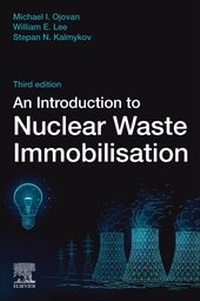
An Introduction to Nuclear Waste Immobilisation
3rd Edition
Published on 5. April 2019
Book
Paperback/Softback
512 pages
978-0-08-102702-8 (ISBN)
Description
An Introduction to Nuclear Waste Immobilisation, Third Edition examines nuclear waste issues, including natural levels of radionuclides in the environment, the geological disposal of waste-forms, and their long-term behavior. It covers all-important aspects of processing and immobilization, including nuclear decay, regulations, new technologies and methods. The book has been updated to include a discussion of the disposal of nuclear waste from non-energy sources, also adding a chapter on the nuclear fuel cycle. Significant focus is given to the analysis of the various matrices used, especially cement and glass, with further discussion of other matrices, such as bitumen.
The book's final chapter concentrates on the performance assessment of immobilizing materials and safety of disposal, providing a full range of resources needed to understand and correctly immobilize nuclear waste.
The book's final chapter concentrates on the performance assessment of immobilizing materials and safety of disposal, providing a full range of resources needed to understand and correctly immobilize nuclear waste.
More details
Edition
3rd edition
Language
English
Place of publication
London
United Kingdom
Publishing group
Elsevier Health Sciences
Target group
College/higher education
Dimensions
Height: 229 mm
Width: 152 mm
Weight
820 gr
ISBN-13
978-0-08-102702-8 (9780081027028)
Copyright in bibliographic data and cover images is held by Nielsen Book Services Limited or by the publishers or by their respective licensors: all rights reserved.
Schweitzer Classification
Other editions
Additional editions
Michael I. Ojovan | WIlliam E. Lee | Stepan N. Kalmykov
An Introduction to Nuclear Waste Immobilisation
E-Book
04/2019
3rd Edition
Elsevier
€200.00
Available for download
Previous edition
Michael I. Ojovan | WIlliam E. Lee
An Introduction to Nuclear Waste Immobilisation
Book
10/2018
2nd Edition
Elsevier
€193.45
The article will not be published
Persons
Michael I. Ojovan has been Nuclear Engineer of International Atomic Energy Agency (IAEA), visiting Professor of Imperial College London, Associate Reader in Materials Science and Waste Immobilisation of the University of Sheffield, UK, and Leading Scientist of Radiochemistry Department of Lomonosov Moscow State University. M. Ojovan is Editorial Board Member of scientific journals: "Materials Degradation? (Nature Partner Journal), "International Journal of Corrosion?, "Science and Technology of Nuclear Installations?, "Journal of Nuclear Materials?, and Associate Editor of journal "Innovations in Corrosion and Materials Science?. He has published 12 monographs including the "Handbook of Advanced Radioactive Waste Conditioning Technologies? by Woodhead and three editions of "An Introduction to Nuclear Waste Immobilisation? by Elsevier - 2005, 2013 and 2019. He has founded and led the IAEA International Predisposal Network (IPN) and the IAEA International Project on Irradiated Graphite Processing (GRAPA). M. Ojovan is known for the connectivity-percolation theory of glass transition, Sheffield model (two-exponential equation) of viscosity of glasses and melts, condensed Rydberg matter, metallic and glass-composite materials for nuclear waste immobilisation, and self-sinking capsules to investigate Earth' deep interior. Professor Lee has been Co-Director of the Institute of Security Science and Technology (ISST), Chair in Ceramic Science and Engineering, and President of the American Ceramic Society. Previous positions at Imperial include Director of the Centre for Nuclear Engineering, Director of the Centre for Doctoral Training in Nuclear Energy (with Cambridge and The Open Universities), and Director of the Centre for Advanced Structural Ceramics. He is a member of the Government advisory committee The Nuclear Innovation and Research Advisory Board (NIRAB), the Leverhulme Trust Panel of Advisors, the Royal Academy of Engineering International Activities Committee, and the Scientific and Environmental Advisory Board Tokamak Energy Ltd. He was from Jan 2006 to Sept 2010 Head of the Department of Materials. Bill was Deputy Chair of the Government advisory Committee on Radioactive Waste Management (CoRWM) from 2007-2013, has acted as special advisor nuclear to the House of Lords Science and Technology Committee (2013) and is an IAEA Technical Expert. Stepan N. Kalmykov has been Head of Radiochemistry Department and Deputy Dean of Faculty of Chemistry of Lomonosov Moscow State University. He has been known as an expert in radiochemistry and especially in environmental chemistry of actinides and fission products, radionuclide speciation, rare and radioactive metals separation and radiopharmaceutical chemistry. Stepan Kalmykov is the member of the advisory committee of "Radiochimica Acta?. He has published more than 120 research papers and several monographs, including "Actinide nanoparticle research?. Springer. 2011, 440 p. ISBN 978-3-642-11431-1. Stepan Kalmykov was an invited lecturer at several large international conferences including "Actinides? and "Migration
Content
1. Intro2. Nuclear Decay3. Contaminants4. NORM5. Background6. Power NE use7. Non-power NE8. Regulation9. Principles10. Sources11. Short Lived12. Long13. Processing schemes14. Characterization15. Pretreatment16. Treatment17. Cement18. Bitumen19. Glass20. Ceramics21. Transport and Storage22. Disposal23. Performance24. Safety25. Conclusion