

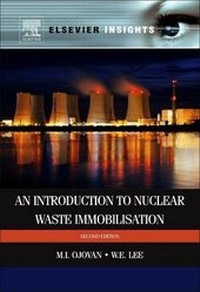
An Introduction to Nuclear Waste Immobilisation
2nd Edition
Published on 30. October 2018
Book
Paperback/Softback
376 pages
978-0-08-101363-2 (ISBN)
Description
Drawing on the authors' extensive experience in the processing and disposal of waste, An Introduction to Nuclear Waste Immobilisation, Second Edition examines the gamut of nuclear waste issues from the natural level of radionuclides in the environment to geological disposal of waste-forms and their long-term behavior. It covers all-important aspects of processing and immobilization, including nuclear decay, regulations, new technologies and methods. Significant focus is given to the analysis of the various matrices used, especially cement and glass, with further discussion of other matrices such as bitumen. The final chapter concentrates on the performance assessment of immobilizing materials and safety of disposal, providing a full range of the resources needed to understand and correctly immobilize nuclear waste.
Reviews / Votes
"The second edition of this book is a great opportunity to learn about the state-of-the-art of radioactive waste management, both from a scientific and a technical perspective. The book is made up of 21 short, clear, nicely-illustrated chapters covering most aspects of the problem...authors are well-known scientists with broad international experience..." --MaterialsToday.com, March 2014From first edition:
"The book is intended as an introductory text for postgraduate students and researchers in the field. In addition, it serves as an excellent source of knowledge for undergraduates (in physics, chemistry, geology, materials etc.) who require general information on nuclear waste and its immobilisation." --Dr. John Fernie, MATERIALS WORLD, May 2007
More details
Edition
2nd edition
Language
English
Place of publication
London
United Kingdom
Publishing group
Elsevier Health Sciences
Target group
College/higher education
Materials, environmental and energy scientists and researchers. Anyone researching or developing materials for nuclear waste immobilization.
Dimensions
Height: 229 mm
Width: 152 mm
ISBN-13
978-0-08-101363-2 (9780081013632)
Copyright in bibliographic data and cover images is held by Nielsen Book Services Limited or by the publishers or by their respective licensors: all rights reserved.
Schweitzer Classification
Other editions
New editions
Michael I. Ojovan | WIlliam E. Lee | Stepan N. Kalmykov
An Introduction to Nuclear Waste Immobilisation
Book
04/2019
3rd Edition
Elsevier
€216.65
Shipment within 15-20 days
Additional editions
Michael I. Ojovan | WIlliam E. Lee
An Introduction to Nuclear Waste Immobilisation
Book
12/2013
2nd Edition
Elsevier
€173.32
Article exhausted; check for reprint
Persons
Michael I. Ojovan has been Nuclear Engineer of International Atomic Energy Agency (IAEA), visiting Professor of Imperial College London, Associate Reader in Materials Science and Waste Immobilisation of the University of Sheffield, UK, and Leading Scientist of Radiochemistry Department of Lomonosov Moscow State University. M. Ojovan is Editorial Board Member of scientific journals: "Materials Degradation? (Nature Partner Journal), "International Journal of Corrosion?, "Science and Technology of Nuclear Installations?, "Journal of Nuclear Materials?, and Associate Editor of journal "Innovations in Corrosion and Materials Science?. He has published 12 monographs including the "Handbook of Advanced Radioactive Waste Conditioning Technologies? by Woodhead and three editions of "An Introduction to Nuclear Waste Immobilisation? by Elsevier - 2005, 2013 and 2019. He has founded and led the IAEA International Predisposal Network (IPN) and the IAEA International Project on Irradiated Graphite Processing (GRAPA). M. Ojovan is known for the connectivity-percolation theory of glass transition, Sheffield model (two-exponential equation) of viscosity of glasses and melts, condensed Rydberg matter, metallic and glass-composite materials for nuclear waste immobilisation, and self-sinking capsules to investigate Earth' deep interior. Professor Lee has been Co-Director of the Institute of Security Science and Technology (ISST), Chair in Ceramic Science and Engineering, and President of the American Ceramic Society. Previous positions at Imperial include Director of the Centre for Nuclear Engineering, Director of the Centre for Doctoral Training in Nuclear Energy (with Cambridge and The Open Universities), and Director of the Centre for Advanced Structural Ceramics. He is a member of the Government advisory committee The Nuclear Innovation and Research Advisory Board (NIRAB), the Leverhulme Trust Panel of Advisors, the Royal Academy of Engineering International Activities Committee, and the Scientific and Environmental Advisory Board Tokamak Energy Ltd. He was from Jan 2006 to Sept 2010 Head of the Department of Materials. Bill was Deputy Chair of the Government advisory Committee on Radioactive Waste Management (CoRWM) from 2007-2013, has acted as special advisor nuclear to the House of Lords Science and Technology Committee (2013) and is an IAEA Technical Expert.
Content
1. Introduction to immobilisation
2. Nuclear decay
3. Contaminants and hazards
4. Heavy metals
5. Naturally occurring radionuclides
6. Background radiation
7. Nuclear waste regulations
8. Principles of nuclear waste management
9. Sources and characteristics of nuclear waste
10. Short-lived waste radionuclides
11. Long-lived waste radionuclides
12. Management and characterisation of radioactive waste
13. Pre-treatment of radioactive wastes
14. Treatment of radioactive wastes
15. Immobilisation of radioactive wastes in cement
16. Immobilisation of radioactive wastes in bitumen
17. Immobilisation of radioactive wastes in glass
18. New immobilising hosts and technologies
19. Nuclear waste disposal
20. Performance assessment
2. Nuclear decay
3. Contaminants and hazards
4. Heavy metals
5. Naturally occurring radionuclides
6. Background radiation
7. Nuclear waste regulations
8. Principles of nuclear waste management
9. Sources and characteristics of nuclear waste
10. Short-lived waste radionuclides
11. Long-lived waste radionuclides
12. Management and characterisation of radioactive waste
13. Pre-treatment of radioactive wastes
14. Treatment of radioactive wastes
15. Immobilisation of radioactive wastes in cement
16. Immobilisation of radioactive wastes in bitumen
17. Immobilisation of radioactive wastes in glass
18. New immobilising hosts and technologies
19. Nuclear waste disposal
20. Performance assessment