

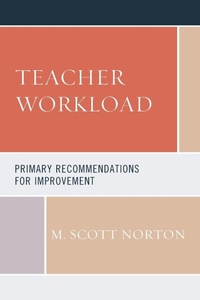
Teacher Workload
Primary Recommendations for Improvement
Published on 12. December 2021
Book
Paperback/Softback
104 pages
978-1-4758-6120-4 (ISBN)
Description
The book opens by underscoring the importance of teacher workload in education and its history of problems related to inequality of work assignments and its effect on student learning. Other chapters give special attention to how workload has been allocated historically. Best practices regarding teacher workload assignments are detailed in relation to best student learning outcomes. How to measure teacher workload and make necessary load adjustments are set forth in various strategies and innovative programming.
Reviews / Votes
Teacher Workload by M. Scott Norton, a former superintendent and professor emeritus at Arizona State University, would be a great college textbook for aspiring superintendents or an informative read for a data-driven human resources professional. The book is quite well-researched, and I enjoyed the historical look at teacher workload and the early work of education pioneers who created mathematical formulas for calculating teacher workload... Aspiring superintendents and human resource professionals will find the book fascinating as they add background and tools to their belt. * School Administrator * Norton's research on and discussion of the workload of today's teachers addresses the most challenging issue facing teachers charged with the responsibility of educating our youth both today as well as in the years to come. His discussion of the many aspects of teacher workload give the reader-educator as well as layman-incredible insight into the complexity of the daily responsibilities and workload of teachers at all levels of education-particularly in primary, elementary and secondary schools. Specifically, the attention he gives to teacher activities, responsibilities and assignments as well as their impact on teacher selection, retention and turnover enables the reader to more clearly comprehend and understand the magnitude of teacher workload. It will prompt the reader to give more specific and direct attention to ensuring an equitable workload for all teachers. Readers who desire to ensure the best possible preparation of our youth of today to serve our citizens of tomorrow will want to read Teacher Workload. -- Larry K. Kelly, Ed.D., author, educator, international consultantMore details
Language
English
Place of publication
United States
Publishing group
Bloomsbury Publishing Plc
Target group
Professional and scholarly
Illustrations
8 tables; 2 textboxes
Dimensions
Height: 229 mm
Width: 152 mm
Thickness: 6 mm
Weight
167 gr
ISBN-13
978-1-4758-6120-4 (9781475861204)
Copyright in bibliographic data and cover images is held by Nielsen Book Services Limited or by the publishers or by their respective licensors: all rights reserved.
Schweitzer Classification
Other editions
Additional editions
E-Book
12/2021
1st Edition
Rowman & Littlefield Publishers
€24.49
Available for download
E-Book
12/2021
1st Edition
Bloomsbury eBooks US
€24.49
Available for download
Person
M. Scott Norton has served as a secondary school teacher of mathematics, coordinator of curriculum for the Lincoln, Nebraska School District, assistant superintendent for instruction, and superintendent of schools in Salina, Kansas, before joining the University of Nebraska as professor and Vice-Chair of the Department of Educational Administration and Supervision. Later he served as Professor and Chair of the Department of Educational Administration and Policy Studies at Arizona State University where he is currently professor emeritus.
Content
Chapter One: The Factors, Conditions and Activities That Constitute a Teacher's Workload
Chapter Two: Calculating and Assessing the Workload of Teacher Personnel
Chapter Three: School Climate and Its Influence on Teacher Workload
Chapter 4: The Primary Recommendations for Improving Teacher Workload
Chapter Two: Calculating and Assessing the Workload of Teacher Personnel
Chapter Three: School Climate and Its Influence on Teacher Workload
Chapter 4: The Primary Recommendations for Improving Teacher Workload