

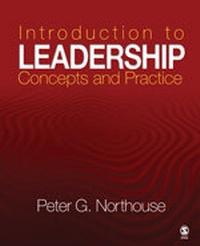
Introduction to Leadership
Concepts and Practice
1st Edition
Published on 14. January 2009
Book
Paperback/Softback
224 pages
978-1-4129-1655-4 (ISBN)
Description
A practical, applied introduction to the art of leadership Offering a straightforward introduction to the basic principles of leadership, Peter G. NorthouseAEs Introduction to Leadership: Concepts and Practice focuses on providing readers with practical strategies for becoming better leaders. An applied text by the author of the SAGE best-seller Leadership: Theory and Practice, Fourth Edition, this new text provides the much needed ohow-tooe component of leading for students in leadership courses. Three interactive components in every chapteruself-assessment questionnaires, observational exercises, and reflection and action worksheetsuget readers actively involved in applying leadership concepts to their own lives. Grounded in leadership theory, yet accessible and reader-friendly, this book covers a fundamental aspect of leadership in each chapter and illustrates its application in real leadership situations. A final chapter discusses the key topic of ethics in leadership. Key Features Looks at one quality of leadership per chapter, making it easier for readers to understand and apply material to their own lives Uses examples and case studies to illustrate each fundamental aspect of leadership (creating a vision, listening to out-group members, and overcoming obstacles, for example) Encourages readers to complete a Self-Assessment Questionnaire before reading each chapter to explore their own leadership styles and preferences Guides readers in examining behaviors of leaders from their own lives through each chapterAEs Observational Exercise Includes Reflection and Action Worksheets that encourage readers to reflect upon their own leadership styles and identify an action plan for improving their leadership skills Instructor Resources on CD, including PowerPoint slides, a test bank, writing assignments, and chapter reviews, are available to qualified instructors by contacting SAGE Customer Care at 1-800-818-SAGE (7243) between 6 a.m. and 5 p.m. PST. Introduction to Leadership: Concepts and Practice is intended as a primary text for leadership courses in departments of business, communication, education, public administration, or other departments. It can also be used in student activities, continuing education, corporate training, executive development, in-service training, and government or military training programs.oAn outstanding introductory text for new leaders! Northouse combines self-knowledge with essential competencies that every effective leader should possess.oe uBarry L. Boyd, Texas A&BAD:amp;M University oFor four editions and more than a decade, its concise, intelligent, insightful introduction to the study of leadership has made oNorthouseoe [Leadership: Theory and Practice, Fourth Edition, SAGE, (c)2007] the go-to text for students and teachers. With this book, Peter Northouse has done the same for the practice of leadership.oe uRichard A. Couto, Antioch University, Senior Scholar, Burns Academy, Reflections on Leadership (ed.) oI have followed Peter Northouse's work for years. He has written another excellent book, this time a perfect introductory book for the new student of leadership.oe uCarl Larson, University of Denver
Reviews / Votes
"I found Northouse's style of writing to be unambiguous, complex but wonderfully understandable. His writing style stoked the fires of my imagination regarding my own approach to leadership. It also made complex concepts in leadership understandable without sullying the integrity of the academic discipline of leadership or leadership praxis. The content of the book flows seamlessly and logically. Northouse's book gets a strong recommendation from this reviewer. Introduction to Leadership: Concepts and Practices demonstrates Northouse's depth and breadth of experience as an academician and consultant. He is patently passionate about communicating not only the essence of leadership but the manner in which thoughtful leadership can transform people, communities, and organizations." -- Journal of Leadership Studies "I have followed Peter Northouse's work for years. He has written another excellent book, this time a perfect introductory book for the new student of leadership."-- Carl Larson "In Northouse's most recent publication, Introduction to Leadership: Concepts and Practices, he continues his impressive ability to render leadership theories and concepts extremely accessible. Despite the fact that this book is much lighter on theory than Northouse's previous work, it is nonetheless better than most resources I have used in the past in addressing the personal and organizational implications of leadership in a matter-of-fact, nuts-and bolts manner. The content of the book flows seamlessly and logically. Northouse's book gets a strong recommendation from this reviewer. He is patently passionate about communicating not only the essence of leadership but the manner in which thoughtful leadership can transform people, communities, and organizations. In this latest publication, he has done exactly that." -- Jeffrey D. Yergler "This textbook is a very useful introduction to the fundamental concepts and practices of leadership. The background theoretical inputs are short, snappy and relevant and designed to engage and inspire students towards further study...The interactive features are definitely the distinguishing factor of this textbook and allow readers to apply theoretical concepts to practice. With its use of questionnaires, reflective analyses, action planning worksheets and observational exercises, the textbook provides a valuable mechanism for transferring knowledge into practice." -- David McGuire * Journal of European Industrial Training * "For four editions and more than a decade, its concise, intelligent, insightful introduction to the study of leadership has made "Northouse" [Leadership: Theory and Practice, Fourth Edition, SAGE, (c)2007] the go-to text for students and teachers. With this book, Peter Northouse has done the same for the practice of leadership." -- Richard A. Couto "The theoretical concepts are brought to life through the readings and there's more"how to" info to actually become a better leader as opposed to just studying the theories, all of which have many, many gaps anyway. Moreover, with only 10 chapters and a CLU 11 week term, the flow of the book makes it easy to cover 1 chapter per week (no cramming)." -- Karen Hanen "I have been looking for a good intro to Leadership [book] with class exercises-this is it!" -- Richard Bell "This text is critical, concise, theory based, and engages students with activities." -- Lauren Williams "Peter Northouse's Introduction to Leadership is an excellent text that I have used for freshman/sophomore levels classes. It contains most of the major topics from his more comprehensive Leadership: Theory and Practice but omits much of the more academic content that we love but freshman don't. It also has 3 excellent activities at the end of each chapter for self-reflection/ application on each topic, with abbreviated versions of many typical leadership assessments." -- Frank Markow
More details
Language
English
Place of publication
Thousand Oaks
United States
Target group
College/higher education
Dimensions
Height: 232 mm
Width: 187 mm
Weight
369 gr
ISBN-13
978-1-4129-1655-4 (9781412916554)
Copyright in bibliographic data and cover images is held by Nielsen Book Services Limited or by the publishers or by their respective licensors: all rights reserved.
Schweitzer Classification
Other editions
New editions
Book
05/2011
2nd Edition
SAGE Publications Inc
€68.27
Article exhausted; check different version
Additional editions
Book
05/2009
1st Edition
SAGE Publications Inc
€95.52
Article exhausted; check different version
Person
Peter G. Northouse, PhD, is Professor Emeritus of Communication in the School of Communication at Western Michigan University. Leadership: Theory and Practice is the best-selling academic textbook on leadership in the world and has been translated into 15 languages. In addition to authoring publications in professional journals, he is the author of Introduction to Leadership: Concepts and Practice (now in its sixth edition) and co-author of Leadership Case Studies in Education (now in its fourth edition) and Health Communication: Strategies for Health Professionals (now in its third edition). His scholarly and curricular interests include models of leadership, leadership assessment, ethical leadership, and leadership and group dynamics. For more than 40 years, he has taught courses in leadership, interpersonal communication, and organizational communication on both the undergraduate and graduate levels. Currently, he is a consultant and lecturer on trends in leadership research, leadership development, and leadership education. He holds a doctorate in speech communication from the University of Denver, and master's and bachelor's degrees in communication education from Michigan State University.
Content
Preface
1. Being a Leader
Defining Leadership
Global Leadership Attributes
Practicing Leadership
Summary
References
1.1 Conceptualizing Leadership Questionnaire
1.2 Observational Exercise
1.3 Reflection and Action Worksheet
2. Recognizing Your Traits
Historical Leaders: What Traits Do These Leaders Display?
Leadership Studies: What Traits Do Effective Leaders Exhibit?
Summary
References
2.1 Leadership Traits Questionnaire
2.2 Observational Exercise
2.3 Reflection and Action Worksheet
3. Recognizing Your Philosophy and Style of Leadership
What Is Your View of Human Behavior at Work
Styles of Leadership: Authoritarian, Democratic, and Laissez-Faire
What Is Your Style of Leadership?
Summary
References
3.1 Leadership Styles Questionnaire
3.2 Observational Exercise
3.3 Reflection and Action Worksheet
4. Attending to Tasks and Relationships
What Is Your Personal Style?
What Kind of Leader Are You?
Summary
References
4.1 Task and Relationship Questionnaire
4.2 Observational Exercise
4.3 Reflection and Action Worksheet
5. Developing Leadership Skills
What Are Your Core Leadership Skills?
Summary
References
5.1 Leadership Skills Questionnaire
5.2 Observational Exercise
5.3 Reflection and Action Worksheet
6. Creating a Vision
What Are the Characteristics of a Vision?
How Is a Vision Articulated?
How Is a Vision Implemented?
Summary
References
6.1 Leadership Vision Questionnaire
6.2 Observational Exercise
6.3 Reflection and Action Worksheet
7. Setting the Tone
Provide Structure
Clarify Norms
Build Cohesiveness
Promote Standards of Excellence
Summary
References
7.1 Setting the Tone Questionnaire
7.2 Observational Exercise
7.3 Reflection and Action Worksheet
8. Listening to Out-Group Members
Who Is in the Out-Group?
Why Do Out-Groups Form?
What Is the Impact of Out-Groups?
How Should a Leader Respond to Out-Groups?
Summary
References
8.1 Responding to Members of the Out-Group Questionnaire
8.2 Observational Exercise
8.3 Reflection and Action Worksheet
9. Overcoming Obstacles
Obstacle 1: Unclear Goals
Obstacle 2: Unclear Directions
Obstacle 3: Low Motivation
Obstacle 4: Complex Tasks
Obstacle 5: Simple Tasks
Obstacle 6: Low Involvement
Obstacle 7: Lack of a Challenge
Summary
References
9.1 Path-Goal Styles Questionnaire
9.2 Observational Exercise
9.3 Reflection and Action Worksheet
10. Addressing Ethics in Leadership
Ethical Leadership Is About
Ethical Leadership Is About the Character of the Leader
Ethical Leadership Is About the Actions of the Leader
Ethical Leadership Is About the Goals of the Leader
Ethical Leadership Is About the Honesty of the Leader
Ethical Leadership Is About the Power of the Leader
Ethical Leadership Is About the Values of the Leader
Summary
References
10.1 Core Values Questionnaire
10.2 Observational Exercise
10.3 Reflection and Action Worksheet
1. Being a Leader
Defining Leadership
Global Leadership Attributes
Practicing Leadership
Summary
References
1.1 Conceptualizing Leadership Questionnaire
1.2 Observational Exercise
1.3 Reflection and Action Worksheet
2. Recognizing Your Traits
Historical Leaders: What Traits Do These Leaders Display?
Leadership Studies: What Traits Do Effective Leaders Exhibit?
Summary
References
2.1 Leadership Traits Questionnaire
2.2 Observational Exercise
2.3 Reflection and Action Worksheet
3. Recognizing Your Philosophy and Style of Leadership
What Is Your View of Human Behavior at Work
Styles of Leadership: Authoritarian, Democratic, and Laissez-Faire
What Is Your Style of Leadership?
Summary
References
3.1 Leadership Styles Questionnaire
3.2 Observational Exercise
3.3 Reflection and Action Worksheet
4. Attending to Tasks and Relationships
What Is Your Personal Style?
What Kind of Leader Are You?
Summary
References
4.1 Task and Relationship Questionnaire
4.2 Observational Exercise
4.3 Reflection and Action Worksheet
5. Developing Leadership Skills
What Are Your Core Leadership Skills?
Summary
References
5.1 Leadership Skills Questionnaire
5.2 Observational Exercise
5.3 Reflection and Action Worksheet
6. Creating a Vision
What Are the Characteristics of a Vision?
How Is a Vision Articulated?
How Is a Vision Implemented?
Summary
References
6.1 Leadership Vision Questionnaire
6.2 Observational Exercise
6.3 Reflection and Action Worksheet
7. Setting the Tone
Provide Structure
Clarify Norms
Build Cohesiveness
Promote Standards of Excellence
Summary
References
7.1 Setting the Tone Questionnaire
7.2 Observational Exercise
7.3 Reflection and Action Worksheet
8. Listening to Out-Group Members
Who Is in the Out-Group?
Why Do Out-Groups Form?
What Is the Impact of Out-Groups?
How Should a Leader Respond to Out-Groups?
Summary
References
8.1 Responding to Members of the Out-Group Questionnaire
8.2 Observational Exercise
8.3 Reflection and Action Worksheet
9. Overcoming Obstacles
Obstacle 1: Unclear Goals
Obstacle 2: Unclear Directions
Obstacle 3: Low Motivation
Obstacle 4: Complex Tasks
Obstacle 5: Simple Tasks
Obstacle 6: Low Involvement
Obstacle 7: Lack of a Challenge
Summary
References
9.1 Path-Goal Styles Questionnaire
9.2 Observational Exercise
9.3 Reflection and Action Worksheet
10. Addressing Ethics in Leadership
Ethical Leadership Is About
Ethical Leadership Is About the Character of the Leader
Ethical Leadership Is About the Actions of the Leader
Ethical Leadership Is About the Goals of the Leader
Ethical Leadership Is About the Honesty of the Leader
Ethical Leadership Is About the Power of the Leader
Ethical Leadership Is About the Values of the Leader
Summary
References
10.1 Core Values Questionnaire
10.2 Observational Exercise
10.3 Reflection and Action Worksheet