

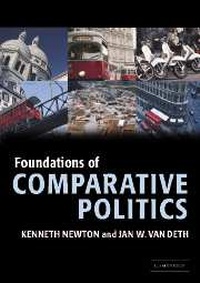
Foundations of Comparative Politics
Published on 1. September 2005
Book
Hardback
402 pages
978-0-521-82931-1 (ISBN)
Description
This authoritative new introductory text covers the key concepts, theories and issues involved in the study of comparative politics. Focusing on democratic government, it covers all important topics in the field from constitutional design and institutions; through mass and elite politics, groups, parties, the media and governments; to policy making and implementation. The final chapter considers the future of the state and democracy in a globalising world. The authors draw on experiences and examples from around the world, and the book includes extensive supporting apparatus for students and teachers, including briefings, fact files, key terms, guides to further reading, and related websites. Each chapter ends with a section dealing with the major theoretical approaches to the subject. The aim is to give students a clear and comprehensive account of democratic politics and government at the start of the twenty first century.
Reviews / Votes
'Foundations of Comparative Politics is both intelligent and accessible. This book has the virtue of compelling students to think through basic choices confronting mature Western democracies in the 21st century. The authors make big ideas accessible by introducing the student to diverse briefings, controversies, and fact files that whet the appetite for active debate. In short, the book is a gem which will make teaching more fun for teachers and more meaningful for students.' Liesbet Hooghe, Vrije Universiteit Amsterdam and University of North Carolina, Chapel Hill 'The authors succeed brilliantly in covering the vast and complex field of comparative politics in a highly efficient and to-the-point manner - and with maximum accessibility for students who are new to the field. This is an ideal textbook for the 21st century, in which democracy may remain the dominant paradigm but in which the world's democracies face many grave challenges to their well-being and even survival, such as ethnic and religious conflict and the forces of globalization.' Arend Lijphart, University of California, San Diego 'This text would be useful for instructors who are teaching an introductory class on developed democracy comparative politics, or who are willing to supplement the text with additional material for less institutionalized democracies and non democracies.' Journal of Political Science Education 'I think this book is ideal for teaching and represents a better alternative than many textbooks in comparative politics. I strongly recommend its usage, either for second or even first-year students.' Political Studies ReviewMore details
Series
Language
English
Place of publication
Cambridge
United Kingdom
Target group
College/higher education
Professional and scholarly
Illustrations
16 Tables, unspecified
Dimensions
Height: 255 mm
Width: 180 mm
Thickness: 36 mm
Weight
950 gr
ISBN-13
978-0-521-82931-1 (9780521829311)
Copyright in bibliographic data and cover images is held by Nielsen Book Services Limited or by the publishers or by their respective licensors: all rights reserved.
Schweitzer Classification
Other editions
New editions
Kenneth Newton | Jan W. Van Deth
Foundations of Comparative Politics
Book
12/2009
2nd Edition
Cambridge University Press
€99.03
Article exhausted; check for reprint
Additional editions
Ken Newton | Jan W. Van Deth
Foundations of Comparative Politics
E-Book
05/2006
Cambridge University Press
€26.49
Available for download
Persons
Ken Newton is Professor of Comparative Politics at the University of Southampton. He previously taught at the University of Essex, and was Director of the European Consortium for Political Research. Among his publications is the successful textbook The New British Politics (Longman). Jan W. van Deth is Professor of Political Science and International Comparative Social Research at the University of Mannheim, Germany. His main research areas are political culture (especially social capital and citizenship), social change, and comparative research methods.
Content
Part I. The State: Origins and Development: 1. The development of the modern state; 2. The democratic state; Part II. The Polity: Structures and Institutions: 3. Constitutions; 4. Presidential and parliamentary government; 5. Multi-level government: international, national and sub-national; 6. Policy-making and legislating: executives and legislatures; 7. Implementation: the public bureaucracy; Part III. Citizens, Elites, and Interest Mediation: 8. Political attitudes and behaviour; 9. Pressure groups and social movements; 10. The mass media; 11. Voters and elections; 12. Parties and governments; Part IV. Policies and Performances: 13. Political ideologies: conservatism, liberalism, Christian democracy and socialism; 14. Decision-making; 15. Defence and security; 16. Welfare; 17. The future of the democratic state.