

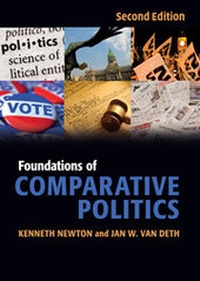
Foundations of Comparative Politics
2nd Edition
Published in December 2009
Book
Hardback
472 pages
978-0-521-19988-9 (ISBN)
Description
This student-friendly introduction to the key theories and concepts of comparative politics now provides even broader coverage of the world's democracies, with examples drawn from across the globe. Foundations of Comparative Politics contains a wealth of information, clearly structured and easy to read, with clear definition of Key Terms. It covers all the important themes in the field, including constitutional design and institutions; mass and elite politics; policy-making and implementation; and the future of the state and democracy in a globalising world. A new chapter on studying comparative politics, and new 'What Have We Learned?' and 'Lessons of Comparison' summary sections help students pull together the lessons of each chapter. Combining facts and theory throughout, debate is stimulated through the use of Controversy boxes, and Fact Files and Briefings give students interesting data that illustrates the key issues in the text. Online resources, including MCQs and Powerpoint slides, complete the package.
Reviews / Votes
'Thanks to new chapters on the purpose and method of making comparisons plus a separate chapter on democratization, this revised edition is even more comprehensive than the last.' Matthijs Bogaards, Jacobs University Bremen '... both intelligent and accessible ... this book has the virtue of compelling students to think through basic choices confronting mature Western democracies in the 21st century. The authors make big ideas accessible by introducing the student to diverse briefings, controversies, and fact files that whet the appetite for active debate. In short, the book is a gem which will make teaching more fun for teachers and more meaningful for students.' Liesbet Hooghe, Vrije Universiteit Amsterdam and University of North Carolina, Chapel Hill '... an ideal textbook for the 21st century, in which democracy may remain the dominant paradigm but in which the world's democracies face many grave challenges to their well-being and even survival.' Arend Lijphart, University of California, San DiegoMore details
Series
Edition
2nd Revised edition
Language
English
Place of publication
Cambridge
United Kingdom
Target group
College/higher education
Professional and scholarly
Edition type
Revised edition
Illustrations
16 Tables, unspecified; 1 Maps
Dimensions
Height: 255 mm
Width: 182 mm
Thickness: 28 mm
Weight
1050 gr
ISBN-13
978-0-521-19988-9 (9780521199889)
Copyright in bibliographic data and cover images is held by Nielsen Book Services Limited or by the publishers or by their respective licensors: all rights reserved.
Schweitzer Classification
Other editions
New editions
Book
05/2016
3rd Edition
Cambridge University Press
€101.51
Article exhausted; check for reprint
Additional editions
Kenneth Newton | Jan W. Van Deth
Foundations of Comparative Politics
E-Book
06/2010
2nd Edition
Cambridge University Press
€33.99
Available for download
Kenneth Newton
Foundations of Comparative Politics
E-Book
12/2009
Cambridge University Press
€27.99
Available for download
Previous edition
Ken Newton | Jan W. Van Deth
Foundations of Comparative Politics
Book
09/2005
Cambridge University Press
€65.61
Article exhausted; check for reprint
Persons
Kenneth Newton is Emeritus Professor of Comparative Politics at the University of Southampton and Visiting Professor at the WZB, Berlin. Jan W. van Deth is Professor of Political Science and International Comparative Social Research at the University of Mannheim.
Content
Introduction: why comparative politics?; Part I. The State: Origins and Development: 1. The development of the modern state; 2. States and democracy; 3. Democratic change and persistence; Part II. The Polity: Structures and Institutions: 4. Constitutions; 5. Presidential and parliamentary government; 6. Multi-level government: international, national and sub-national; 7. Policy making and legislating: executives and legislatures; 8. Implementation: the public bureaucracy; Part III. Citizens, Elites and Interest Mediation: 9. Political attitudes and behaviour; 10. Pressure groups and social movements; 11. The mass media; 12. Voters and elections; 13. Party government; Part IV. Policies and Performance: 14. Political ideologies: conservatism, liberalism, Christian democracy and socialism; 15. Decision making; 16. Defence and security; 17. Welfare; 18. The future of the democratic state; Postscript: how and what to compare.