

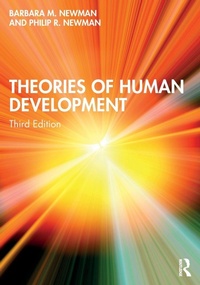
Theories of Human Development
3rd Edition
Published on 29. July 2022
Book
Paperback/Softback
568 pages
978-0-367-85689-2 (ISBN)
Description
This bestselling textbook provides an engaging introduction to 11 major theories about human development that continue to guide research, intervention, and practice. The theories are grouped into three families: those that emphasize biological systems, those that focus on environmental factors, and those that reflect the interaction between the two. This organization encourages readers to evaluate, compare, and contrast key theoretical ideas both within and across families. Pedagogical features foster critical thinking and an active approach to learning.
Each family of theories is introduced with a brief overview of their unique perspectives and the rationale for grouping them together. Discussion of each theory includes the cultural/historical context within which the theory developed, key concepts and ideas, extensions of the theory in new directions, a research example, an illustration of how the theory is applied in contemporary practice, and an analysis of how the theory answers six basic questions that a theory of human development should address. Each chapter begins with a case example and related application. There is expanded visual material throughout to enhance and extend key concepts.
The third edition also features:
a new chapter, "Social Justice Theory," which addresses definitions of social justice, the development of social justice reasoning, emotional foundations, and behaviors related to activism, with particular focus on societal conditions of privilege and disadvantage that create social inequities and impact developmental outcomes
consideration of social justice themes as they emerge across theories
an increased focus on how theories account for and characterize individual differences, and the value of diversity for human adaptation
a new emphasis on gender and sexual identities across theories
greater attention to the role of culture as it is featured within each theory, as a component of the macro environment, and as it is internalized through socialization processes
a revised epilogue, focusing on implications for family dynamics and links from theory to practice
By focusing on theories that have had a major impact on development science, this book is ideal for advanced undergraduate and graduate courses in theories of development, lifespan, or child development, taught in the fields of psychology, human development, family studies, education, and social work.
Each family of theories is introduced with a brief overview of their unique perspectives and the rationale for grouping them together. Discussion of each theory includes the cultural/historical context within which the theory developed, key concepts and ideas, extensions of the theory in new directions, a research example, an illustration of how the theory is applied in contemporary practice, and an analysis of how the theory answers six basic questions that a theory of human development should address. Each chapter begins with a case example and related application. There is expanded visual material throughout to enhance and extend key concepts.
The third edition also features:
a new chapter, "Social Justice Theory," which addresses definitions of social justice, the development of social justice reasoning, emotional foundations, and behaviors related to activism, with particular focus on societal conditions of privilege and disadvantage that create social inequities and impact developmental outcomes
consideration of social justice themes as they emerge across theories
an increased focus on how theories account for and characterize individual differences, and the value of diversity for human adaptation
a new emphasis on gender and sexual identities across theories
greater attention to the role of culture as it is featured within each theory, as a component of the macro environment, and as it is internalized through socialization processes
a revised epilogue, focusing on implications for family dynamics and links from theory to practice
By focusing on theories that have had a major impact on development science, this book is ideal for advanced undergraduate and graduate courses in theories of development, lifespan, or child development, taught in the fields of psychology, human development, family studies, education, and social work.
More details
Edition
3rd edition
Language
English
Place of publication
London
United Kingdom
Publishing group
Taylor & Francis Ltd
Target group
Professional and scholarly
Professional
Illustrations
40 s/w Abbildungen, 22 s/w Photographien bzw. Rasterbilder, 18 s/w Zeichnungen, 25 s/w Tabellen
25 Tables, black and white; 18 Line drawings, black and white; 22 Halftones, black and white; 40 Illustrations, black and white
Dimensions
Height: 254 mm
Width: 178 mm
Thickness: 31 mm
Weight
1087 gr
ISBN-13
978-0-367-85689-2 (9780367856892)
Copyright in bibliographic data and cover images is held by Nielsen Book Services Limited or by the publishers or by their respective licensors: all rights reserved.
Schweitzer Classification
Other editions
New editions

Barbara M. Newman | Philip R. Newman
Theories of Human Development
Book
approx. 10/2026
4th Edition
Taylor & Francis
€142.50
Not yet published
Additional editions

Barbara M. Newman | Philip R. Newman
Theories of Human Development
Book
07/2022
3rd Edition
Routledge
€295.40
Shipment within 15-20 days
Barbara M. Newman | Philip R. Newman
Theories of Human Development
E-Book
07/2022
3rd Edition
Routledge
€165.99
Available for download
Barbara M. Newman | Philip R. Newman
Theories of Human Development
E-Book
07/2022
3rd Edition
Routledge
€165.99
Available for download
Previous edition
Barbara M. Newman | Philip R. Newman
Theories of Human Development
Book
07/2015
2nd Edition
Psychology Press Ltd
€133.69
Article exhausted; check for reprint
Persons
Barbara M. Newman is Professor Emeritus at the University of Rhode Island in Human Development and Family Science.
Philip R. Newman is Fellow of the American Psychological Association, SPSSI, and the Global Alliance for Behavioral Health and Social Justice (formerly the American Orthopsychiatric Association).
Philip R. Newman is Fellow of the American Psychological Association, SPSSI, and the Global Alliance for Behavioral Health and Social Justice (formerly the American Orthopsychiatric Association).
Content
Preface Acknowledgments 1. Introduction Part I: Theories that Emphasize Biological Factors 2. Evolutionary Theory 3. Psychoanalytic Theory 4. Cognitive Developmental Theory Part II: Theories that Emphasize Environmental Factors 5. Learning Theories 6. Social Role Theory 7. Life-Course Theory 8. Social Justice Theory Part III: Theories that Emphasize the Interaction between the Person and the Environment 9. Psychosocial Theory 10. Cognitive Social-Historical Theory 11. Bioecological Theory 12. Dynamic Systems Theory 13. Epilogue Index