

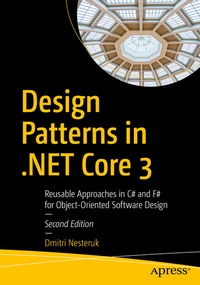
Design Patterns in .NET Core 3
Reusable Approaches in C# and F# for Object-Oriented Software Design
2nd Edition
Published on 5. January 2021
Book
Paperback/Softback
XVII, 372 pages
978-1-4842-6179-8 (ISBN)
Description
Implement design patterns in .NET Core 3 using the latest versions of the C# and F# languages. This book provides a comprehensive overview of the field of design patterns as they are used in today's developer toolbox. This new edition introduces topics such as Functional Builder, Asynchronous Factory Method, Generic Value Adapter, and new Composite Proxies, including one that attempts to solve the SoA/AoS problem.
Using the C# and F# programming languages, Design Patterns in .NET Core 3 explores the classic design pattern implementations and discusses the applicability and relevance of specific language features for implementing patterns. You will learn by example, reviewing scenarios where patterns are applicable. MVP and patterns expert Dmitri Nesteruk demonstrates possible implementations of patterns, discusses alternatives and pattern inter-relationships, and illustrates the way that a dedicated refactoring tool (ReSharper) can be used to implement design patterns with ease.
What You Will Learn
Who This Book Is For
Developers who have some experience in the C# language and want to expand their comprehension of the art of programming by leveraging design approaches to solving modern problems
Using the C# and F# programming languages, Design Patterns in .NET Core 3 explores the classic design pattern implementations and discusses the applicability and relevance of specific language features for implementing patterns. You will learn by example, reviewing scenarios where patterns are applicable. MVP and patterns expert Dmitri Nesteruk demonstrates possible implementations of patterns, discusses alternatives and pattern inter-relationships, and illustrates the way that a dedicated refactoring tool (ReSharper) can be used to implement design patterns with ease.
What You Will Learn
- Become familiar with the latest pattern implementations available in C# 8 and F# 5
- Know how to better reason about software architecture
- Understand the process of refactoring code to patterns
-
Refer to researched and proven variations of patterns
-
Study complete, self-contained examples, including many that cover advanced scenarios
- Use the latest implementations of C# and Visual Studio/Rider/ReSharper
Who This Book Is For
Developers who have some experience in the C# language and want to expand their comprehension of the art of programming by leveraging design approaches to solving modern problems
More details
Edition
2nd ed.
Language
English
Place of publication
CA
United States
Target group
Professional and scholarly
Edition type
Revised edition
Illustrations
10 s/w Abbildungen
XVII, 372 p. 10 illus.
Dimensions
Height: 25.4 cm
Width: 17.8 cm
Weight
743 gr
ISBN-13
978-1-4842-6179-8 (9781484261798)
DOI
10.1007/978-1-4842-6180-4
Schweitzer Classification
Other editions
New editions
Dmitri Nesteruk
Design Patterns in .NET 6
Reusable Approaches in C# and F# for Object-Oriented Software Design
Book
08/2022
3rd Edition
APress
€69.54
Shipment within 15-20 days
Additional editions
Dmitri Nesteruk
Design Patterns in .NET Core 3
Reusable Approaches in C# and F# for Object-Oriented Software Design
E-Book
01/2021
2nd Edition
APress
€46.99
Available for download
Previous edition
Dmitri Nesteruk
Design Patterns in .NET
Reusable Approaches in C# and F# for Object-Oriented Software Design
Book
05/2019
Apress
€35.30
Article exhausted; check for reprint
Person
Dmitri Nesteruk
is a quantitative analyst, developer, course and book author, and an occasional conference speaker. His interests lie in software development and integration practices in the areas of computation, quantitative finance, and algorithmic trading. His technological interests include C# and C++ programming as well as high-performance computing using technologies such as CUDA and FPGAs. He has been a C# MVP from 2009 to 2018.
Content
Part I: Introduction
.- Chapter 1: The SOLID Design Principles Chapter 2: The Functional Perspective
Part II: Creational Patterns
Chapter 3: Builder Chapter 4: Factories Chapter 5: Prototype Chapter 6: Singleton
Part III: Structural Patterns
Chapter 7: Adapter Chapter 8: Bridge Chapter 9: Composite Chapter 10: DecoratorChapter 11: Façade Chapter 12: Flyweight Chapter 13: Proxy
Part IV: Behavioral Patterns
Chapter 14: Chain of Responsibility Chapter 15: Command Chapter 16: Interpreter Chapter 17: Iterator Chapter 18: Mediator Chapter 19: Memento Chapter 20: Null Object Chapter 21: Observer Chapter 22: State Chapter 23: Strategy Chapter 24: Template MethodChapter 25: Visitor