

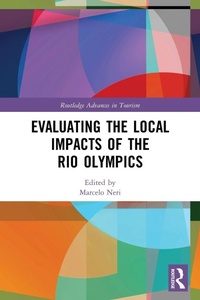
Evaluating the Local Impacts of the Rio Olympics
1st Edition
Published on 1. August 2022
Book
Paperback/Softback
318 pages
978-0-367-51184-5 (ISBN)
Description
This book evaluates the local impacts and legacies of the Olympics in Rio by comparing Rio2016 with other Olympic experiences and evaluating the ways in which the Games served the city.
The 2016 Rio Olympic Games took place in a scenario of enormous economic challenges and persistent inequalities. In contrast to all previous Olympic experiences, Brazil faced its worst economic recession ever recorded during the preparation phase for the Games. In addition to the national crisis, falling oil prices and corruption scandals fuelled the State of Rio's economic downfall. This book specifically assesses the relative social performance of Rio's city population with respect to control groups; covers traditional aspects of the Games' legacy such as tourism, infrastructure and sports practice; includes ordinary day-by-day aspects of the city's life, such as education, employment and housing; and scrutinizes critical areas such as urban mobility, gentrification and Guanabara Bay's pollution.
This thorough analysis offers readers further understanding on assessing the impacts and legacies of the Olympic experience. It will be of great interest to upper-level students and academics of tourism, hospitality and events management.
The 2016 Rio Olympic Games took place in a scenario of enormous economic challenges and persistent inequalities. In contrast to all previous Olympic experiences, Brazil faced its worst economic recession ever recorded during the preparation phase for the Games. In addition to the national crisis, falling oil prices and corruption scandals fuelled the State of Rio's economic downfall. This book specifically assesses the relative social performance of Rio's city population with respect to control groups; covers traditional aspects of the Games' legacy such as tourism, infrastructure and sports practice; includes ordinary day-by-day aspects of the city's life, such as education, employment and housing; and scrutinizes critical areas such as urban mobility, gentrification and Guanabara Bay's pollution.
This thorough analysis offers readers further understanding on assessing the impacts and legacies of the Olympic experience. It will be of great interest to upper-level students and academics of tourism, hospitality and events management.
More details
Series
Language
English
Place of publication
London
United Kingdom
Publishing group
Taylor & Francis Ltd
Target group
College/higher education
Professional and scholarly
Postgraduate
Illustrations
48 s/w Zeichnungen, 30 s/w Tabellen, 48 s/w Abbildungen
30 Tables, black and white; 48 Line drawings, black and white; 48 Illustrations, black and white
Dimensions
Height: 234 mm
Width: 156 mm
Thickness: 17 mm
Weight
488 gr
ISBN-13
978-0-367-51184-5 (9780367511845)
Copyright in bibliographic data and cover images is held by Nielsen Book Services Limited or by the publishers or by their respective licensors: all rights reserved.
Schweitzer Classification
Other editions
Additional editions
Marcelo Neri
Evaluating the Local Impacts of the Rio Olympics
Book
07/2020
1st Edition
Routledge
€206.90
Shipment within 15-20 days
Marcelo Neri
Evaluating the Local Impacts of the Rio Olympics
E-Book
07/2020
1st Edition
Routledge
€59.49
Available for download
Marcelo Neri
Evaluating the Local Impacts of the Rio Olympics
E-Book
07/2020
1st Edition
Routledge
€59.49
Available for download
Person
Marcelo Neri is the director of the Fundacaeo Getulio Vargas (FGV) Social at the Getulio Vargas Foundation. He is the former president of IPEA and minister of Strategic Affairs in Brazil.
Content
Part 1: Setting the Olympic Stage: Global and Local Perspectives 1. Participation Legacy and the Olympic and Paralympic Games 2. An Urbanistic View of Rio2016: Aspiration, planning and legacy 3. Population's Perceptions of the Games. Part 2: Broad View of Imapcts. 4. Olympic Social Changes: Local Transformations before and after Rio2016 5. Population?s Perceptions on Public Policies 6. Fiscal Impact of the Rio Olympics 7. Employment and Wages Evolution of the Core Olympics Economic Sectors 8. Changing Consumption Patterns? Sports Practice, Tourism and Recreation. Part 3: Evaluating Sectoral Legacies. 9. Paralympic City? Assessing Employment Quotas and Disabilities 10. Transport legacy of mega-events and inequalities in access to opportunities in Rio de Janeiro 11. Population's Perceptions on Urban Mobility Impacts 12. Legacy of the Olympic Games for the Guanabara Bay. 13. Rio Slums Removal: what is the Olympic urban legacy? Part 4: Post-Rio2016 Challenges: Olympic Legacy Management. 14. Evidencing the Impacts of the Olympic Games - The view from London 2012. 15. Exchanges of Experiences during the Olympic Cycle 16. Past and Future of Rio City and Main Conclusions on the Games' Impact.