

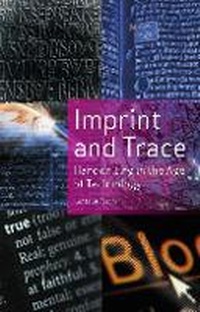
Imprint and Trace
Handwriting in the Age of Technology
Published on 1. June 2010
Book
Hardback
368 pages
978-1-86189-653-7 (ISBN)
Description
In today's world, written communication is a highly technical business. Most writing is composed on computer, while correspondence is largely transmitted by means of email or text message. We type our shopping orders online, blogs are our diaries and we have Facebook. Consequently, the practice that seems to be falling into neglect as a result is the physical and material act of handwriting.
In Imprint and Trace: Handwriting in the Age of Technology, Sonja Neef first uncovers the real historical resilience of handwriting. She shows us how advances in the form of the printing press (a technical form of writing) and the typewriter, for example, initiated in their wake radically new writing implements (steel-tipped feather quill, fountain-pen, ballpoint); and she points out how current digital applications such as Tablet PCs, screensavers and handwriting recognition software stimulate new handwriting practices. Behind this intertwined relationship between the physical and the technical are posited paired conceptual principles - trace, the unique cursive line drawn by an individual hand, and imprint, the principle that handwriting needs to be serial, standardized and repeatable in order to be readable. It is the dualistic creativity of imprint and trace that leads to a series of fascinating illustrated case studies on the topics of screensavers, urban graffiti, body tattooing, and a pair of twentieth-century diaries, one by Anne Frank, the other briefly believed to have been written by Adolf Hitler.
Imprint and Trace presents an original and distinctive re-evaluation of the relationships between handwriting and technology, and between the various imprints and traces that have defined writing throughout history. This book will appeal to readers and scholars of both media studies and critical theory, as well as to all those interested in the cultural phenomena of writing and print production past and present.
In Imprint and Trace: Handwriting in the Age of Technology, Sonja Neef first uncovers the real historical resilience of handwriting. She shows us how advances in the form of the printing press (a technical form of writing) and the typewriter, for example, initiated in their wake radically new writing implements (steel-tipped feather quill, fountain-pen, ballpoint); and she points out how current digital applications such as Tablet PCs, screensavers and handwriting recognition software stimulate new handwriting practices. Behind this intertwined relationship between the physical and the technical are posited paired conceptual principles - trace, the unique cursive line drawn by an individual hand, and imprint, the principle that handwriting needs to be serial, standardized and repeatable in order to be readable. It is the dualistic creativity of imprint and trace that leads to a series of fascinating illustrated case studies on the topics of screensavers, urban graffiti, body tattooing, and a pair of twentieth-century diaries, one by Anne Frank, the other briefly believed to have been written by Adolf Hitler.
Imprint and Trace presents an original and distinctive re-evaluation of the relationships between handwriting and technology, and between the various imprints and traces that have defined writing throughout history. This book will appeal to readers and scholars of both media studies and critical theory, as well as to all those interested in the cultural phenomena of writing and print production past and present.
Reviews / Votes
In her scholarly and absorbing book, Imprint and Trace, Sonja Neef argues that the dichotomy between handwriting and digital, mechanical and technical modes of writing is a false one * <i>TLS</i> * Neefs book not only conveys valuable insights into the cultural-philosophical significance of theold medium of handwriting, but also whets the readers appetite to dig out that old fountain pen again - irrespective of whether one intends to draw precise block letters on a page or indulge in the magnificent swirls of ornate calligraphy. * <i>Berlin Review of Books</i> *More details
Language
English
Place of publication
London
United Kingdom
Illustrations
74 illustrations
Dimensions
Height: 138 mm
Width: 216 mm
ISBN-13
978-1-86189-653-7 (9781861896537)
Copyright in bibliographic data and cover images is held by Nielsen Book Services Limited or by the publishers or by their respective licensors: all rights reserved.
Schweitzer Classification
Person
Sonja Neef is a cultural analyst and media historian. From 2003 to 2010 she was Junior Professor of European Media-Culture at the Bauhaus University in Weimar, Germany. She is the author of Kalligramme (Amsterdam, 2000), and of many articles in the field of European media and culture.
Content
- Before Aleph Introduction Manus ex Machina: Thinking handwriting, from the perspective of the screen. Etched in and etched off. Fire and Cinders. Before a Stele Exergue Imprint and Trace: Icon and Index. Resemblance and Touch. In the Beginning Was the Hand. Two Left Hands. Dactylography. Stylus. Before a Line Preamble (Running on)scription: What is Handwriting? Currere. A. a. Carolingian. Itera. 'Ceci tuera cela'. The Calamus of Erasmus. Preposterous Writing. Litterae antiquae. Before a Cookery Book Prolegomenon Writing and Technology: Prometheus and Epimetheus. Tachygraphs. The Script of the Nation. Typewriter and Carbon Paper. Steel-pens and electric fountain-pens. Graphite. As warm as blood: Waterman's Ideal Fountain Pen. Ballpoint Pen. Amnes/t/ia of the text processor. Ink Eraser Pen (Tintenkiller). Writing Technology. Before a Photo Fore-Word A Distance, however close: Printed Hands and Electric Pens. Original Copy. The Right Copy. Inversion of the Remainder or: The Left-Handed Snail. The Polygraph. Infra-mince. A Distance, however far. INCIPIT LIBER [= the book begins here] Before a Hand The Screen Saver Writing on the Screen and Saving Handwriting: 'Sports'. Dustfree, not leaving any remainder behind. Technotext. Writing at the start of the 21st century. Writing at the start of the 20th century. On Ballgames. Making the point cursive. Indifference. 0-X/X-0. 0/1 or the Great Attack. Before a Greetings Card The Diary Anne Frank versus Kujau-Hitler: Trace of Remembering and Imprint of Memory. Authentic Ghosts. Archive and Museum. Authentically fake. Archival Authenticity. Text-Images. Deferred Authenticity. Commodity/Reality Fetishism, Nostalgia, Anachronism. Expositions. Fixed Narrative. Image-Texts. 'Dear Kitty'. Anne Frank live. 'Archivization' and 'Musealization'. Before a Grave Tattooing Perforation, Performance: 'I, the Undersigned'. Who is writing? The Tattooing Machine. Till Death Do Us Part. Perforations. The Magic of the Name. Performance. Enfolding the Other. Before a Wall Graffiti Arcades of Writing: Passing by. Arcades. Killing Kool. Power or Meaning. Drawing and Showing. The Graffiti Museum. Aerosol. 'How Can We Know the Dancer from the Dance?'. The Right Side of Writing. 'I christen myself'. The Right Side of the Wall. Border-Crossings. Paralipomena This Side of Writing After Omega - List of Illustrations Bibliography