


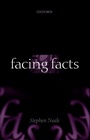
Facing Facts
Published on 1. November 2001
Book
Hardback
272 pages
978-0-19-924715-8 (ISBN)
Description
Facing Facts is a powerful, original examination of attempts to dislodge a cornerstone of modern philosophy: the idea that our thoughts and utterances are representations of slices of reality. Representations that are accurate are usually said to be true, to correspond to the facts - this is the foundation of correspondence theories of truth. A number of prominent philosophers have tried to undermine the idea that propositions, facts and correspondence can play any useful role in philosophy, and formal arguments
have been advanced to demonstrate that, under seemingly uncontroversial conditions, such entities collapse into an undifferentiated unity. The demise of individual facts is meant to herald the dawn of a new era in
philosophy, in which debates about scepticism, realism, subjectivity, representational and computational theories of mind, possible worlds, and divergent conceptual schemes that represent reality in different ways to
different persons, periods, or cultures evaporate through lack of subject matter.
By carefully untangling a host of intersecting metaphysical, epistemological, semantic, and logical issues, and providing rich and original analyses of key aspects of the work of Frege, Russell, Goedel, and
Davidson, Stephen Neale demonstrates that arguments for the collapse of facts are considerably more complex and interesting than either friend or foe ever imagined. A number of deep semantic facts emerge along with a
powerful proof: while it is technically possible to avoid the collapse of facts, rescue the idea of representations of reality, and thereby face anew the problems raised by the sceptic or the relativist, doing so requires
making some tough semantic decisions about predicates and descriptions. It is simply impossible, Neale shows, to invoke representations, facts, states, or propositions without making hard choices - choices that may send many
philosophers scurrying back to the drawing board. Facing Facts will be crucial to future work in metaphysics, the philosophy of language and mind, and logic, and will have profound implications far beyond.
have been advanced to demonstrate that, under seemingly uncontroversial conditions, such entities collapse into an undifferentiated unity. The demise of individual facts is meant to herald the dawn of a new era in
philosophy, in which debates about scepticism, realism, subjectivity, representational and computational theories of mind, possible worlds, and divergent conceptual schemes that represent reality in different ways to
different persons, periods, or cultures evaporate through lack of subject matter.
By carefully untangling a host of intersecting metaphysical, epistemological, semantic, and logical issues, and providing rich and original analyses of key aspects of the work of Frege, Russell, Goedel, and
Davidson, Stephen Neale demonstrates that arguments for the collapse of facts are considerably more complex and interesting than either friend or foe ever imagined. A number of deep semantic facts emerge along with a
powerful proof: while it is technically possible to avoid the collapse of facts, rescue the idea of representations of reality, and thereby face anew the problems raised by the sceptic or the relativist, doing so requires
making some tough semantic decisions about predicates and descriptions. It is simply impossible, Neale shows, to invoke representations, facts, states, or propositions without making hard choices - choices that may send many
philosophers scurrying back to the drawing board. Facing Facts will be crucial to future work in metaphysics, the philosophy of language and mind, and logic, and will have profound implications far beyond.
Reviews / Votes
'Neales book is written with such thoroughness, clarity, and rigor . . . No one with an interest in intensionality or the semantics of descriptions will want to miss this book.' * John MacFarlane, Notre Dame Philosophical Reviews *More details
Language
English
Place of publication
Oxford
United Kingdom
Target group
Professional and scholarly
Dimensions
Height: 222 mm
Width: 145 mm
Thickness: 20 mm
Weight
518 gr
ISBN-13
978-0-19-924715-8 (9780199247158)
Copyright in bibliographic data and cover images is held by Nielsen Book Services Limited or by the publishers or by their respective licensors: all rights reserved.
Schweitzer Classification
Other editions
Additional editions
Person
Stephen Neale is Professor of Philosophy at Rutgers University.
Content
Preface ; 1. The End of Representation ; 2. Davidson: Truth, Correspondence, Representation ; 3. Frege: Composition, Reference, Truth ; 4. Russell: Facts, Abbreviations, Descriptions ; 5. Godel: Facts and Descriptions ; 6. Extensionality ; 7. Principles of Inference ; 8. Connective Proofs and Logical Equivalence ; 9. Connective Proofs and Godelian Equivalence ; 10. Descriptions and Equivalence ; 11. Facts Revisited ; Glossary ; References, Index