

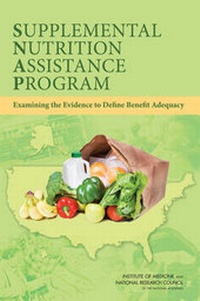
Supplemental Nutrition Assistance Program
Examining the Evidence to Define Benefit Adequacy
Published on 23. April 2013
Book
Paperback/Softback
234 pages
978-0-309-26294-1 (ISBN)
Description
For many Americans who live at or below the poverty threshold, access to healthy foods at a reasonable price is a challenge that often places a strain on already limited resources and may compel them to make food choices that are contrary to current nutritional guidance. To help alleviate this problem, the U.S. Department of Agriculture (USDA) administers a number of nutrition assistance programs designed to improve access to healthy foods for low-income individuals and households. The largest of these programs is the Supplemental Nutrition Assistance Program (SNAP), formerly called the Food Stamp Program, which today serves more than 46 million Americans with a program cost in excess of $75 billion annually. The goals of SNAP include raising the level of nutrition among low-income households and maintaining adequate levels of nutrition by increasing the food purchasing power of low-income families.
In response to questions about whether there are different ways to define the adequacy of SNAP allotments consistent with the program goals of improving food security and access to a healthy diet, USDA's Food and Nutrition Service (FNS) asked the Institute of Medicine (IOM) to conduct a study to examine the feasibility of defining the adequacy of SNAP allotments, specifically: the feasibility of establishing an objective, evidence-based, science-driven definition of the adequacy of SNAP allotments consistent with the program goals of improving food security and access to a healthy diet, as well as other relevant dimensions of adequacy; and data and analyses needed to support an evidence-based assessment of the adequacy of SNAP allotments. Supplemental Nutrition Assistance Program: Examining the Evidence to Define Benefit Adequacy reviews the current evidence, including the peer-reviewed published literature and peer-reviewed government reports.
Although not given equal weight with peer-reviewed publications, some non-peer-reviewed publications from nongovernmental organizations and stakeholder groups also were considered because they provided additional insight into the behavioral aspects of participation in nutrition assistance programs. In addition to its evidence review, the committee held a data gathering workshop that tapped a range of expertise relevant to its task.
In response to questions about whether there are different ways to define the adequacy of SNAP allotments consistent with the program goals of improving food security and access to a healthy diet, USDA's Food and Nutrition Service (FNS) asked the Institute of Medicine (IOM) to conduct a study to examine the feasibility of defining the adequacy of SNAP allotments, specifically: the feasibility of establishing an objective, evidence-based, science-driven definition of the adequacy of SNAP allotments consistent with the program goals of improving food security and access to a healthy diet, as well as other relevant dimensions of adequacy; and data and analyses needed to support an evidence-based assessment of the adequacy of SNAP allotments. Supplemental Nutrition Assistance Program: Examining the Evidence to Define Benefit Adequacy reviews the current evidence, including the peer-reviewed published literature and peer-reviewed government reports.
Although not given equal weight with peer-reviewed publications, some non-peer-reviewed publications from nongovernmental organizations and stakeholder groups also were considered because they provided additional insight into the behavioral aspects of participation in nutrition assistance programs. In addition to its evidence review, the committee held a data gathering workshop that tapped a range of expertise relevant to its task.
More details
Language
English
Place of publication
Washington
United States
Target group
Professional and scholarly
Dimensions
Height: 229 mm
Width: 152 mm
ISBN-13
978-0-309-26294-1 (9780309262941)
Copyright in bibliographic data and cover images is held by Nielsen Book Services Limited or by the publishers or by their respective licensors: all rights reserved.
Schweitzer Classification
Other editions
Additional editions
National Research Council | Institute of Medicine | Committee on National Statistics
Supplemental Nutrition Assistance Program
Examining the Evidence to Define Benefit Adequacy
E-Book
04/2013
1st Edition
National Academies Press
€7.99
Available for download
Content
1 Front Matter; 2 Summary; 3 1 Introduction and Conceptual Framework; 4 2 History, Background, and Goals of the Supplemental Nutrition Assistance Program; 5 3 Food Security and Access to a Healthy Diet in Low-Income Populations; 6 4 Individual, Household, and Environmental Factors Affecting Food Choices and Access; 7 5 Impact of Program Design on Allotment Adequacy; 8 6 Conclusions and Recommendations; 9 Appendix A: Acronyms, Abbreviations, and Terms; 10 Appendix B: Open Session with Sponsors; 11 Appendix C: Workshop Agenda; 12 Appendix D: Approach to Literature Review; 13 Appendix E: Questions Related to the Statement of Task; 14 Appendix F: Questions on theCore Food Security Module; 15 Appendix G: Key Recommendations of the *Dietary Guidelines for Americans*; 16 Appendix H: Biographical Sketches of Committee Members