

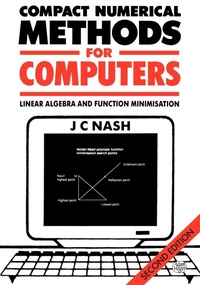
Compact Numerical Methods for Computers
Linear Algebra and Function Minimisation
2nd Edition
Published on 1. January 1990
Book
Paperback/Softback
290 pages
978-0-85274-319-5 (ISBN)
Description
This second edition of Compact Numerical Methods for Computers presents reliable yet compact algorithms for computational problems. As in the previous edition, the author considers specific mathematical problems of wide applicability, develops approaches to a solution and the consequent algorithm, and provides the program steps. He emphasizes useful applicable methods from various scientific research fields, ranging from mathematical physics to commodity production modeling. While the ubiquitous personal computer is the particular focus, the methods have been implemented on computers as small as a programmable pocket calculator and as large as a highly parallel supercomputer.
New to the Second Edition
Presents program steps as Turbo Pascal code
Includes more algorithmic examples
Contains an extended bibliography
The accompanying software (available by coupon at no charge) includes not only the algorithm source codes, but also driver programs, example data, and several utility codes to help in the software engineering of end-user programs. The codes are designed for rapid implementation and reliable use in a wide variety of computing environments. Scientists, statisticians, engineers, and economists who prepare/modify programs for use in their work will find this resource invaluable. Moreover, since little previous training in numerical analysis is required, the book can also be used as a supplementary text for courses on numerical methods and mathematical software.
New to the Second Edition
Presents program steps as Turbo Pascal code
Includes more algorithmic examples
Contains an extended bibliography
The accompanying software (available by coupon at no charge) includes not only the algorithm source codes, but also driver programs, example data, and several utility codes to help in the software engineering of end-user programs. The codes are designed for rapid implementation and reliable use in a wide variety of computing environments. Scientists, statisticians, engineers, and economists who prepare/modify programs for use in their work will find this resource invaluable. Moreover, since little previous training in numerical analysis is required, the book can also be used as a supplementary text for courses on numerical methods and mathematical software.
Reviews / Votes
Praise for the first edition"Anyone who must solve complex problems on a small computer would be well advised to consult Nash's book for both ideas and actual procedures. Those with the luxury of a large-scale computer for their numerical work will also find much of interest here."
-Peter Castro (Eastman Kodak), Technometrics, 22 February 1980
More details
Edition
2. Auflage
Language
English
Place of publication
London
United Kingdom
Publishing group
Taylor & Francis Ltd
Target group
College/higher education
Professional and scholarly
Professional
Dimensions
Height: 254 mm
Width: 178 mm
Thickness: 16 mm
Weight
554 gr
ISBN-13
978-0-85274-319-5 (9780852743195)
Copyright in bibliographic data and cover images is held by Nielsen Book Services Limited or by the publishers or by their respective licensors: all rights reserved.
Schweitzer Classification
Other editions
Additional editions
E-Book
12/2018
1st Edition
Routledge
€68.49
Available for download
E-Book
12/2018
1st Edition
Routledge
€68.49
Available for download
Book
06/2018
1st Edition
Routledge
€163.42
Shipment within 10-20 days
Person
John C. Nash
Content
A starting point Formal problems in linear algebra The singular-value decomposition and its use to solve least-squares problems Handling larger problems Some comments on the formation of the cross-product matrix ATA Linear equations-a direct approach The Choleski decomposition The symmetric positive definite matrix again The algebraic eigenvalue generalized problem Real symmetric matrices The generalized symmetric matrix eigenvalue problem Optimization and nonlinear equations One-dimensional problems Direct search methods Descent to a minimum I-variable metric algorithms Descent to a minimum II-conjugate gradients Minimizing a nonlinear sum of squares Leftovers The conjugate gradients method applied to problems in linear algebra Appendices Bibliography Index