

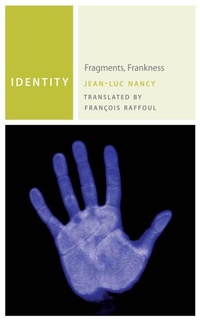
Identity
Fragments, Frankness
Published on 14. November 2014
Book
Paperback/Softback
64 pages
978-0-8232-5611-2 (ISBN)
Description
Identity: Fragments, Frankness is a rich and powerful essay on the notion of identity and on how it operates in our contemporary world. In contrast to the various attempts to cling to established identities or to associate identity with dubious agendas, Nancy shows that an identity is always open to alterity and its transformations.
Against cynical initiatives that seek to instrumentalize the question of identity in an attempt to manipulate sentiment against immigration, Nancy problematizes anew the notions of identity, nation, and national identity. He seeks to show that there is never a given identity but always an open process of identification that retains an exposure to difference. Thus identity can never operate as a self-identical subject, such as "the French."
Ultimately, for Nancy, one does not have an identity but has to become one. One can never return to a self-same identity but can only seek to locate oneself within difference and singularity. Nancy shows the impasse of a certain conception of identity that he calls the "identity of the identifiable," which refers to some permanent, given, substantial identity. In opposition to such identity, Nancy offers the identity of whatever or whoever invents itself in an open process of exposure to others and internal difference. Hence, an identity is never given but "makes itself by seeking and inventing itself." One does not have an identity, but is an identity.
Identity is an act, not a state.
This important book will provide much-needed philosophical clarification of a complex and strategic notion at the center of many current events and discussions.
Against cynical initiatives that seek to instrumentalize the question of identity in an attempt to manipulate sentiment against immigration, Nancy problematizes anew the notions of identity, nation, and national identity. He seeks to show that there is never a given identity but always an open process of identification that retains an exposure to difference. Thus identity can never operate as a self-identical subject, such as "the French."
Ultimately, for Nancy, one does not have an identity but has to become one. One can never return to a self-same identity but can only seek to locate oneself within difference and singularity. Nancy shows the impasse of a certain conception of identity that he calls the "identity of the identifiable," which refers to some permanent, given, substantial identity. In opposition to such identity, Nancy offers the identity of whatever or whoever invents itself in an open process of exposure to others and internal difference. Hence, an identity is never given but "makes itself by seeking and inventing itself." One does not have an identity, but is an identity.
Identity is an act, not a state.
This important book will provide much-needed philosophical clarification of a complex and strategic notion at the center of many current events and discussions.
More details
Series
Language
English
Place of publication
New York
United States
Target group
Professional and scholarly
Product notice
Paperback (trade)
Dimensions
Height: 188 mm
Width: 127 mm
Thickness: 15 mm
Weight
159 gr
ISBN-13
978-0-8232-5611-2 (9780823256112)
Copyright in bibliographic data and cover images is held by Nielsen Book Services Limited or by the publishers or by their respective licensors: all rights reserved.
Schweitzer Classification
Other editions
Persons
Jean-Luc Nancy (1940-2021) was Distinguished Professor of Philosophy at the Universite de Strasbourg and one of the late twentieth and early twenty-first century's foremost thinkers of politics, art, and the body. His wide-ranging thought runs through many books, including Being Singular Plural, The Ground of the Image, Corpus, The Disavowed Community, and Sexistence. His book The Intruder was adapted into an acclaimed film by Claire Denis.
Content
0. Fragments 1. Causes and Consequences 2. Gros Rouge 3. Identity is no Figure 4. Frankly 5. Absolute 6. Who? 7. Why Speak of Identity? 8. Peoples 9. Nations 10. Empires 11. Identities, Intimacies