

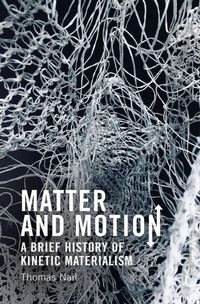
Matter and Motion
A Brief History of Kinetic Materialism
Published on 6. December 2023
Book
Hardback
176 pages
978-1-3995-2542-8 (ISBN)
Description
Thomas Nail traces an alternative history of ancient and modern thinkers who share a radically different understanding of the nature of matter and motion compared to the rest of the Euro-Western tradition. From Archaic Greek poetry and Bronze Age Minoan religion to the Roman poet Lucretius, and from German philosopher Karl Marx and English writer Virginia Woolf to contemporary physicists Carlo Rovelli and Karen Barad, Nail identifies a minor tradition of what he calls 'kinetic materialism' and its three central ideas: indeterminacy, relationality and process.
For the most part, Western thinkers have considered matter and motion to be inferior to more formal and static principles. Philosophers placed metaphysical categories such as eternity, God, the soul, forms and essences at the 'top' of a hierarchy that secured and ordered the movement at the bottom. This has real consequences in our world. By placing stasis above motion, this hierarchy places form above matter, life above death, God above humans, humans above nature, men above women, white skin above brown skin, the first world over the third world, citizens above migrants, straight above queer... The result? Patriarchy, capitalism, racism, homophobia, ecocide. Nail seeks to undermine this inherited hierarchy and the notion that matter and motion are inferior. There are no fixed authorities. This new history of matter and motion leaves the good life up to us, whoever we may become.
For the most part, Western thinkers have considered matter and motion to be inferior to more formal and static principles. Philosophers placed metaphysical categories such as eternity, God, the soul, forms and essences at the 'top' of a hierarchy that secured and ordered the movement at the bottom. This has real consequences in our world. By placing stasis above motion, this hierarchy places form above matter, life above death, God above humans, humans above nature, men above women, white skin above brown skin, the first world over the third world, citizens above migrants, straight above queer... The result? Patriarchy, capitalism, racism, homophobia, ecocide. Nail seeks to undermine this inherited hierarchy and the notion that matter and motion are inferior. There are no fixed authorities. This new history of matter and motion leaves the good life up to us, whoever we may become.
More details
Language
English
Place of publication
Edinburgh
United Kingdom
Target group
College/higher education
Product notice
sewn/stitched
Cloth over boards
Illustrations
26 black and white illustrations
Dimensions
Height: 203 mm
Width: 127 mm
Thickness: 11 mm
Weight
299 gr
ISBN-13
978-1-3995-2542-8 (9781399525428)
Copyright in bibliographic data and cover images is held by Nielsen Book Services Limited or by the publishers or by their respective licensors: all rights reserved.
Schweitzer Classification
Other editions
Additional editions
E-Book
09/2023
1st Edition
Edinburgh University Press
€14.99
Available for download
Person
Thomas Nail is Distinguished Scholar and Professor of Philosophy at the University of Denver. He is the award-winning author of eight prestigious University Press books which cover a wide range of topics including migration, borders, technology, digital media, history, science, economics, contemporary politics and climate change. His current research focuses on the influence of mobility on society and the arts in the 21st century. His work has been translated into ten major languages and cited across more than 20 academic disciplines.His published books are Marx in Motion: A New Materialist Marxism (Oxford University Press, 2020), Lucretius II: An Ethics of Motion (Edinburgh University Press, 2020), Theory of the Image (Oxford University Press, 2019), Being and Motion (Oxford University Press, 2018), Lucretius I: An Ontology of Motion (Edinburgh University Press, 2018), Theory of the Border (Oxford University Press, 2016), The Figure of the Migrant (Stanford University Press, 2015) and Returning to Revolution: Deleuze, Guattari, and Zapatismo (Edinburgh University Press, 2012).He also writes for Aeon: Ideas and Culture, The Huffington Post, Quartz, Pacific Standard: The Science of Society, History News Network and Monthly Review.
Content
Introduction
I. Indeterminacy
1. Ancient Indeterminacy: Minoan Metamorphosis, Hesiod's Khaos and Lucretius' Swerve
2. Modern Indeterminacy: Marx's Void, Woolf's Moments and Quantum Flux
II. Relationality
3. Ancient Relationality: Minoan Epiphany, Archaic Oracles and Lucretius' Muses
4. Modern Relationality: Marx's Metabolism, Woolf's Rapture and Quantum Entanglement
III. Process and Pattern
5. Ancient Process and Pattern: The Minoan Labyrinth, the Eleusinan Mysteries and Weaving Strings
6. Modern Process and Pattern: Marx's Motion, Woolf's Waves and Quantum Gravity
Conclusion
I. Indeterminacy
1. Ancient Indeterminacy: Minoan Metamorphosis, Hesiod's Khaos and Lucretius' Swerve
2. Modern Indeterminacy: Marx's Void, Woolf's Moments and Quantum Flux
II. Relationality
3. Ancient Relationality: Minoan Epiphany, Archaic Oracles and Lucretius' Muses
4. Modern Relationality: Marx's Metabolism, Woolf's Rapture and Quantum Entanglement
III. Process and Pattern
5. Ancient Process and Pattern: The Minoan Labyrinth, the Eleusinan Mysteries and Weaving Strings
6. Modern Process and Pattern: Marx's Motion, Woolf's Waves and Quantum Gravity
Conclusion