

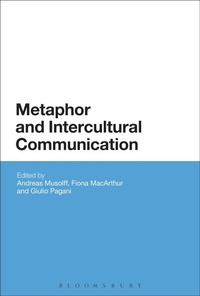
Metaphor and Intercultural Communication
Published on 10. April 2014
Book
Hardback
248 pages
978-1-4411-6547-3 (ISBN)
Description
Metaphor and Intercultural Communication examines in detail the dynamics of metaphor in interlingual contact, translation and globalization processes. Its case-studies, which combine methods of cognitive metaphor theory with those of corpus-based and discourse-oriented research, cover contact linguistic and cultural contacts between Chinese, English including Translational English and Aboriginal English, Greek, Kabyle, Romanian, Russian, Serbian, and Spanish.
Part I introduces readers to practical and methodological problems of the intercultural transfer of metaphor through empirical (corpus-based and experimental) studies of translators' experiences and strategies in dealing with figurative language in a variety of contexts. Part II explores the universality-relativity dimension of cross- and intercultural metaphor on the basis of empirical data from various European and non-European cultures. Part III investigates the socio-economic and political consequences of figurative language use through case studies of communication between aboriginal and mainstream cultures, in the media, in political discourse and gender-related discourses.
Special attention is paid to cases of miscommunication and of deliberate re- and counter-conceptualisation of cliches from one culture into another. The results open new perspectives on some of the basic assumptions of the 'classic' cognitive paradigm, e.g. regarding metaphor understanding, linguistic relativity and concept-construction.
Part I introduces readers to practical and methodological problems of the intercultural transfer of metaphor through empirical (corpus-based and experimental) studies of translators' experiences and strategies in dealing with figurative language in a variety of contexts. Part II explores the universality-relativity dimension of cross- and intercultural metaphor on the basis of empirical data from various European and non-European cultures. Part III investigates the socio-economic and political consequences of figurative language use through case studies of communication between aboriginal and mainstream cultures, in the media, in political discourse and gender-related discourses.
Special attention is paid to cases of miscommunication and of deliberate re- and counter-conceptualisation of cliches from one culture into another. The results open new perspectives on some of the basic assumptions of the 'classic' cognitive paradigm, e.g. regarding metaphor understanding, linguistic relativity and concept-construction.
Reviews / Votes
The collection ... distinguishes itself by making a new effort to meet the challenge of investigating intercultural communication from the angle of metaphor by offering new theoretical concepts and new methodologies for analyzing metaphor in discourse ... Both students and professionals in the fields of metaphor studies and intercultural research could benefit from reading this volume. * Metaphor and Symbol * The issues of metaphor and conceptualisation are excellently addressed and defined in every chapter of this book, giving the volume good coherence overall and allowing the reader to follow the trains of thought easily. An advantage of the book is that most papers are sufficiently accessible and succinct to be readable by a wide audience of both scholars and interested non-scholarly readers ... In all, the book presents a great collection of studies of metaphor and conceptualisation with implications for intercultural research. * LINGUIST List *More details
Language
English
Place of publication
New York
United States
Publishing group
Bloomsbury Publishing Plc
Target group
College/higher education
Professional and scholarly
Dimensions
Height: 240 mm
Width: 161 mm
Thickness: 18 mm
Weight
543 gr
ISBN-13
978-1-4411-6547-3 (9781441165473)
DOI
CBID169872
Copyright in bibliographic data and cover images is held by Nielsen Book Services Limited or by the publishers or by their respective licensors: all rights reserved.
Schweitzer Classification
Other editions
Additional editions
Andreas Musolff | Fiona MacArthur | Giulio Pagani
Metaphor and Intercultural Communication
E-Book
05/2014
1st Edition
Bloomsbury Academic
€42.99
Available for download
Andreas Musolff | Fiona MacArthur | Giulio Pagani
Metaphor and Intercultural Communication
E-Book
05/2014
1st Edition
Bloomsbury Academic
€42.99
Available for download
Persons
Andreas Musolff is Professor of Intercultural Communication at the University of East Anglia, UK.
Fiona MacArthur is a Senior Lecturer in the Department of English Philology at the University of Extremadura, Spain.
Giulio Pagani is Lecturer in Discourse and European Politics at the University of East Anglia, UK
Fiona MacArthur is a Senior Lecturer in the Department of English Philology at the University of Extremadura, Spain.
Giulio Pagani is Lecturer in Discourse and European Politics at the University of East Anglia, UK
Content
Preface, Zoltan Koevecses
Introduction: metaphor in intercultural communication, Andreas Musolff, Fiona MacArthur & Giulio Pagani
Part I: Metaphor in Translation
1. The evolution of translation trainees' subjective theories: an empirical study of metaphors about translation, Celia Martin de Leon & Marisa Presas
2. Translation of Metaphor in Popular Technology Discourse, Dafni Padadoudi
3. Revisiting the function of background information in sight translating metaphor: An analysis of translation product and process, Xia Xiang and Binghan Zheng
4. Conceptual metaphors in translation - A corpus based study on quantitative differences between translated and non-translated English, Claudia Foerster-Hegrenaes
Part II: Universal vs. Culture-Specific Aspects of Metaphor
5. Variation within universals: The 'metaphorical profile' approach to the study of anger concepts in English, Russian, and Spanish, Anna Ogarkova & Cristina Soriano
6. Conceptual metaphor in intercultural communication between speakers of Aboriginal English and Australian English, Farzad Sharifian
7. Cultural influence on the use of dogs in English and Kabyle proverbs, Sadia Belkhir
Part III: Metaphor, Globalization and Intercultural Communication
8. English idioms borrowed and reshaped: The emergence of a hybrid metaphor in Spanish, Jose L. Oncins-Martinez
9. 'Economic conquistadors conquer new worlds': Metaphor scenarios in English-language newspaper headlines on Spanish Foreign Direct Investment, Jasper Vandenberghe, Patrick Goethals and Geert Jacobs
10. One step forward, two steps back - Conceptualising the EU accession in Serbian and EU discourse, Nadezda Silaski and Tatjana ?urovic
11."Metaphor and self/other representations: A study on British and Romanian headlines on migration", Mariana Neagu and Gabriela Iuliana Colipca-Ciobanu
Index
Introduction: metaphor in intercultural communication, Andreas Musolff, Fiona MacArthur & Giulio Pagani
Part I: Metaphor in Translation
1. The evolution of translation trainees' subjective theories: an empirical study of metaphors about translation, Celia Martin de Leon & Marisa Presas
2. Translation of Metaphor in Popular Technology Discourse, Dafni Padadoudi
3. Revisiting the function of background information in sight translating metaphor: An analysis of translation product and process, Xia Xiang and Binghan Zheng
4. Conceptual metaphors in translation - A corpus based study on quantitative differences between translated and non-translated English, Claudia Foerster-Hegrenaes
Part II: Universal vs. Culture-Specific Aspects of Metaphor
5. Variation within universals: The 'metaphorical profile' approach to the study of anger concepts in English, Russian, and Spanish, Anna Ogarkova & Cristina Soriano
6. Conceptual metaphor in intercultural communication between speakers of Aboriginal English and Australian English, Farzad Sharifian
7. Cultural influence on the use of dogs in English and Kabyle proverbs, Sadia Belkhir
Part III: Metaphor, Globalization and Intercultural Communication
8. English idioms borrowed and reshaped: The emergence of a hybrid metaphor in Spanish, Jose L. Oncins-Martinez
9. 'Economic conquistadors conquer new worlds': Metaphor scenarios in English-language newspaper headlines on Spanish Foreign Direct Investment, Jasper Vandenberghe, Patrick Goethals and Geert Jacobs
10. One step forward, two steps back - Conceptualising the EU accession in Serbian and EU discourse, Nadezda Silaski and Tatjana ?urovic
11."Metaphor and self/other representations: A study on British and Romanian headlines on migration", Mariana Neagu and Gabriela Iuliana Colipca-Ciobanu
Index