

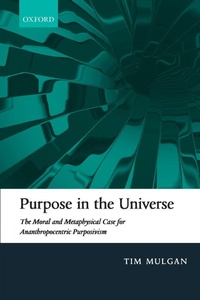
Purpose in the Universe
The moral and metaphysical case for Ananthropocentric Purposivism
Published on 24. May 2019
Book
Paperback/Softback
448 pages
978-0-19-882277-6 (ISBN)
Description
Two familiar worldviews dominate Western philosophy: materialist atheism and the benevolent God of the Abrahamic faiths. Tim Mulgan explores a third way. Ananthropocentric Purposivism claims that there is a cosmic purpose, but human beings are irrelevant to it. Purpose in the Universe develops a philosophical case for Ananthropocentric Purposivism that it is at least as strong as the case for either theism or atheism. The book borrows traditional theist arguments to defend a cosmic purpose. These include cosmological, teleological, ontological, meta-ethical, and mystical arguments. It then borrows traditional atheist arguments to reject a human-centred purpose. These include arguments based on evil, diversity, and the scale of the universe. Mulgan also highlights connections between morality and metaphysics, arguing that evaluative premises play a crucial and underappreciated role in metaphysical debates about the existence of God, and Ananthropocentric Purposivism mutually supports an austere consequentialist morality based on objective values. He concludes that, by drawing on a range of secular and religious ethical traditions, a non-human-centred cosmic purpose can ground a distinctive human morality. Our moral practices, our view of the moral universe, and our moral theory are all transformed if we shift from the familiar choice between a universe without meaning and a universe where humans matter to the less self-aggrandising thought that, while it is about something, the universe is not about us.
Reviews / Votes
Mulgan makes some powerful arguments...I would strongly recommend it for anyone interested in these fundamental questions of existence. * Philip Goff, International Journal for Philosophy of Religion * This book is a great success. * Stephanie Rennick, Australasian Journal of Philosophy * This book has expanded my philosophical horizons in substantial ways, offering an incredibly original, provocative, and unified account of the nature of reality and of value from within the Western tradition. I will not view debates about cosmology and about ethics the same way again. In a nutshell, Tim Mulgan argues for a third alternative that stands in between" atheism and monotheism. ... his book is complex, intricate, and intelligible, and I also think it is beautiful. It is extraordinarily wide-ranging ... a work of brave and exhilarating philosophy." * Thaddeus Metz, Ethics * ground-breaking, far-reaching, and carefully-argued ... I cannot possibly do justice to the range and subtlety of his many arguments ... We should, therefore, pay careful attention to this intriguing contribution to the field * Joshua W. Seachris Notre Dame Philosophical Reviews * Mulgan has written a magnificent book that deserves serious engagement. * Olli-Pekka Vainio, ESSSAT * Mulgan's project is both important and ambitious and his method is admirable * Peter Forrest, Philosophical Quarterly *More details
Language
English
Place of publication
Oxford
United Kingdom
Target group
College/higher education
Dimensions
Height: 234 mm
Width: 156 mm
Thickness: 24 mm
Weight
670 gr
ISBN-13
978-0-19-882277-6 (9780198822776)
Copyright in bibliographic data and cover images is held by Nielsen Book Services Limited or by the publishers or by their respective licensors: all rights reserved.
Schweitzer Classification
Person
Tim Mulgan is Professor of Philosophy at the University of Auckland, and Professor of Moral and Political Philosophy at the University of St Andrews. He was educated at the Universities of Otago and Oxford, and is the author of The Demands of Consequentialism (OUP, 2001), Future People (OUP, 2006), Understanding Utilitarianism (Acumen, 2007), and Ethics for a Broken World (Acumen/McGill-Queens University Press, 2011).
Content
1: Introduction
2: Meta-ethics
Part One: The case against atheism
3: Cosmological Arguments
4: Teleological Arguments
5: Mysticism
6: Ontological Arguments
Part Two: The case against benevolent theism
7: Arguments from Scale
8: Arguments from Evil
9: Religious Diversity
10: Immortality
Part Three: Ananthropocentric Purposivist Morality
11: A Dialogue
12: Human Well-being
13: Ananthropocentric Purposivist Moral Theory
Bibliography
Index
2: Meta-ethics
Part One: The case against atheism
3: Cosmological Arguments
4: Teleological Arguments
5: Mysticism
6: Ontological Arguments
Part Two: The case against benevolent theism
7: Arguments from Scale
8: Arguments from Evil
9: Religious Diversity
10: Immortality
Part Three: Ananthropocentric Purposivist Morality
11: A Dialogue
12: Human Well-being
13: Ananthropocentric Purposivist Moral Theory
Bibliography
Index