

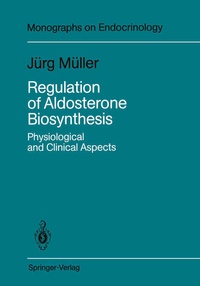
Regulation of Aldosterone Biosynthesis
Physiological and Clinical Aspects
2nd Edition
Published on 8. December 2011
Book
Paperback/Softback
XV, 364 pages
978-3-642-83122-5 (ISBN)
Description
Sixteen years is a long time, not only in human life but also in the rapid history of contemporary endocrinology. Since the publication of the first edition of this monograph, numerous new lines of research and discoveries have greatly contrib- uted to our knowledge of the physiological and pathological regulation of aldos- terone biosynthesis in man and animals. The first reports about a sensitive ra- dioimmunoassay for plasma aldosterone and about a preparation of dispersed zona glomerulosa cells were published in 1970 (Mayes et al. 1970; Haning et al. 1970). These two developments alone turned out to have a tremendous impact on research in aldosterone physiology (for reviews see Coghlan et al. 1979b; J. F. Tait et al. 1980b). In 1971, atrial natriuretic peptides, somatostatin, and the precursor molecule of ACTH had not yet been discovered. Angiotensin antagonists and con- verting-enzyme inhibitors were not yet available. The clinical syndrome of hypo- reninemic hypo aldosteronism was unknown. The possible roles of prostaglandins and dopamine in the control of aldosterone pwduction had not been considered.
Cyclic AMP was then the only substance with a clearly established second-mes- senger function.
Cyclic AMP was then the only substance with a clearly established second-mes- senger function.
More details
Series
Edition
Second Edition 1988
Language
English
Place of publication
Berlin
Germany
Publishing group
Springer Berlin
Target group
Professional and scholarly
Research
Illustrations
XV, 364 p.
Dimensions
Height: 244 mm
Width: 170 mm
Thickness: 21 mm
Weight
661 gr
ISBN-13
978-3-642-83122-5 (9783642831225)
DOI
10.1007/978-3-642-83120-1
Schweitzer Classification
Other editions
Additional editions
Book
11/1987
2nd Edition
Springer
€139.09
Article exhausted; check different version
Content
1 Zona Glomerulosa of the Adrenal Cortex: Source of Aldosterone.- 2 Pathway of Aldosterone Biosynthesis.- 2.1 Classical Pathway and Alternative Pathways.- 2.2 Corticosterone as an Intermediate Product.- 2.3 18-Hydroxycorticosterone: Intermediate Product or By-product?.- 2.4 Alternative Pathway Through 18-Hydroxy-11-deoxycorticosterone?.- 2.5 Deoxycorticosterone Secretion.- 3 Aldosterone Biosynthesis by Cell-Free Systems.- 4 Substances Directly Influencing Aldosterone Biosynthesis in Shortterm Incubation or Perfusion Experiments.- 4.1 Angiotensins.- 4.2 Monovalent Cations.- 4.3 Divalent Cations.- 4.4 ACTH, ACTH-related Peptides, and Other Pituitary Hormones.- 4.5 Amines.- 4.6 Prostaglandins and Inhibitors of Prostaglandin Biosynthesis.- 4.7 Aldosterone-Inhibiting Peptides.- 4.8 Specific Inhibitors of Steroidogenic Enzymes.- 4.9 Inhibitors of RNA or Protein Synthesis.- 4.10 Steroid Hormones.- 4.11 Ouabain.- 4.12 Miscellaneous Biological Substances with Direct Stimulatory or Inhibitory Effects on Aldosterone Biosynthesis.- 4.13 Site of Action of Stimulators or Inhibitors in the Biosynthetic Pathway.- 4.14 Primary Effects and Intracellular Mediation.- 5 Alterations in Aldosterone Biosynthesis and Secretion in Long-Term Experiments and Diseases.- 5.1Alterations in Sodium Intake or in Sodium Balance.- 5.2 Alterations in Potassium Intake or in Potassium Balance.- 5.3 Exogenous Angiotensin or Renin.- 5.4 Pharmacological Blockade of the Renin-Angiotensin System.- 5.5 Role of the Kidneys.- 5.6 Role of the Pituitary Gland.- 5.7 Dopaminergic Regulation of Aldosterone Secretion.- 5.8 Role of the Central Nervous System.- 5.9 Normal Life.- 5.10 Estrogens and Progestogens.- 5.11 Aspects of Negative Feedback Regulation.- 6 Conclusions.- 6.1 Multiplicity of Aldosterone-Stimulating Substances.- 6.2 "Adrenoglomerulotropins".- 6.3 Physiological Inhibitors of Aldosterone Biosynthesis.- 6.4 The Shrinking Black Box.- 6.5 Long-Term Regulation of Late Steps in Aldosterone Biosynthesis.- 6.6 A Matter of Time.- 6.7 Enzymology of the Final Steps in Aldosterone Biosynthesis.- 6.8 Predominance of the Renin-Angiotensin System in the Physiological Control of Aldosterone Secretion?.- 6.9 Multifactorial Control of Aldosterone Biosynthesis.- References.