

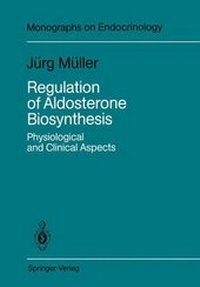
Regulation of Aldosterone Biosynthesis
Physiological and Clinical Aspects
2nd Edition
Published on 27. November 1987
Book
Hardback
XV, 364 pages
978-3-540-17907-8 (ISBN)
More details
Series
Edition
2nd rev. ed.
Language
English
Place of publication
Heidelberg
Germany
Publishing group
Springer Berlin
Target group
College/higher education
Professional and scholarly
Edition type
Revised edition
Illustrations
13
13 s/w Tabellen
13 black & white tables, biography
Weight
800 gr
ISBN-13
978-3-540-17907-8 (9783540179078)
DOI
10.1007/978-3-642-83120-1
Schweitzer Classification
Other editions
Additional editions
E-Book
12/2012
2nd Edition
Springer
€96.29
Available for download
Book
12/2011
2nd Edition
Springer
€106.99
Shipment within 7-9 days
Previous edition
J. Rg M Ller | J'Urg M'Uller
Regulation of Aldosterone Biosynthesis
Book
01/1971
Springer
€91.07
Article exhausted; check for reprint
Content
1 Zona Glomerulosa of the Adrenal Cortex: Source of Aldosterone.- 2 Pathway of Aldosterone Biosynthesis.- 2.1 Classical Pathway and Alternative Pathways.- 2.2 Corticosterone as an Intermediate Product.- 2.3 18-Hydroxycorticosterone: Intermediate Product or By-product?.- 2.4 Alternative Pathway Through 18-Hydroxy-11-deoxycorticosterone?.- 2.5 Deoxycorticosterone Secretion.- 3 Aldosterone Biosynthesis by Cell-Free Systems.- 4 Substances Directly Influencing Aldosterone Biosynthesis in Shortterm Incubation or Perfusion Experiments.- 4.1 Angiotensins.- 4.1.1 Angiotensin II.- 4.1.2 Angiotensin III.- 4.1.3 Angiotensin I and Des-asp1-angiotensin I.- 4.1.4 Synthetic Angiotensin Analogues.- 4.1.5 Adrenocortical Angiotensin Receptors.- 4.2 Monovalent Cations.- 4.2.1 Sodium.- 4.2.2 Potassium.- 4.2.3 Ammonium, Rubidium, and Cesium.- 4.2.4 Lithium.- 4.2.5 Hydrogen Ions.- 4.3 Divalent Cations.- 4.3.1 Calcium.- 4.3.2 Substances Affecting Transport and Second-Messenger Functions of Calcium.- 4.3.3 Magnesium.- 4.4 ACTH, ACTH-related Peptides, and Other Pituitary Hormones.- 4.4.1 ACTH.- 4.4.2 ACTH-related Pituitary Peptides.- 4.4.3 Prolactin.- 4.4.4 Aldosterone-Stimulating Factor.- 4.4.5 Vasopressin.- 4.5 Amines.- 4.5.1 Serotonin.- 4.5.2 Serotonin-Related Indole Derivatives.- 4.5.3 Serotonin Antagonists.- 4.5.4 Dopamine, Dopaminergic Agonists, and Dopamine Antagonists.- 4.5.5 Histamine and Histamine Antagonists.- 4.5.6 Adrenergic Agonists and Antagonists.- 4.6 Prostaglandins and Inhibitors of Prostaglandin Biosynthesis.- 4.6.1 Prostaglandins.- 4.6.2 Inhibitors of Prostaglandin Biosynthesis.- 4.7 Aldosterone-Inhibiting Peptides.- 4.7.1 Atrial Natriuretic Peptides.- 4.7.2 Adrenal-Medullary Inhibitory Factor.- 4.7.3 Somatostatin.- 4.8 Specific Inhibitors of Steroidogenic Enzymes.- 4.8.1 Metyrapone.- 4.8.2 Su-8000, Su-9055, and Su-10603.- 4.8.3 Aminoglutethimide.- 4.8.4 Cyanosteroids.- 4.8.5 Spirolactones.- 4.9 Inhibitors of RNA or Protein Synthesis.- 4.9.1 Actinomycin D.- 4.9.2 Cycloheximide.- 4.9.3 Puromycin and Chloramphenicol.- 4.10 Steroid Hormones.- 4.10.1 Corticosteroids and Gestagens.- 4.10.2 Androgens and Estrogens.- 4.11 Ouabain.- 4.12 Miscellaneous Biological Substances with Direct Stimulatory or Inhibitory Effects on Aldosterone Biosynthesis.- 4.13 Site of Action of Stimulators or Inhibitors in the Biosynthetic Pathway.- 4.13.1 "Early Steps" and "Late Steps".- 4.13.2 Endogenous Steroid Output.- 4.13.3 Conversion of Labeled Precursors.- 4.13.4 Experiments with Unlabeled Precursors.- 4.13.5 Experiments with Inhibitors of Steroidogenic Enzymes.- 4.14 Primary Effects and Intracellular Mediation.- 4.14.1 General Considerations.- 4.14.2 Cyclic AMP.- 4.14.3 Cyclic GMP.- 4.14.4 Calcium.- 4.14.5 Phospholipid Metabolism.- 4.14.6 Intracellular Potassium and (Na, K)-ATPase.- 5 Alterations in Aldosterone Biosynthesis and Secretion in Long-Term Experiments and Diseases.- 5.1Alterations in Sodium Intake or in Sodium Balance.- 5.1.1 "Sodium Deficiency".- 5.1.2 Morphological and Histochemical Changes.- 5.1.3 Altered Sensitivity of the Zona Glomerulosa to.- Aldosterone-Stimulating Substances.- 5.1.4 Sites of Action in the Biosynthetic Pathway.- 5.1.5 Role of the Renin-Angiotensin System.- 5.1.6 Role of Plasma Potassium Concentration.- 5.1.7 Role of Plasma Volume.- 5.1.8 Role of Plasma Sodium Concentration.- 5.1.9 Involvement of the Central Nervous System.- 5.2 Alterations in Potassium Intake or in Potassium Balance.- 5.2.1 General Considerations.- 5.2.2 Morphological Changes.- 5.2.3 Duration of Stimulatory Effects of Potassium.- 5.2.4 Alterations in Zona Glomerulosa Sensitivity.- 5.2.5 Site of Action in the Biosynthetic Pathway.- 5.2.6 Potassium-Induced Mitochondrial Protein.- 5.2.7 Potassium Intake and the Renin-Angiotensin System.- 5.3 Exogenous Angiotensin or Renin.- 5.3.1 Aldosterone Stimulation by Pressor and Nonpressor Doses.- 5.3.2 Selectivity of Aldosterone Stimulation.- 5.3.3 Persistence of Aldosterone Stimulation.- 5.3.4 Effects on Angiotensin II Receptors and on Steroidogenic Enzymes.- 5.3.5 Effects on Sodium Balance.- 5.3.6 Renal Arterial Infusion of Angiotensin II.- 5.3.7 Immunization Against Renin or Angiotensin.- 5.3.8 Morphological and Histochemical Alterations of the Adrenal Cortex.- 5.4 Pharmacological Blockade of the Renin-Angiotensin System.- 5.4.1 Angiotensin Antagonists.- 5.4.2 Converting-Enzyme Inhibitors.- 5.4.3 Beta-Adrenergic Blocking Agents.- 5.4.4 Inhibitors of Prostaglandin Synthesis.- 5.5 Role of the Kidneys.- 5.5.1 Renovascular Hypertension.- 5.5.2 Renal Denervation, Kidney Transplantation, and Unilateral Nephrectomy.- 5.5.3 Renal Failure and Hemodialysis.- 5.5.4 Bilateral Nephrectomy.- 5.5.5 Primary Reninism.- 5.5.6 Hyporeninemic Hypoaldosteronism.- 5.6 Role of the Pituitary Gland.- 5.6.1 Hypophysectomy and Hypopituitarism.- 5.6.2 Adrenocorticotropin (ACTH).- 5.6.3 ACTH-Related Pituitary Peptides.- 5.6.4 Glucocorticoids.- 5.6.5 Growth Hormone.- 5.6.6 Prolactin.- 5.6.7 Thyroid Hormones.- 5.6.8 Vasopressin.- 5.7 Dopaminergic Regulation of Aldosterone Secretion.- 5.7.1 General Considerations.- 5.7.2 Experiments with Metoclopramide.- 5.7.3 Other Dopamine Antagonists.- 5.7.4 Dopamine and l-Dopa.- 5.7.5 Bromocriptine.- 5.8 Role of the Central Nervous System.- 5.8.1 General Considerations.- 5.8.2 Electrical and Humoral Stimulation of the Central Nervous System.- 5.8.3 Brain Lesions.- 5.8.4 Hypothalamic Factors.- 5.8.5 Pineal Gland.- 5.8.6 Spinal Cord Transection.- 5.8.7 Manic-depressive Psychosis.- 5.9 Normal Life.- 5.9.1 Fetal Development.- 5.9.2 Infancy and Childhood.- 5.9.3 Age.- 5.9.4 Diurnal Rhythms.- 5.9.5 Posture.- 5.9.6 Exercise.- 5.9.7 Heat and Cold.- 5.9.8 Altitude.- 5.9.9 Fasting and Refeeding.- 5.10 Estrogens and Progestogens.- 5.10.1 Exogenous Estrogens.- 5.10.2 Exogenous Progestogens.- 5.10.3 Oral Contraceptive Medication.- 5.10.4 Menstrual Cycle.- 5.10.5 Pregnancy.- 5.11 Aspects of Negative Feedback Regulation.- 5.11.1 Mineralocorticoids.- 5.11.2 Licorice and Carbenoxolone.- 5.11.3 Pseudohyperaldosteronism (Liddle's Syndrome).- 5.11.4 Acquired Forms of Primary Hypoaldosteronism.- 5.11.5 Congenital Deficiencies of Steroidogenic Enzymes.- 5.11.6 Pseudohypoaldosteronism.- 5.11.7 Spirolactones.- 5.11.8 Heparin and Heparinoids.- 6 Conclusions.- 6.1 Multiplicity of Aldosterone-Stimulating Substances.- 6.2 "Adrenoglomerulotropins".- 6.3 Physiological Inhibitors of Aldosterone Biosynthesis.- 6.4 The Shrinking Black Box.- 6.5 Long-Term Regulation of Late Steps in Aldosterone Biosynthesis.- 6.6 A Matter of Time.- 6.7 Enzymology of the Final Steps in Aldosterone Biosynthesis.- 6.8 Predominance of the Renin-Angiotensin System in the Physiological Control of Aldosterone Secretion?.- 6.9 Multifactorial Control of Aldosterone Biosynthesis.- References.