

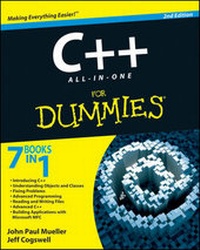
C++ All-In-One Desk Reference For Dummies
2nd Edition
Published on 1. September 2009
Book
Paperback/Softback
864 pages
978-0-470-31735-8 (ISBN)
Description
Here's the easy way to learn how to use C++
C++, developed by Bjarne Stroustrup at Bell Labs, is one of the most widely used programming languages, with close to four million C++ programmers and growing. C++'s popularity has earned it a spot as part of the Standard Library.
Fully updated for the new C++ 2009 standard, C++ All-in-One for Dummies, 2nd Edition compiles seven books into one. This guidebook covers key topics like an introduction to C++, understanding objects and classes, fixing problems, advanced programming, reading and writing files, advanced C++, and building applications with Microsoft MFC. If you're a C++ newbie, start with Book I. But if you're experienced with C++, simply jump in anywhere to learn more! This all-in-one reference helps you learn to:
* Use C++ for Windows, Mac, and Linux by using the CodeBlocks compiler
* Understand object-oriented programming
* Use various diagrams to design your programs
* Recognize how local variables are stored
* Use packages, notes, and tags effectively
* Make a class persistent
* Handle constructors and destructors
With over 25,000 sold of the previous bestselling edition, this second edition with a bonus CD makes C++ easier to understand. It's a perfect introduction for new programmers and guide for advanced programmers.
Note: CD-ROM/DVD and other supplementary materials are not included as part of eBook file.
C++, developed by Bjarne Stroustrup at Bell Labs, is one of the most widely used programming languages, with close to four million C++ programmers and growing. C++'s popularity has earned it a spot as part of the Standard Library.
Fully updated for the new C++ 2009 standard, C++ All-in-One for Dummies, 2nd Edition compiles seven books into one. This guidebook covers key topics like an introduction to C++, understanding objects and classes, fixing problems, advanced programming, reading and writing files, advanced C++, and building applications with Microsoft MFC. If you're a C++ newbie, start with Book I. But if you're experienced with C++, simply jump in anywhere to learn more! This all-in-one reference helps you learn to:
* Use C++ for Windows, Mac, and Linux by using the CodeBlocks compiler
* Understand object-oriented programming
* Use various diagrams to design your programs
* Recognize how local variables are stored
* Use packages, notes, and tags effectively
* Make a class persistent
* Handle constructors and destructors
With over 25,000 sold of the previous bestselling edition, this second edition with a bonus CD makes C++ easier to understand. It's a perfect introduction for new programmers and guide for advanced programmers.
Note: CD-ROM/DVD and other supplementary materials are not included as part of eBook file.
More details
Edition
2., Auflage
Language
English
Place of publication
Chichester
United Kingdom
Publishing group
John Wiley and Sons Ltd
Target group
Professional and scholarly
Edition type
Revised edition
Illustrations
Illustrations
Dimensions
Height: 23.3 cm
Width: 18.7 cm
Thickness: 46 mm
Weight
1260 gr
ISBN-13
978-0-470-31735-8 (9780470317358)
Schweitzer Classification
Other editions
New editions
John Paul Mueller | Jeff Cogswell
C++ All-in-One For Dummies
Book
09/2014
3rd Edition
Wiley
Unfortunately, price unknown
Article exhausted; check for reprint
Previous edition
Jeff Cogswell
C++ All-in-One Desk Reference For Dummies
Book
01/2003
1st Edition
Hungry Minds Inc,U.S.
€37.90
Article exhausted; check for reprint
Persons
John Paul Mueller has written more than 300 articles and 80 books on technology, including LINQ For Dummies.
Jeff Cogswell has been an application developer and trainer for 13 years, working with clients from startups to Fortune 500 companies. He has developed courses on C++ and other technologies.
Jeff Cogswell has been an application developer and trainer for 13 years, working with clients from startups to Fortune 500 companies. He has developed courses on C++ and other technologies.
Content
Introduction.
Book I: Introducing C++.
Chapter 1: Creating a First C++ Program.
Chapter 2: Storing Data in C++.
Chapter 3: Directing Your C++ Program Flow.
Chapter 4: Dividing Your Work with Functions.
Chapter 5: Dividing Between Source-Code Files.
Chapter 6: Referring to Your Data through Pointers.
Chapter 7: Working with Classes.
Chapter 8: Using Advanced C++ Features.
Book II: Understanding Objects and Classes.
Chapter 1: Planning and Building Objects.
Chapter 2: Describing Your Program with UML.
Chapter 3: Structuring Your Classes with UML.
Chapter 4: Demonstrating Behavior with UML.
Chapter 5: Modeling Your Programs with UML.
Chapter 6: Building with Design Patterns.
Book III: Fixing Problems.
Chapter 1: Dealing with Bugs.
Chapter 2: Debugging a Program.
Chapter 3: Stopping and Inspecting Your Code.
Chapter 4: Traveling About the Stack.
Book IV: Advanced Programming.
Chapter 1: Working with Arrays, Pointers, and References.
Chapter 2: Creating Data Structures.
Chapter 3: Constructors, Destructors, and Exceptions.
Chapter 4: Advanced Class Usage.
Chapter 5: Creating Classes with Templates.
Chapter 6: Programming with the Standard Library.
Book V: Reading and Writing Files.
Chapter 1: Filing Information with the Streams Library.
Chapter 2: Writing with Output Streams.
Chapter 3: Reading with Input Streams.
Chapter 4: Building Directories and Contents.
Chapter 5: Streaming Your Own Classes.
Book VI: Advanced C++.
Chapter 1: Exploring the Standard Library Further.
Chapter 2: Building Original Templates.
Chapter 3: Investigating Boost.
Chapter 4: Boosting up a Step.
Book VII: Building Applications with Microsoft MFC.
Chapter 1: Working with the Visual C++ 2008 IDE and Projects.
Chapter 2: Creating an MFC Dialog Box Project.
Chapter 3: Creating an MFC SDI Project.
Chapter 4: Using the Visual C++ 2008 Debugger.
Chapter 5: Analyzing Your Visual C++ 2008 Code.
Appendix A: Automating Your Programs with Makefiles.
Appendix B: About the CD.
Index.
Book I: Introducing C++.
Chapter 1: Creating a First C++ Program.
Chapter 2: Storing Data in C++.
Chapter 3: Directing Your C++ Program Flow.
Chapter 4: Dividing Your Work with Functions.
Chapter 5: Dividing Between Source-Code Files.
Chapter 6: Referring to Your Data through Pointers.
Chapter 7: Working with Classes.
Chapter 8: Using Advanced C++ Features.
Book II: Understanding Objects and Classes.
Chapter 1: Planning and Building Objects.
Chapter 2: Describing Your Program with UML.
Chapter 3: Structuring Your Classes with UML.
Chapter 4: Demonstrating Behavior with UML.
Chapter 5: Modeling Your Programs with UML.
Chapter 6: Building with Design Patterns.
Book III: Fixing Problems.
Chapter 1: Dealing with Bugs.
Chapter 2: Debugging a Program.
Chapter 3: Stopping and Inspecting Your Code.
Chapter 4: Traveling About the Stack.
Book IV: Advanced Programming.
Chapter 1: Working with Arrays, Pointers, and References.
Chapter 2: Creating Data Structures.
Chapter 3: Constructors, Destructors, and Exceptions.
Chapter 4: Advanced Class Usage.
Chapter 5: Creating Classes with Templates.
Chapter 6: Programming with the Standard Library.
Book V: Reading and Writing Files.
Chapter 1: Filing Information with the Streams Library.
Chapter 2: Writing with Output Streams.
Chapter 3: Reading with Input Streams.
Chapter 4: Building Directories and Contents.
Chapter 5: Streaming Your Own Classes.
Book VI: Advanced C++.
Chapter 1: Exploring the Standard Library Further.
Chapter 2: Building Original Templates.
Chapter 3: Investigating Boost.
Chapter 4: Boosting up a Step.
Book VII: Building Applications with Microsoft MFC.
Chapter 1: Working with the Visual C++ 2008 IDE and Projects.
Chapter 2: Creating an MFC Dialog Box Project.
Chapter 3: Creating an MFC SDI Project.
Chapter 4: Using the Visual C++ 2008 Debugger.
Chapter 5: Analyzing Your Visual C++ 2008 Code.
Appendix A: Automating Your Programs with Makefiles.
Appendix B: About the CD.
Index.