

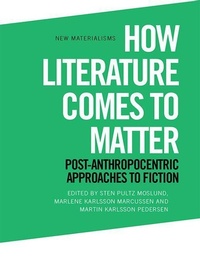
How Literature Comes to Matter
Post-Anthropocentric Approaches to Fiction
Published on 15. December 2020
Book
Hardback
288 pages
978-1-4744-6131-3 (ISBN)
Description
Through a rethinking of the relationship between the subject and object, the human and the nonhuman, this volume shows how literature and post-anthropocentric theory can illuminate each other in mutually productive ways. Focusing on how the study of literature is an underdeveloped field within 'the material turn', the introduction and each of the eleven chapters examine ways in which new materialist and object-oriented theory opens the study of literature in new ways just as they demonstrate the deep entanglements in literature of human and nonhuman realities.
The collection includes an Afterword by Timothy Morton and hands-on analyses and close readings of individual works by such diverse writers as Hans Christian Andersen, Djuna Barnes, Sylvia Plath, Georges Perec, Ayi Kwei Armah, Jeanette Winterson and Paolo Bacigalupi.
The collection includes an Afterword by Timothy Morton and hands-on analyses and close readings of individual works by such diverse writers as Hans Christian Andersen, Djuna Barnes, Sylvia Plath, Georges Perec, Ayi Kwei Armah, Jeanette Winterson and Paolo Bacigalupi.
Reviews / Votes
[How Literature Comes to Matter] is an exciting and often path-breaking look at how literature might contribute to contemporary reflections on the entangled relations between humans and more-than-human material realities. Far from being inert and dead, matter - in all its attendant complexity and glory -turns out to be teeming and writhing with life. In the final analysis, matter matters, perhaps much more than the human. -- Vedant Srinivas * Journal of Posthumanism *More details
Series
Language
English
Place of publication
Edinburgh
United Kingdom
Target group
Professional and scholarly
Product notice
sewn/stitched
Cloth over boards
Illustrations
4 colour illustrations
Dimensions
Height: 231 mm
Width: 165 mm
Thickness: 20 mm
Weight
567 gr
ISBN-13
978-1-4744-6131-3 (9781474461313)
Copyright in bibliographic data and cover images is held by Nielsen Book Services Limited or by the publishers or by their respective licensors: all rights reserved.
Schweitzer Classification
Other editions
Additional editions
Sten Pultz Moslund | Marlene Karlsson Marcussen | Martin Karlsson Pedersen
How Literature Comes to Matter
Post-Anthropocentric Approaches to Fiction
E-Book
11/2020
Edinburgh University Press
€0.00
Available for download
Persons
Sten Pultz Moslund is Associate Profess of Comparative Literature & English Studies at the University of Southern Denmark. He is co-author of The Postmigrant Condition: New Perspectives on Migration, Multiculturalism and the Arts (Routledge, 2018). He is author of Literature's Sensuous Geographies: Place Matters in Postcolonial Literature (Palgrave Macmillan, 2015), Migration Literature and Hybridity (Palgrave Macmillan, 2010), Making Use of History in New South African Fiction (Museum Tusculanum Press, 2003). He is co-editor of The Culture of Migration: Politics, Aesthetics and Histories (IB Tauris, 2015). Marlene Marcussen is Assistant Lecturer in Comparative Literature at the University of Southern Denmark. She is the author of a number of articles in Danish journals. Martin Karlsson Pederson is Assistant Lecturer in Comparative Literature at the University of Southern Denmark.
Content
Acknowledgements
Foreword
I. Introduction
II. Matter-oriented Perspectives on Literary Techniques, Language and Representation
1. The Abundance of Things in the Midst of Writing: A Post-Anthropocentric View on Description and Georges Perec's Still Life/Style Leaf?Marlene Karlsson Marcussen
2. Slow Narrative and the Perception of Material FormsMarco Caracciolo
III. Object Intrusions in Subject-Centric Texts
3. Aisthetic Realities in Ayi Kwei Armah's The Beautyful Ones Are Not Yet Born. A Matter-Oriented Reading of Postcolonial LiteratureSten Pultz Moslund
4. Sylvia Plath's 'Tulips': On the Hostile Nature of ThingsMichael Karlsson Pedersen
5. 'We have nothing to be arrogant about' - Hans Christian Andersen and Anti-AnthropocentrismTorsten Bogh Thomsen?
IV. Carnal Realities: Lively Flesh in Feminist and Queer Readings
6. Feminist New Materialism and Literary Studies: Methodological Meditations on the Tradition of Feminist Literary Criticism and (Post)CritiqueTobias Skiveren
7. Djuna Barnes and Queer InterioritiesLaura Oulanne
8. Corporeal Creativity and Queer Gaps in TimeKarin Sellberg
V. Capitalism, Crisis and the Anthropocene
9. Putting the Earth to Use: Reading Resources in the End Times (Through Science Fiction) Rune Graulund
10. Dry Ontology and Finance Capitalism: An Affective-Material Reading of Financial Crisis Fiction Martin Karlsson Pedersen
11. The New Work of Art in the Age of Capitalist Realism: Materiality/ Aura/ ApocalypseMaurizia Boscagli
VI. Afterword
12. Woodenness: The (Palm) Heart of The MatterTimothy Morton
Notes on Contributors
Index.
Foreword
I. Introduction
II. Matter-oriented Perspectives on Literary Techniques, Language and Representation
1. The Abundance of Things in the Midst of Writing: A Post-Anthropocentric View on Description and Georges Perec's Still Life/Style Leaf?Marlene Karlsson Marcussen
2. Slow Narrative and the Perception of Material FormsMarco Caracciolo
III. Object Intrusions in Subject-Centric Texts
3. Aisthetic Realities in Ayi Kwei Armah's The Beautyful Ones Are Not Yet Born. A Matter-Oriented Reading of Postcolonial LiteratureSten Pultz Moslund
4. Sylvia Plath's 'Tulips': On the Hostile Nature of ThingsMichael Karlsson Pedersen
5. 'We have nothing to be arrogant about' - Hans Christian Andersen and Anti-AnthropocentrismTorsten Bogh Thomsen?
IV. Carnal Realities: Lively Flesh in Feminist and Queer Readings
6. Feminist New Materialism and Literary Studies: Methodological Meditations on the Tradition of Feminist Literary Criticism and (Post)CritiqueTobias Skiveren
7. Djuna Barnes and Queer InterioritiesLaura Oulanne
8. Corporeal Creativity and Queer Gaps in TimeKarin Sellberg
V. Capitalism, Crisis and the Anthropocene
9. Putting the Earth to Use: Reading Resources in the End Times (Through Science Fiction) Rune Graulund
10. Dry Ontology and Finance Capitalism: An Affective-Material Reading of Financial Crisis Fiction Martin Karlsson Pedersen
11. The New Work of Art in the Age of Capitalist Realism: Materiality/ Aura/ ApocalypseMaurizia Boscagli
VI. Afterword
12. Woodenness: The (Palm) Heart of The MatterTimothy Morton
Notes on Contributors
Index.