

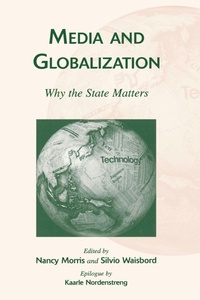
Media and Globalization
Why the State Matters
Published on 23. May 2001
Book
Paperback/Softback
224 pages
978-0-7425-1030-2 (ISBN)
Description
Media and Globalization shows why the state matters to media and telecommunications industries in a globalizing world: governments control and regulate these industries in important ways and states remain central arenas for policymaking and international agreements. Using case studies drawn from around the world, this book sheds light on the extent of state power in the face of transnational pressures and explores policy, economics, and culture as they factor into media globalization.
Reviews / Votes
I am impressed with the clarity of the argument and the value of the project-for what is at stake in it is a more balanced, less rhetorically driven debate on the relations of the state and forces of supranational change. . . . A significant contribution to the literature. -- Stuart Cunningham, Queensland University of Technology This book is not only timely but vital for anyone who wants to understand the state of affairs in international communication studies. -- Kaarle Nordenstreng The topics and nations covered in this collection are of singular importance to the analysis of media and globalization as we feel our way into the twenty-first century. Morris and Waisbord have assembled a remarkably perceptive and prescient group of scholars whose expertise in this area is second to none. -- John D. H. Downing A significant contribution to the debate about the often-conflicted relationship between states and globalizing forces in shaping telecommunications policies. The essays assembled here will stimulate and facilitate further comparative analysis of the responses of media systems in different countries to the forces of globalization. -- Michael Gurevitch, University of Maryland Provocative book. * Press/Politics * An important source that furthers understanding and leads the way for additional research. * Choice Reviews * This edited collection is clearly relevant to the tensions between the state and global media and it is an extremely useful text for teaching. * European Journal Of Communication *More details
Language
English
Place of publication
United States
Publishing group
Bloomsbury Publishing Plc
Target group
College/higher education
Professional and scholarly
Dimensions
Height: 229 mm
Width: 152 mm
Thickness: 13 mm
Weight
355 gr
ISBN-13
978-0-7425-1030-2 (9780742510302)
Copyright in bibliographic data and cover images is held by Nielsen Book Services Limited or by the publishers or by their respective licensors: all rights reserved.
Schweitzer Classification
Persons
Nancy Morris is assistant professor of broadcasting, telecommunications, and mass media at Temple University. Silvio Waisbord is assistant professor of journalism and mass media at Rutgers University.
Content
Chapter 1 Introduction: Rethinking Media Globalization and State Power
Part 2 Part I: States and Internet Regulation
Chapter 3 Exporting the First Amendment to Cyberspace: The Internet and State Sovereignty
Chapter 4 Where the National Meets the Global: Australia's Internet Censorship Policies
Part 5 Part II: States and Communications Reform in Societies in Transition
Chapter 6 "Negotiated Liberalization": The Politics of Communication Sector Reform in South Africa
Chapter 7 State Transformation and India's Telecommunications Reform
Chapter 8 The IMF, Globalization, and Changes in the Media-Power Structure in South Korea
Part 9 Part III: States, Media, and Regional Cultures
Chapter 10 Tensions in the Construction of European Media Policies
Chapter 11 The Unsovereign Century: Canada's Media Industries and Cultural Politics
Chapter 12 Brazil: The Role of the State in World Television
Chapter 13 Epilogue
Part 2 Part I: States and Internet Regulation
Chapter 3 Exporting the First Amendment to Cyberspace: The Internet and State Sovereignty
Chapter 4 Where the National Meets the Global: Australia's Internet Censorship Policies
Part 5 Part II: States and Communications Reform in Societies in Transition
Chapter 6 "Negotiated Liberalization": The Politics of Communication Sector Reform in South Africa
Chapter 7 State Transformation and India's Telecommunications Reform
Chapter 8 The IMF, Globalization, and Changes in the Media-Power Structure in South Korea
Part 9 Part III: States, Media, and Regional Cultures
Chapter 10 Tensions in the Construction of European Media Policies
Chapter 11 The Unsovereign Century: Canada's Media Industries and Cultural Politics
Chapter 12 Brazil: The Role of the State in World Television
Chapter 13 Epilogue