

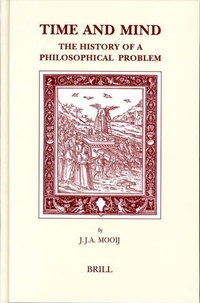
Time and Mind
The History of a Philosophical Problem
Published on 28. February 2005
Book
Hardback
304 pages
978-90-04-14152-0 (ISBN)
Description
This book deals with the history of a central problem in the philosophy of time: Can time exist without mind or consciousness, and if not, in what respects? Aristotle was the first to formulate this problem, and it has been intensively discussed ever since. This book analyses the answers and arguments and sets them in their historical context. Although there have been very different approaches, the book shows important continuities as well.
Besides being a specialist monograph, it can be used in courses on the philosophy of time in general, or on the realism/idealism debate.
Besides being a specialist monograph, it can be used in courses on the philosophy of time in general, or on the realism/idealism debate.
More details
Series
Language
English
Place of publication
Leiden
Netherlands
Target group
College/higher education
Professional and scholarly
Product notice
sewn/stitched
Cloth over boards
Dimensions
Height: 247 mm
Width: 169 mm
Thickness: 25 mm
Weight
676 gr
ISBN-13
978-90-04-14152-0 (9789004141520)
Copyright in bibliographic data and cover images is held by Nielsen Book Services Limited or by the publishers or by their respective licensors: all rights reserved.
Schweitzer Classification
Other editions
Additional editions

Software
02/2005
Brill
Unfortunately, price unknown
Available (delivery time upon request)
Person
J.J.A. Mooij, M.Sc. in Mathematics (Utrecht), Ph.D. in Philosophy (University of Amsterdam, 1966). Professor of Analytical Philosophy (1970-1976) and of Comparative Literature (1976-1991) in the University of Groningen. Main publications: La philosophie des mathematiques de Henri Poincare (1966), A Study of Metaphor (1976), Fictional Realities. The Uses of Literary Imagination (1993).
Content
Preface
Acknowledgements
1. Introduction: How old is time?
2. How it started: From Pherecydes to Plato
3. Aristotle: Measurable duration and instant
4. Atomists, holists, moralists: the Epicureans and the Stoics
5. The two times of Neoplatonism
6. Saint Augustine: two times and two creations
7. Retrospect and progress
8. Utrum tempus possit esse sine anima: Debates around 1300
9. Intermezzo: The arrival of the clock
10. From Renaissance to Baroque
11. Duration and absolute time: Descartes, Spinoza, Locke, Newton
12. The century of Leibniz, Berkeley and Kant
13. Idealists versus realists
14. In search of authentic time: Bergson and the phenomenologists
15. The view from physics: the empiricists
16. Toward the present
Epilogue
Bibliography
Index
Acknowledgements
1. Introduction: How old is time?
2. How it started: From Pherecydes to Plato
3. Aristotle: Measurable duration and instant
4. Atomists, holists, moralists: the Epicureans and the Stoics
5. The two times of Neoplatonism
6. Saint Augustine: two times and two creations
7. Retrospect and progress
8. Utrum tempus possit esse sine anima: Debates around 1300
9. Intermezzo: The arrival of the clock
10. From Renaissance to Baroque
11. Duration and absolute time: Descartes, Spinoza, Locke, Newton
12. The century of Leibniz, Berkeley and Kant
13. Idealists versus realists
14. In search of authentic time: Bergson and the phenomenologists
15. The view from physics: the empiricists
16. Toward the present
Epilogue
Bibliography
Index