

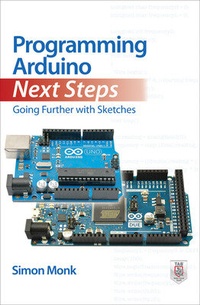
Programming Arduino Next Steps: Going Further with Sketches
Published on 16. November 2013
Book
Paperback/Softback
288 pages
978-0-07-183025-6 (ISBN)
Description
Publisher's Note: Products purchased from Third Party sellers are not guaranteed by the publisher for quality, authenticity, or access to any online entitlements included with the product.Take your Arduino skills to the next level! In this practical guide, electronics guru Simon Monk takes you under the hood of Arduino and reveals professional programming secrets. Featuring coverage of the Arduino Uno, Leonardo, and Due boards, Programming Arduino Next Steps: Going Further with Sketches shows you how to use interrupts, manage memory, program for the Internet, maximize serial communications, perform digital signal processing, and much more. All of the 75+ example sketches featured in the book are available for download.
Learn advanced Arduino programming techniques, including how to:
Use hardware and timer interrupts
Boost performance and speed by writing time-efficient sketches
Minimize power consumption and memory usage
Interface with different types of serial busses, including I2C, 1-Wire, SPI, and TTL Serial
Use Arduino with USB, including the keyboard and mouse emulation features of the Leonardo and Due boards
Program Arduino for the Internet
Perform digital signal processing
Accomplish more than one task at a time-without multi-threading
Create and release your own code library
Learn advanced Arduino programming techniques, including how to:
Use hardware and timer interrupts
Boost performance and speed by writing time-efficient sketches
Minimize power consumption and memory usage
Interface with different types of serial busses, including I2C, 1-Wire, SPI, and TTL Serial
Use Arduino with USB, including the keyboard and mouse emulation features of the Leonardo and Due boards
Program Arduino for the Internet
Perform digital signal processing
Accomplish more than one task at a time-without multi-threading
Create and release your own code library
More details
Other editions
New editions
Simon Monk
Programming Arduino Next Steps: Going Further with Sketches, Second Edition
Going Further with Sketches, Second Edition
Book
01/2019
2nd Edition
McGraw-Hill Education
€23.10
Available immediately
Additional editions
E-Book
11/2013
1st Edition
McGraw-Hill Education Tab
€55.59
Available for download
Person
Dr. Simon Monk has a degree in Cybernetics and Computer Science and a PhD in Software Engineering. He spent several years as an academic before he returned to industry, co-founding the mobile software company Momote Ltd. Dr. Monk has been an active electronics hobbyist since his early teens and is a full-time writer on hobby electronics and open source hardware. He is the author of numerous electronics books, including Programming the Raspberry Pi: Getting Started with Python; Programming Arduino: Getting Started with Sketches; 30 Arduino Projects for the Evil Genius; Arduino + Android Projects for the Evil Genius, and Practical Electronics for Inventors, Third Edition (co-author).
Content
Introduction
1. Programming Arduino
2. Under the Hood
3. Interrupts and Timers
4. Making Arduino Faster
5. Low Power Arduino
6. Memory
7. Using I2C
8. Interfacing with 1-Wire Devices
9. Interfacing with SPI Devices
10. Serial UART Programming
11. USB Programming
12. Network Programming
13. Digital Signal Processing
14. Managing with One Process
15. Software Design
16. Writing Libraries
1. Programming Arduino
2. Under the Hood
3. Interrupts and Timers
4. Making Arduino Faster
5. Low Power Arduino
6. Memory
7. Using I2C
8. Interfacing with 1-Wire Devices
9. Interfacing with SPI Devices
10. Serial UART Programming
11. USB Programming
12. Network Programming
13. Digital Signal Processing
14. Managing with One Process
15. Software Design
16. Writing Libraries