

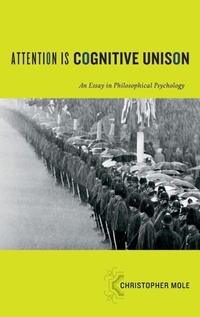
Attention Is Cognitive Unison
An Essay in Philosophical Psychology
1st Edition
Published on 27. January 2011
Book
Hardback
224 pages
978-0-19-538452-9 (ISBN)
Description
Some psychological phenomena can be explained by identifying and describing the processes that constitute them. Others cannot be explained in that way. In ATTENTION IS COGNITIVE UNISON Christopher Mole gives a precise account of the metaphysical difference that divides these two categories and shows that, when current psychologists attempt to explain attention, they assign it to the wrong one.
Having rejected the metaphysical approach taken by our existing theories of attention Mole then develops a new theory. According to this theory the question of whether someone is paying attention is not settled by the facts about which processes are taking place. It is settled by the facts about whether the processes that serve that person's task-- whichever processes those happen to be--are processes that operate in unison. This theory gives us a new account of the problems that have dogged debates about the psychology of attention since the middle of the twentieth century. It also gives us a new way to understand the explanatory importance of cognitive psychology's empirical findings. The book as whole shows that metaphysical questions have a foundational role to play in the explanatory project of cognitive psychology.
Having rejected the metaphysical approach taken by our existing theories of attention Mole then develops a new theory. According to this theory the question of whether someone is paying attention is not settled by the facts about which processes are taking place. It is settled by the facts about whether the processes that serve that person's task-- whichever processes those happen to be--are processes that operate in unison. This theory gives us a new account of the problems that have dogged debates about the psychology of attention since the middle of the twentieth century. It also gives us a new way to understand the explanatory importance of cognitive psychology's empirical findings. The book as whole shows that metaphysical questions have a foundational role to play in the explanatory project of cognitive psychology.
Reviews / Votes
One of the most elegant of the recent clutch of philosophical treatments of attention * Aaron Henry and Tim Bayne, Australasian Journal of Philosophy *More details
Series
Language
English
Place of publication
New York
United States
Target group
College/higher education
Professional and scholarly
The primary audience for the book is academic philosophers (in metaphysics, philosophy of mind, philosophy of science and in the history of philosophy), and academic psychologists (in cognitive psychology, neuropsychology, and elsewhere). Other audiences include pyschologists with an interest in the foundations of the mind, students of philosophy or psychology, general readers with an interest in the historical and intellectual context of our current understanding of cognition.
Dimensions
Height: 240 mm
Width: 161 mm
Thickness: 15 mm
Weight
470 gr
ISBN-13
978-0-19-538452-9 (9780195384529)
Copyright in bibliographic data and cover images is held by Nielsen Book Services Limited or by the publishers or by their respective licensors: all rights reserved.
Schweitzer Classification
Other editions
Additional editions
E-Book
01/2011
1st Edition
OUP eBook
€23.99
Available for download
E-Book
01/2011
1st Edition
OUP eBook
€23.99
Available for download
Person
Assistant Professor in Philosophy at University of British Columbia, Vancouver
Content
1.1 THE PRELIMINARY IDENTIFICATION OF OUR TOPIC; 1.2 THREE APPROACHES; 1.3 BRADLEY'S PROTEST; 1.4 JAMES'S DISJUNCTIVE THEORY; 1.5 THE SOURCE OF BRADLEY'S DISSATISFACTION; 1.6 BEHAVIOURISM AND AFTER; 1.7 HEIRS OF BRADLEY IN THE TWENTIETH CENTURY; 2.1 EXPLANATORY TACTICS; 2.2 THE BASIC DISTINCTION; 2.3 METAPHYSICAL CATEGORIES AND TAXONOMIES; 2.4 ADVERBIALISM, MULTIPLE REALIZABILITY, AND NATURAL KINDS; 2.5 ADVERBIALISM AND LEVELS OF EXPLANATION; 2.6 TAXONOMIES AND SUPERVENIENCE RELATIONS; 3.1 SUPERVENIENCE-FAILURE; 3.2 THE MODAL COMMITMENTS OF THE PROCESS-FIRST VIEW; 3.3 THE INTERFERENCE ARGUMENT - A PUTATIVE PROBLEM FOR ADVERBIALIST ACCOUNTS; 3.4 CONCLUSION; 4.1 INTRODUCTION; 4.2 THE PROBLEM WITH ATTITUDE BASED ADVERBIALISM; 4.3 GILBERT RYLE AND ALAN WHITE; 4.4 WHITE'S ARGUMENT AGAINST DISPOSITION-BASED ADVERBIALISM; 4.5 THE COGNITIVE UNISON THEORY; 4.6 TASKS; 4.7 COGNITIVE PROCESSES; 4.8 POTENTIAL SERVICE OF A TASK; 4.9 SUPERORDINATE TASKS; 4.10 SOME FEATURES OF THE THEORY; 4.11 DIVIDED ATTENTION; 4.12 DEGREES OF ATTENTION AND MERELY PARTIAL ATTENTION; 4.13 SUMMARY; 5.1 MENTAL CAUSATION; 5.2 HOW TO RESPOND TO MENTAL CAUSATION OBJECTIONS; 5.3 THE CAUSAL ROLE OF ATTENTION; 5.4 ATTENTION AS AN ENABLING CONDITION; 5.5 COUNTERFACTUALS; 5.6 THE CAUSAL RELEVANCE OF ATTENTION PER SE; 5.7 COUNTERFACTUALS AND CAUSALLY RELEVANT PROPERTIES; 5.8 OBJECTIONS TO COUNTERFACTUAL ANALYSIS OF CAUSATION AND OF CAUSAL RELEVANCE; 5.9 THE EXTRINSICNESS OF UNISON; 5.10 THE PRIVATIVE CHARACTER OF UNISON AND THE PROBLEM OF ABSENCE CAUSATION; 5.11 CAUSAL EXCLUSION; 5.12 SUMMARY; 6.1 PSYCHOLOGY AND METAPHYSICS; 6.2 THE METAPHYSICAL COMMITMENTS OF THE PROCESS-IDENTIFYING PROJECT; 6.3 THE DIVERSE EXPLANATORY CONSTRUALS OF CURRENT PSYCHOLOGICAL RESULTS; 6.4 REASONS FOR DEFLATION; 6.5 INDUCTIVELY UNRELIABLE PROPERTIES; 6.6 QUESTIONS WITHOUT ANSWERS; 6.7 THE POSITIVE PAYOFF; 7.1 PUTTING ATTENTION TO PHILOSOPHICAL WORK; 7.2 ATTENTION AND REFERENCE; 7.3 ATTENTION AND CONSCIOUSNESS; 7.4 PROSPECTS FOR OPTIMISM; NOTES; REFERENCES