

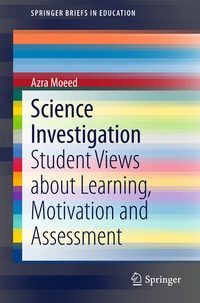
Science Investigation
Student Views about Learning, Motivation and Assessment
Published on 4. February 2015
Book
Paperback/Softback
VIII, 84 pages
978-981-287-383-5 (ISBN)
Description
This book reports the findings of an interpretive case study of the phenomenon of science investigation (science inquiry) from students' perspective. Data were collected from a class of twenty-four Year 11 students in a middle size, co-educational New Zealand school, through Science Laboratory Environment Inventory, student questionnaires, focus group interviews and classroom observations. The participants provided some insightful comments about their learning of science investigation. Illustrative examples highlight; what students found motivational and what demotivated them, what and how they learnt through carrying out science investigation, and how internal assessment influenced their motivation to learn and learning. The connectedness between the complexities of learning science investigation and how motivation, and assessment influenced these 15 year old students' learning is discussed.
More details
Series
Edition
2015 ed.
Language
English
Place of publication
Singapore
Singapore
Target group
Professional and scholarly
Research
Illustrations
2 s/w Abbildungen
VIII, 84 p. 2 illus.
Dimensions
Height: 235 mm
Width: 155 mm
Thickness: 6 mm
Weight
154 gr
ISBN-13
978-981-287-383-5 (9789812873835)
DOI
10.1007/978-981-287-384-2
Schweitzer Classification
Other editions
Additional editions
E-Book
01/2015
1st Edition
Springer
€53.49
Available for download
Person
Dr Azra Moeed is a senior lecturer and Curriculum Leader for Science Education at Victoria University of Wellington, New Zealand. Her research interests include science education, science teacher and environmental education.
Content
Chapter 1 Introduction.- Chapter 2 Science Laboratory Learning Environment, and Learning.- Chapter 3 Motivation to learn science investigation.- Chapter 4 Assessment of Science Investigation.- Chapter 5 Discussion and Conclusion.- Chapter 6 Final thoughts.