

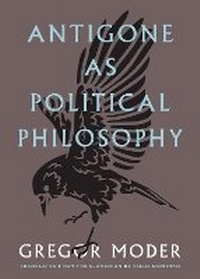
Antigone As Political Philosophy
Will be published approx. on 30. June 2026
Book
Hardback
160 pages
979-8-89948-028-7 (ISBN)
Description
Offering a new perspective on Sophocles's Antigone as a model for reimagining humanity's future-and its end
Why read Antigone today? The premise of this accessible, essayistic work is that humanity finds itself at a crossroads, where it must reinvent itself or perish-a condition similar to Antigone's own. Rereading Antigone via Hegel's engagement with the text can help us understand what it means for a human age to come to an end: that is, to think of our age as an episode whose collapse is also an engine of historical change.
Gregor Moder argues that the task of humanity today may not be to defend the minimal remnants of our civilization but to say farewell to it-to give it a proper burial. As Moder explicates, the central problem of this foundational tragedy lies in the positions of brother and sister, man and woman, representing human and divine law and the institutions of the state and the family. Through a fresh reading of both Sophocles's play and Hegel's productive reworking of the Greek myth, Moder's analysis shows that sometimes the only way through deep social contradictions is in unraveling the framework that has constructed them.
Why read Antigone today? The premise of this accessible, essayistic work is that humanity finds itself at a crossroads, where it must reinvent itself or perish-a condition similar to Antigone's own. Rereading Antigone via Hegel's engagement with the text can help us understand what it means for a human age to come to an end: that is, to think of our age as an episode whose collapse is also an engine of historical change.
Gregor Moder argues that the task of humanity today may not be to defend the minimal remnants of our civilization but to say farewell to it-to give it a proper burial. As Moder explicates, the central problem of this foundational tragedy lies in the positions of brother and sister, man and woman, representing human and divine law and the institutions of the state and the family. Through a fresh reading of both Sophocles's play and Hegel's productive reworking of the Greek myth, Moder's analysis shows that sometimes the only way through deep social contradictions is in unraveling the framework that has constructed them.
Reviews / Votes
"Lucidly written and convincingly argued, this elegant translation of Moder's Antigone as Political Philosophy makes an impassioned case for Antigone's relevance today and her continued significance to our understanding of Hegel's philosophical project." -Andreja Novakovic, University of California, Berkeley"How can we break out of the accumulation of catastrophes and the accompanying attitude that Mark Fisher described as "capitalist realism"? Pursuing his conviction that Hegel's reading of Sophocles' Antigone can provide a key, Moder conjures a surprising and fascinating conceptual framework for thinking beyond the accepted status quo. Not as a recipe for changing our world, but rather as a way of recognizing our own era as already bygone. This book offers a powerful political reactivation of the myth of Antigone." -Alenka Zupancic, The European Graduate School
More details
Language
English
Place of publication
Evanston
United States
Target group
Professional and scholarly
Dimensions
Height: 178 mm
Width: 127 mm
Weight
454 gr
ISBN-13
979-8-89948-028-7 (9798899480287)
Copyright in bibliographic data and cover images is held by Nielsen Book Services Limited or by the publishers or by their respective licensors: all rights reserved.
Schweitzer Classification
Persons
Gregor Moder is a senior research associate in the Department of Philosophy of the Faculty of Arts, University of Ljubljana, Slovenia. His books include Hegel and Spinoza: Substance and Negativity (Northwestern University Press).
Content
List of Abbreviations
Introduction: Why Engage with Antigone Today
Chapter 1: Metaphysics and the Political Act
Chapter 2: Polis and Oikos, War and Death
Chapter 3: Family, Sexual Difference, and Power
Chapter 4: How to Undo Things with Words
Conclusion: For a New Antigone
Acknowledgements
Notes
Works Cited
Index
Introduction: Why Engage with Antigone Today
Chapter 1: Metaphysics and the Political Act
Chapter 2: Polis and Oikos, War and Death
Chapter 3: Family, Sexual Difference, and Power
Chapter 4: How to Undo Things with Words
Conclusion: For a New Antigone
Acknowledgements
Notes
Works Cited
Index